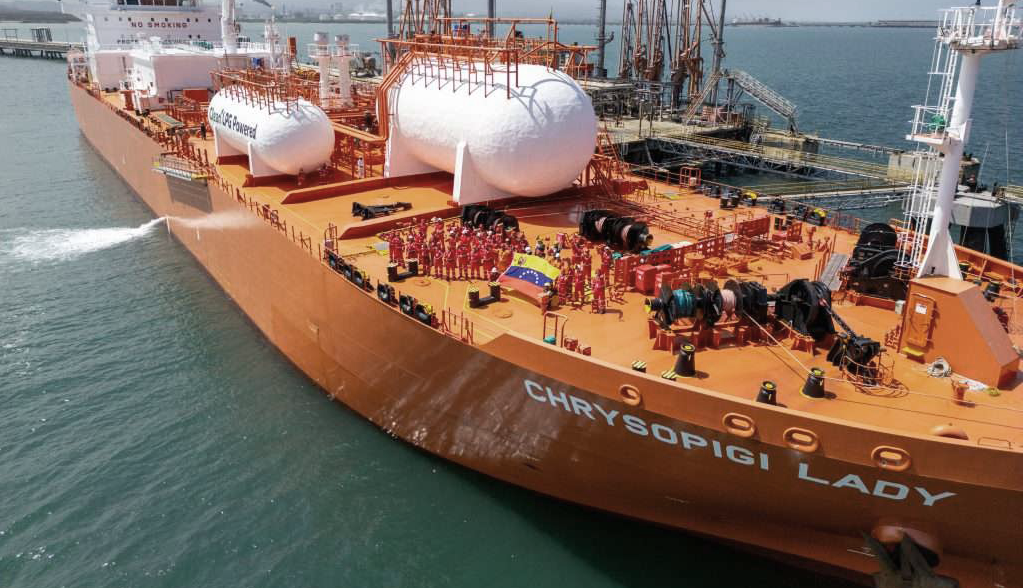
This Sunday, Venezuela’s Acting President Delcy Rodríguez announced that the country has exported its first shipment of liquefied petroleum gas.
“Together with the working class, we marked this historic milestone by exporting the country’s first gas molecule; an achievement for the well-being of the Venezuelan people,” Rodríguez wrote in a public statement.
The shipment departed on the Singapore-flagged vessel Chrysopigi Lady, marking a national milestone for gas exports in Venezuela’s history and opening a new chapter for export diversification and economic stability, reported Venezuelans’ Ministry of Hydrocarbons.
Last December, during the National Council of Productive Economy, Venezuela’s Constitutional President Nicolás Maduro stated that Venezuela would shortly be exporting liquified petroleum gas (LPG). LPG is used as a fuel gas in heating appliances, kitchen equipment, and vehicles. In addition, it can be used as an aerosol propellant or a refrigerant, replacing chlorofluorocarbons and thus producing less damage to the ozone layer. Currently, the world’s greatest exporter of LPG is the United States.
Last Thursday, January 29, the Venezuela’s acting president announced that in the coming hours, the Venezuelan people would be able to see a video that would fill the nation with pride, showing the first export of LPG in the country’s history. “The ship is already in Venezuela,” stated Acting President Rodríguez. “We will see it depart in the next few hours, and I will share that video.”
Acting President Rodríguez enacted the Partial Reform of the Hydrocarbons Law after receiving the draft law, which was unanimously approved during Thursday’s ordinary session of the Venezuelan parliament. “This law reaffirms the sovereignty of our energy resources,” commented the acting president as she signed the legislation.
Acting President Rodríguez noted that profits generated from the management of Venezuelan crude oil will enter sovereign funds to improve public services, which have been affected by the illegal US blockade, and to improve living standards and security for the population.
Delcy Rodríguez emphasized that this legal instrument provides greater security and legal value to both international investments arriving in the country and national investments linked to the energy sector.
In that context, she recalled that Venezuela welcomes foreign and domestic investment aimed at productive development in the areas of oil, gas, and petrochemicals as part of the nation’s ongoing efforts to strengthen and diversify the country’s energy industry.
“Here is a Venezuela that is stepping into the spotlight, that continues to fight, and that continues to compete … to make our industry an energy powerhouse,” stated the acting president.
Objectives of the Partial Reform of Venezuela’s Hydrocarbons Law
(Últimas Noticias) with Orinoco Tribune content
Translation: Orinoco Tribune
SL
Post navigation