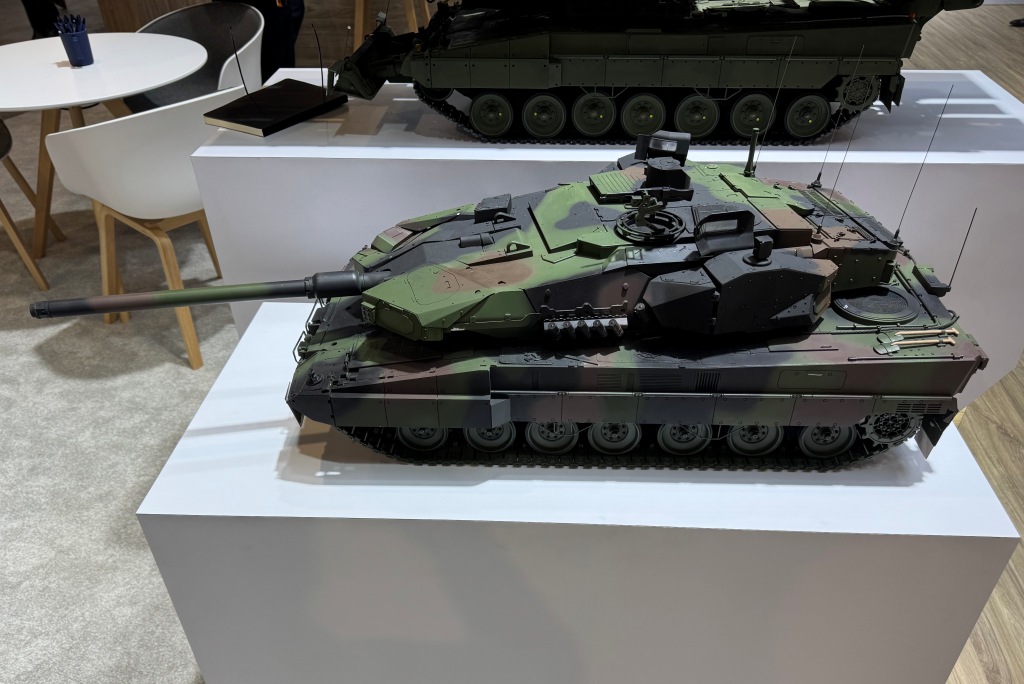
Germany’s latest Leopard 2A8 main battle tank marks a decisive step towards a fully digital, highly protected and networked armoured platform optimised for high‑intensity, missile‑saturated conflict. It was showcased in mock‑up form on the KNDS stand at Singapore Airshow, underlining its export ambitions and its role as a bridge to Europe’s next‑generation combat vehicles
The Leopard 2A8 retains the familiar four‑man crew layout – commander, gunner, loader, and driver – and the proven Leopard 2 hull, but its internal architecture has been fundamentally re‑engineered around a modern digital backbone. Combat mass climbs to roughly 68 tonnes in German configuration with active protection and additional armour, placing it among the heaviest and best‑protected iterations of the Leopard family. Despite this, the tank continues to rely on the 1,500 hp MTU MB 873 Ka‑501 diesel engine coupled to a RENK HSWL 354 transmission, sustaining road speeds of around 60 km/h and robust cross‑country performance. The running gear, including torsion bars and road wheels, has been reinforced to absorb the higher mass and dynamic loads of added armour and mission equipment. An upgraded auxiliary power unit (APU) provides sufficient electrical power for all on‑board systems during silent watch, reducing fuel consumption and acoustic/thermal signature when the main engine is shut down.
 click on image to enlarge
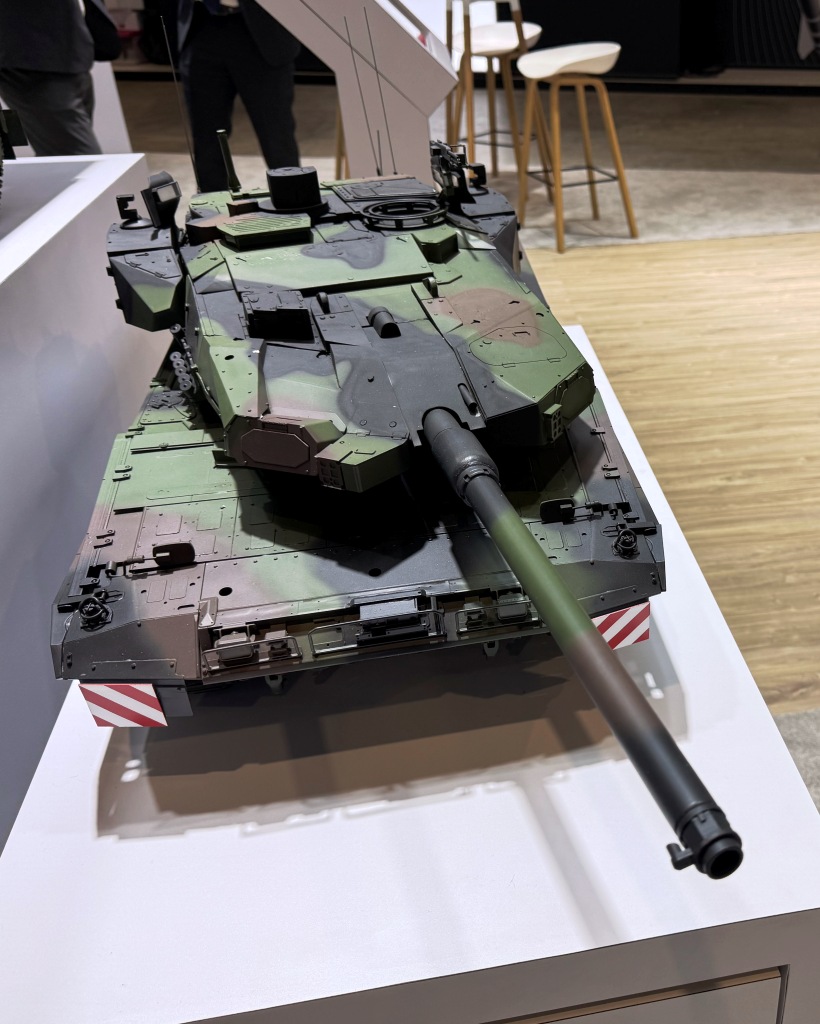
In terms of survivability, the Leopard 2A8 moves beyond incremental armour upgrades towards a layered, active–passive protection concept. Modular passive armour on the hull and turret has been re‑optimised, with particular emphasis on roof protection against top‑attack munitions, loitering weapons, and precision artillery. The belly and mine‑protection elements are enhanced to cope with modern IED and mine threats, continuing the evolution seen on earlier mine‑resistant kits but now integrated more comprehensively into the structure. The most visible leap, however, is the full industrial integration of a hard‑kill active protection system, providing 360‑degree defence against anti‑tank guided missiles and rocket‑propelled grenades. Working in concert with laser warning receivers and threat‑detection sensors, the APS can remain in a low‑emission standby mode until a genuine threat is detected, helping to keep the tank’s electromagnetic footprint under control. A ring of day/thermal cameras and situational awareness sensors further improves close‑in observation and short‑range threat detection, directly supporting the crew’s survivability in complex terrain and urban environments.
The Leopard 2A8’s turret is effectively a fully digitalised combat module built around the latest 120 mm Rheinmetall L55A1 smoothbore gun. This high‑pressure weapon is qualified to fire the newest kinetic energy penetrators and programmable airburst munitions, giving the crew credible options against heavily armoured targets, infantry in defilade and low‑flying drones. Electric turret and gun drives of the latest generation deliver smoother, more precise stabilisation and improved reliability compared to older electro‑hydraulic systems. Within the turret, a modern vehicle network links sights, fire‑control computers, drives and mission systems, enabling faster data exchange, more flexible software updates and easier integration of future subsystems. The digital fire‑control system supports advanced engagement modes, including highly responsive hunter‑killer and potential killer‑killer routines, allowing the commander and gunner to detect, designate and engage multiple targets in rapid succession. Depending on customer requirements, the platform can also accept a remote‑controlled weapon station for secondary armament on the turret roof, adding an extra layer of self‑protection without exposing crew members.
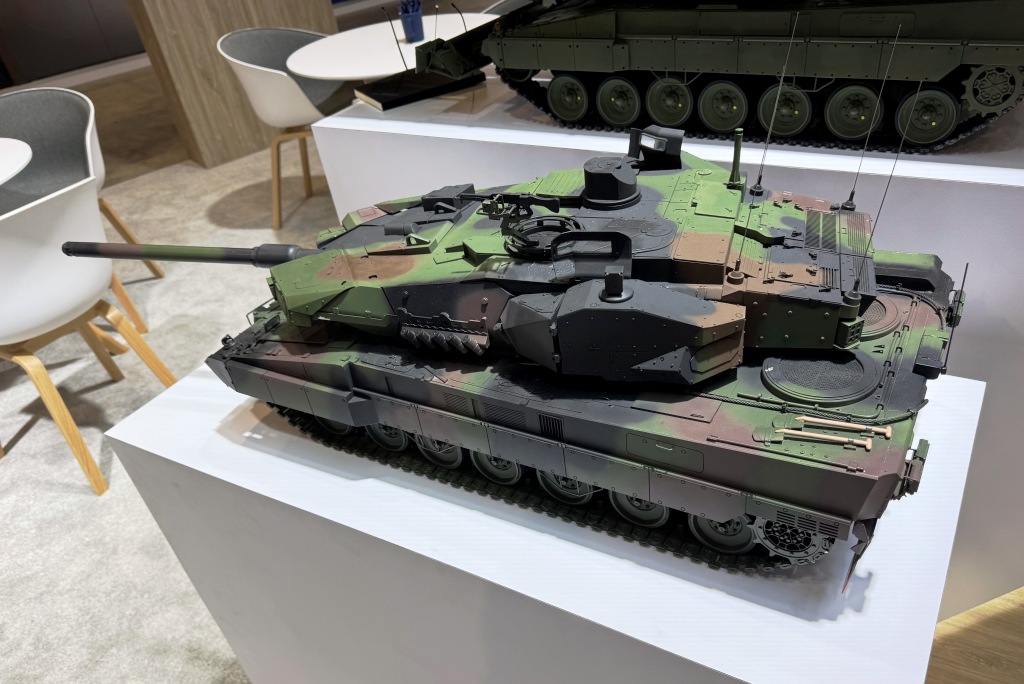
The sensor and optronics suite is one of the Leopard 2A8’s defining features. The commander benefits from a new panoramic sight with high‑definition day channel, integrated laser rangefinder and a state‑of‑the‑art digital thermal imaging channel. The gunner’s primary sight is similarly upgraded with modern thermal imagers, greatly improving detection and identification ranges in adverse weather, smoke and cluttered backgrounds. Digital image processing and powerful on‑board computing enable advanced video enhancement and lay the groundwork for assisted target detection and classification functions, including the integration of artificial intelligence algorithms in the future. The platform’s electronics are designed to comply with contemporary NATO vehicle architecture standards, simplifying the integration of battle management systems, tactical radios, data links and external sensors within a wider, collaborative combat network. This level of digitisation turns the Leopard 2A8 into a true sensor node and effect platform within combined arms and joint operations.
 click on image to enlarge
Inside the turret, human‑machine interfaces have been modernised with multifunction digital displays, rationalised control panels and ergonomic hand controllers, helping to reduce crew workload and accelerate training. Redesigned roof hatches, integrated into the strengthened roof armour, improve both protection and the safety of crew members when operating heads‑out. A dedicated high‑capacity cooling and air‑conditioning system maintains crew comfort and protects sensitive electronics, which is critical for sustained operations in hot climates such as those in the Asia‑Pacific region. Electrically, the Leopard 2A8 features significantly increased generation and distribution capacity, allowing it to power energy‑intensive systems such as the APS, advanced optronics, multiple radios and prospective counter‑UAS suites without compromising reliability. This electrical and thermal headroom, combined with its open, standardised electronic architecture, gives the tank considerable growth potential, whether to integrate new effectors, expanded networking capabilities or, in the longer term, more profound lethality upgrades.
With this combination of digital architecture, active protection, high‑end sensors and growth capacity, the Leopard 2A8 stands less as a simple evolution of the Leopard 2A7 and more as a transitional platform towards Europe’s future main battle tank concepts. Its presentation as a full‑scale mock‑up on the KNDS stand at Singapore Airshow positions it squarely for the export market and underscores its relevance to armed forces seeking a survivable, networked and future‑proof heavy armour solution.
Photos by J. Roukoz