Emboldened by the aggressive US military operation in Venezuela, President Trump announced in January that there is “no going back” on his plans to “own” Greenland either by negotiation or, as was suggested until recently, by force. Between tariff threats and vague overtures toward violence against NATO countries, this represents the biggest crisis between the US and Europe since the end of the Second World War and the establishment of NATO. The US’s drive for imperialist expansion is on full display as Trump, after declaring that the US now runs Venezuela, posted a fake map to Truth Social depicting Venezuela and Canada as US territories and another AI-generated picture of himself planting an American flag on Greenland. He later walked this back somewhat and claimed “the military is not on the table,” but this promise is only on the basis that if people “use their best judgment […] it will not be necessary”—not exactly the steadfast guarantee one would want.
With the drive for imperialist expansion comes the drive for war. As traditional alliances and economic pacts run dry and fail to deliver on the need for constant growth, world leaders turn to gunboat diplomacy. In the anarchic capitalist system, this can happen on several fronts at once, with bombs dropping in Caracas and Gaza, the US flirting with strikes on Iran, and some NATO countries scrambling in real fear of a US invasion of Greenland, all within the span of two weeks. In characteristic fashion, Trump responded to the limited European troop deployments by threatening to levy further 10% tariffs on eight European countries that have publicly opposed the US taking over Greenland—before rescinding that threat as well.
Why Greenland?
Greenland sits in a strategic location between North America, northern Europe, and Russia. In fact, the US has had military bases in Greenland for decades—beginning in the 1940s with the stated purpose of defending the Danish colony from German aggression. This presence was maintained after WWII as a defensive stronghold against the Soviet Union during the Cold War. While the US relinquished some control of these bases following the fall of Stalinism, they never had any intentions of pulling back fully. In January, Trump insisted that “owning is better than renting,” demanding complete US control of Greenland as its own territory, to use as an outpost to monitor and grandstand against Russia and China. As Trump sees it, “we need Greenland for national security very badly. If we don’t have it, we have a big hole in national security.”
Another key impetus behind the current focus on Greenland is the wealth of untapped minerals and metals buried beneath its melting snow. The US’s interest in these resources comes from its imperialist aims and need to challenge China’s hold on markets like electric vehicles and computer chips. It serves to rake in profits for tech companies, creating an incentive to accelerate global warming. Working people in the US or any part of the world have no vested interest in this militaristic venture. On the contrary, workers everywhere should stand in solidarity with indigenous Greenlanders in their fight against imperialist domination.
White House Deputy Chief of Staff Stephen Miller makes clear how they’ll be caught in the crossfire, saying “the new domain of international competition is going to be polar competition.”
Miller’s nationalist rhetoric claims that Greenland rightfully belongs to the US after its decades of defending the territory “for Denmark,” when of course it’s always been in the US’s own imperial interests and not for any altruistic reasons. This is strikingly similar to the claim that the US is responsible for developing the oil industry in Venezuela, and should therefore control it, ignoring the right of Venezuelans to benefit from their own natural resources.
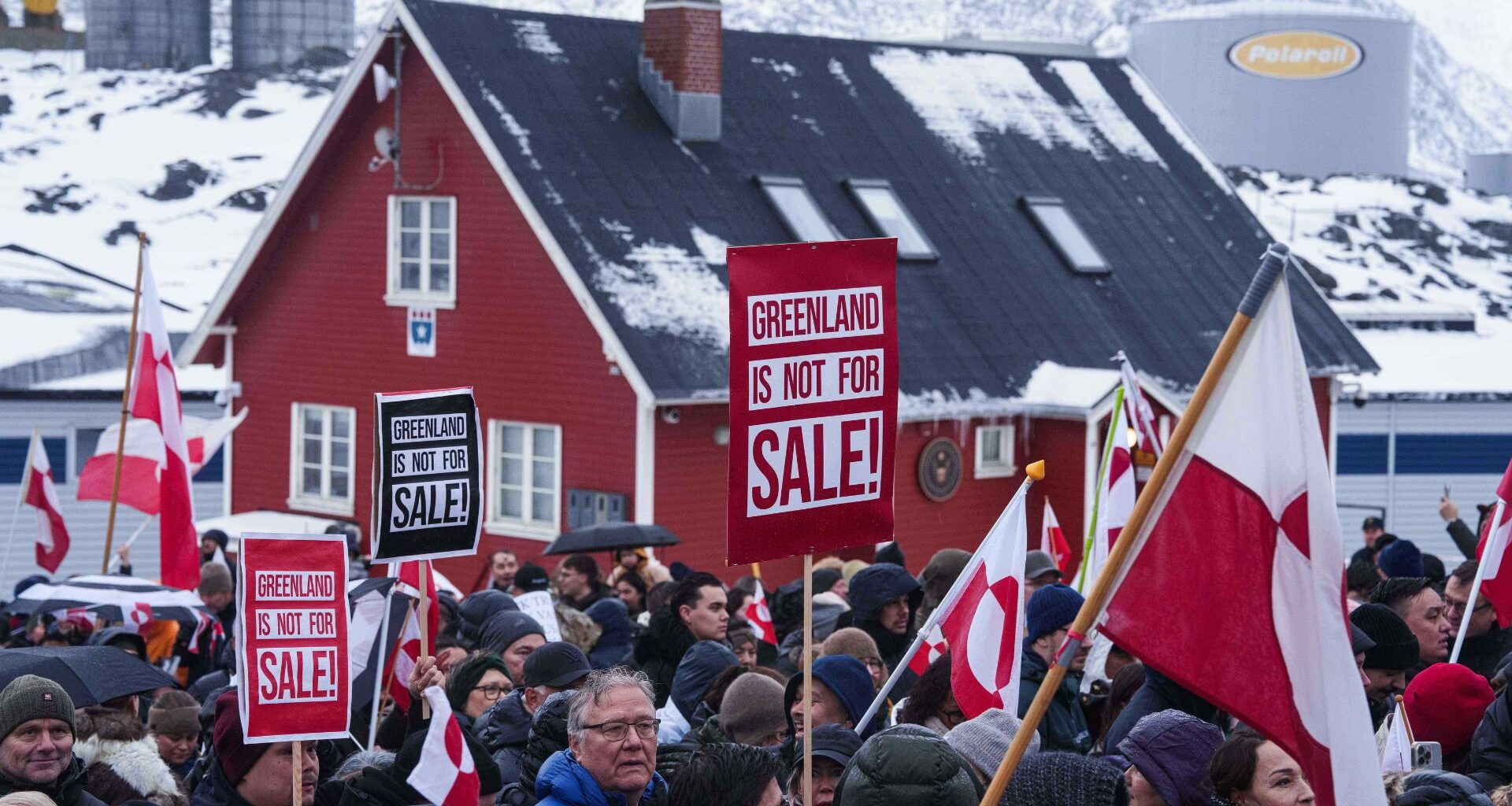
The predominantly Inuit people of Greenland are also conspicuously absent from most coverage of the issue, as if the only options for the nation are to be controlled by one imperialist power or another. In fact, there is a robust mood for Greenlandic independence, with a 2025 poll showing 84% of Greenlanders support independence from Denmark. Even more oppose Greenland joining the US: January saw mass protests on the island, many wearing hats reading “Make America Go Away.” Greenlanders should be able to decide their own future, with the struggle against imperialism linked to struggles for good jobs, and against racism, poverty, and cuts to social services.
Will There Be a Deal?
As we go to print, Trump has walked back his threats of increased tariffs and military aggression in Europe and made public the “framework” of a deal with NATO over Greenland’s future. This means that for the time being, the EU can put their threats of “selling America” on ice and hold back on the economic retaliation they were seriously considering. Such retaliation could be disruptive, but ultimately the European powers are too weak to decisively challenge US imperialism.
Trump is extremely scant on details of the deal, while implying that the US will have a great deal of leeway and control in the region, saying, “We can do military, we can do anything we want.” Trump is seeking to break down as many barriers to US access to Greenland as possible, including negotiating for any deal to hold even if Greenland gains independence from Denmark. Despite Trump’s posturing to the contrary, Danish officials insist there has been no discussion of ceding any land parcels to the US. Discussions also include expanding European and NATO military presence in the region, to prevent encroachment on Greenland from Russia.
This whole debacle is emblematic of Trump’s approach of using extreme threats as a negotiating tactic. His tendency to say something one day and the opposite the next also means the question of unilateral moves to take Greenland are still far from off the table. If Trump backtracks yet again, we could see the EU return to discussions of the “bazooka” option of raising retaliatory tariffs on the US, or selling off a portion of the $8 trillion in US bonds and equities held by Europeans. Even when Trump’s threats don’t materialize, they still make a concrete impact; as fears of a trade war with Europe heightened, all three of Wall Street’s major indices experienced their steepest one-day drop since October, and the US dollar weakened against most major currencies—before rebounding on the news of easing of tensions.
What’s Needed?
Capitalism has thoroughly exposed itself as a system that only devolves into imperialist competition and war. Although it may sometimes seem like it, working people don’t have to pick a side between US imperialism and its drive for conquest and war, and its main competitors, Chinese and Russian imperialism. Nor should we support any so-called solutions to this current crisis coming from the European capitalist classes who have historically benefited from the deadly superexploitation of their colonies, and which continue to exploit the European working class today. Instead, the international working class must stand on its own side, united in a global struggle against the global capitalist system.
No struggle in an individual country, even one as powerful as the US, is enough on its own. Only a truly international working-class struggle can pose a concrete alternative to the capitalist system and win a socialist society, one based on international collaboration, serving the interests of all working people in every country.