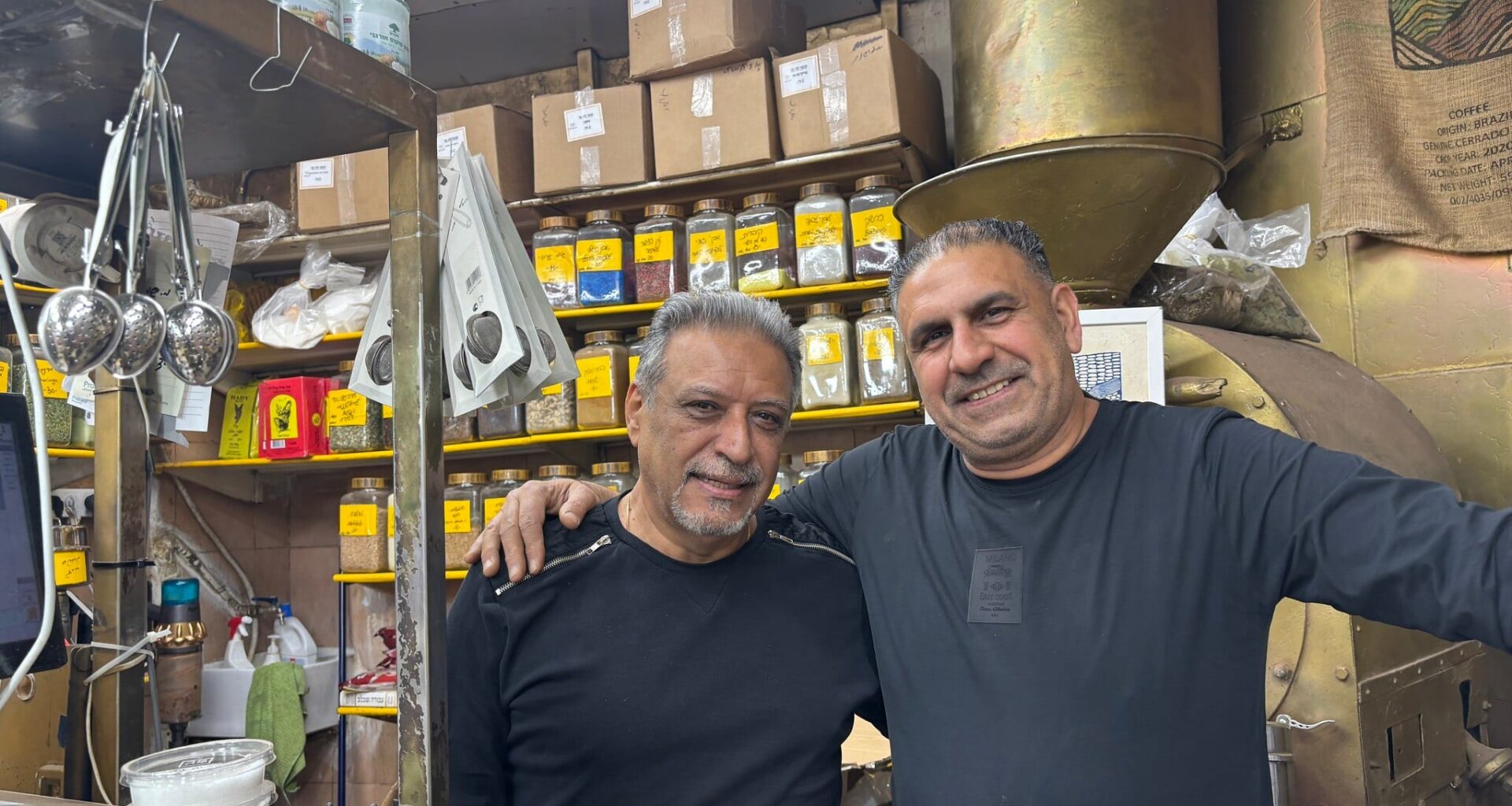
Born and raised in Tehran, Iran, Bijan Barchorderi was sent to Israel at the age of 17 to work on a kibbutz. He is still waiting to return to his former home.
Barchorderi left Iran a few years before the 1979 Islamic Revolution that swept the country and turned it into a closed theocracy. Now 65, he once again has a glimmer of hope of returning, at least to visit, kindled by the recent protest movement that brought tens of thousands of his former countrymen to push for an end to the ayatollah regime. But for most of his time here, he has been resigned to the fact that Tehran might as well be on the moon.
A decade ago, Barchorderi decided he could at least bring Iran to him, opening a restaurant in Tel Aviv that combines his passion for cooking Persian food with his yearning for the smells and tastes of his childhood.
Rushing in and out of the restaurant’s kitchen on a recent weekday, Barchorderi said creating authentic Persian dishes would be impossible without the original ingredients and products coming from Iran.
So in order to cook up adas polo, a classic saffron and cinnamon dish of meat, rice, and lentils; khoresht sabzi, a herb stew with dried Iranian limes, herbs, and spinach; or gondi meatball dumplings in chicken broth, a traditional Shabbat dinner dish, Barchorderi must circumvent the various bans and economic sanctions that have halted trade between the countries since 1979.
He is not alone.
Nestled in a working class part of the city, South Tel Aviv’s Levinsky open-air spice market is a veritable cacophony of the various immigrant communities that have made their way to Israel over the years, filled with bakeries selling Balkan bourekas fresh from the oven, Greek olives, and other delicacies reminiscent of former homelands. Alongside Barchorderi’s Gourmet Sabzi restaurant are a number of other storefronts also manned by Iranian Jewish vendors, many of whom fled the Islamic Republic after Ayatollah Khomeini rose to power in 1979.
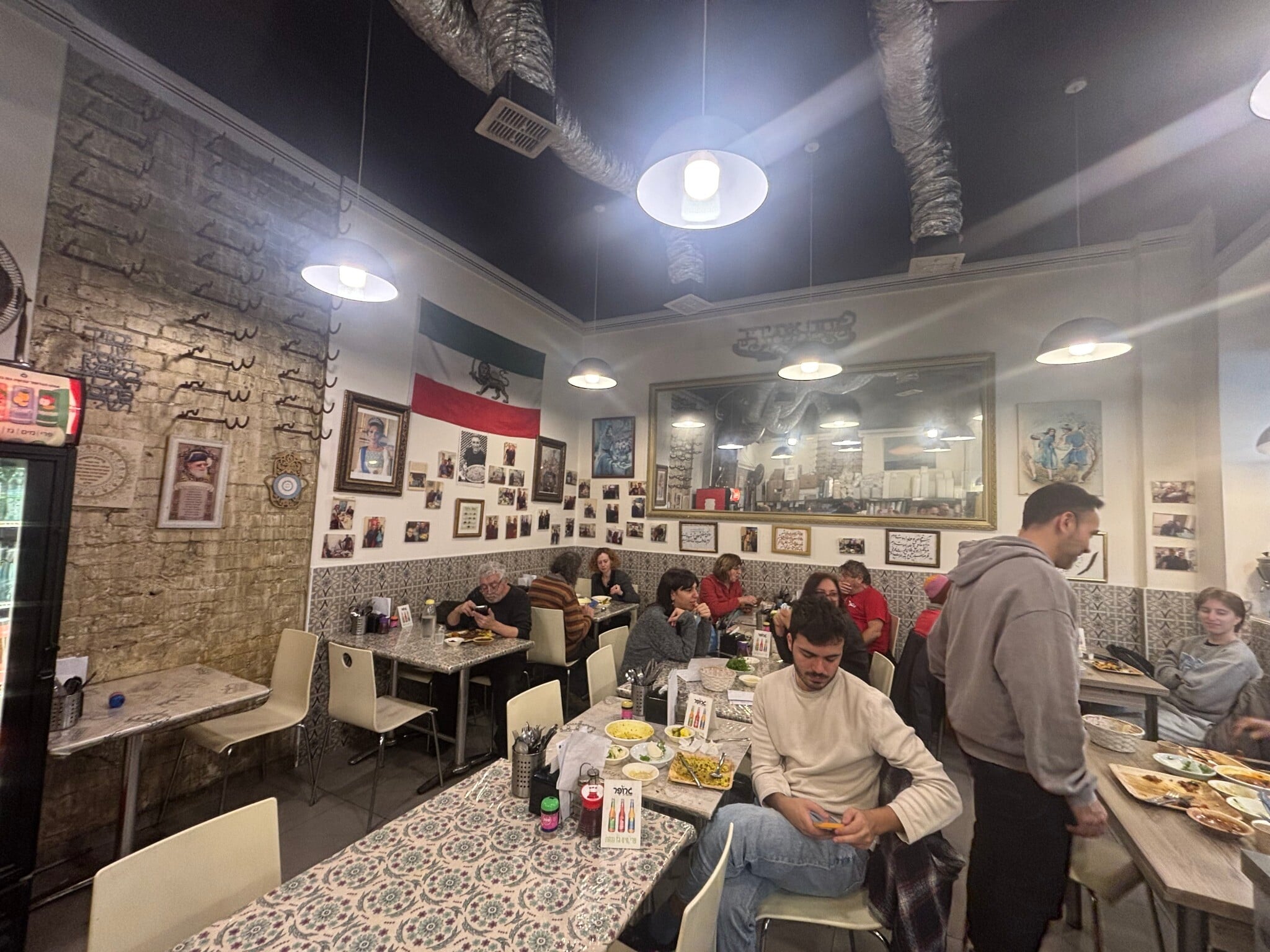
The Persian eatery, Gourmet Sabzi, at South Tel Aviv’s Levinsky Market, January 22, 2026. (Sharon Wrobel/The Times of Israel)
At some stores, shoppers can find goods that have continued to reach Israel despite the ban on trade.
Israel’s Trading with the Enemy Ordinance prohibits conducting any economic or commercial activity, directly or indirectly, between Israel and enemy states, including Iran, Syria, and Lebanon. The restrictions go both ways. The Islamic Republic has passed legislation over the past decades that bars any trade or cooperation with Israel, including the use of any Israeli computer hardware or software.
To get around the ban, importers make use of a loophole that allows them to buy Iranian goods from third-party markets in Europe and elsewhere and sell them in Israel as if they had originated in the third-party country.
“Imports from enemy countries are forbidden, but the fact that there is bypassing presumes that one way of bypassing is to dissimulate the origin, meaning the produce is not labelled as coming from Iran or from Syria or from Lebanon,” Dan Catarivas, president of the Israeli Federation of Bi-National Chambers of Commerce and Industry, told The Times of Israel. “Importers are not breaking the law. They are abiding by the regulation, as the origin of the product is simulated.”
For years, Turkey was the main conduit for the goods. But Ankara has largely downgraded its trade relations in Israel since the war in Gaza, meaning Iranian goods must come from another country, which has sent prices upward, sellers say.
“For many years, Iranian products entered Israel via Turkey, but since this avenue has been closed, the goods arrive in Israel via a third country, often Georgia, or via Dubai, and other places that are not Turkey,” said spice-seller Isaac Simanian. “As a result, prices have gone up by about 30 percent to 40%.”
Since imports and exports happen under the radar, official trade figures are not available, but Catarivas said the practice was fairly limited.
“This is something that exists, but we are not talking about big quantities or huge amounts, and we recommend to our members to respect the regulation and play by the rules,” he said.
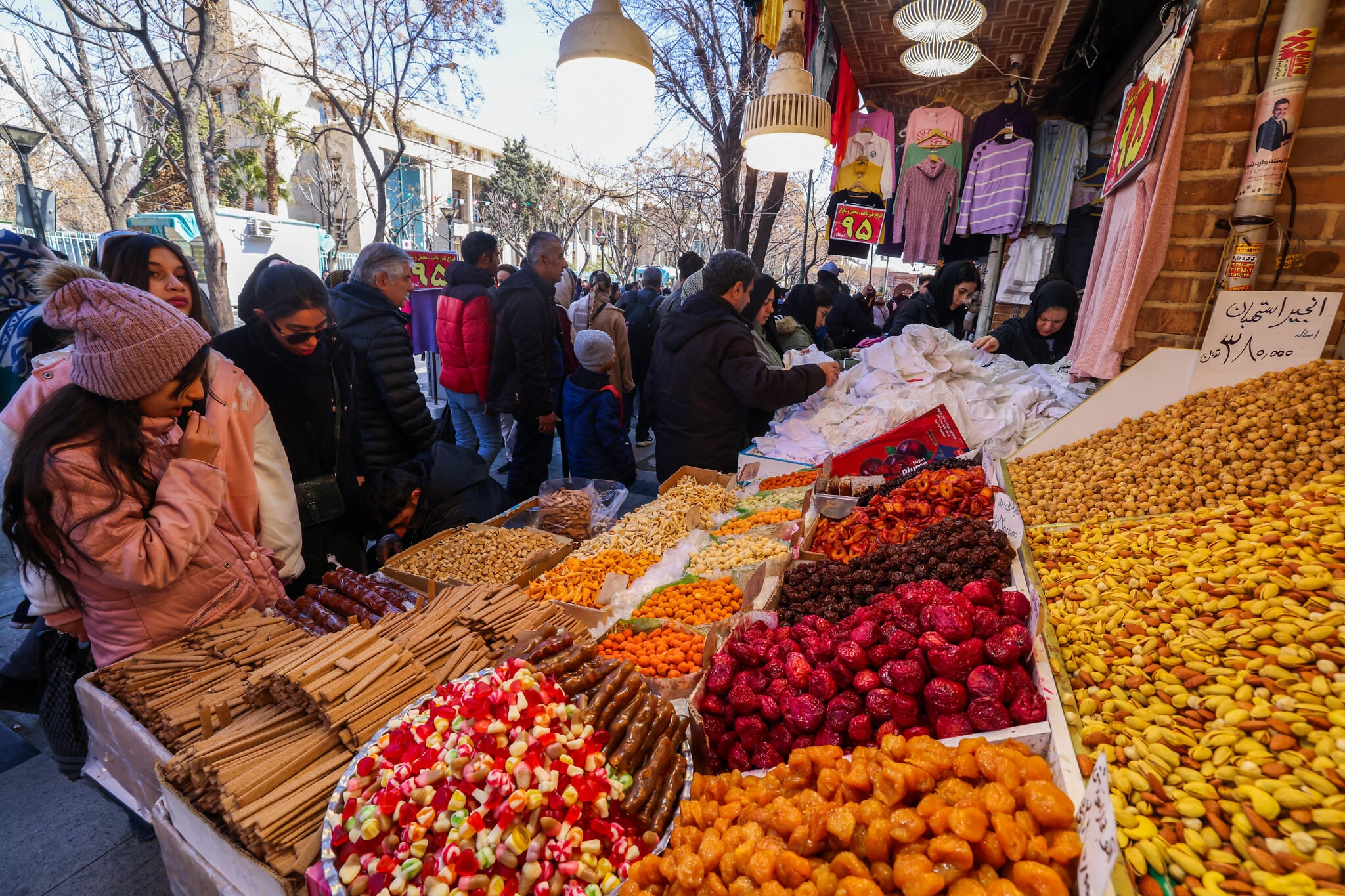
People shop for dried fruits at a stall in the Grand Bazaar in Tehran, Iran, on March 3, 2025. (Atta KENARE / AFP/ File)
At the Gourmet Sabzi, Barchorderi proudly serves traditional Persian dishes to his guests seated around tables beneath portraits of the last shah of Iran, Mohammad Reza Pahlavi, his wife, and signs handwritten in Farsi that are plastered on the walls. It might as well be Tehran.
“People really love our place, the Persian food, and variety of flavors. As they come in, they instantly smell the food from back home, and they sit down to eat,” Barchorderi told The Times of Israel. “Original Persian products made in Iran, like black lemons that we use every day for our cooking, don’t arrive directly from Iran but through alternative routes, and Israeli merchants buy them through a third party or country that has trade relations with Israel.”
“Until not long ago, Iranian products, including plums, figs, dates, and Persian candy, came via nearby Turkey, but because of the trade ban with Israel, the same products pass through another country we have open trade relations with,” he said, listing locations in the Caucasus or the Indian subcontinent as sources for the goods. But, he lamented, bringing them in from further away was “making the goods and the dishes more expensive.”
The restaurant is not only popular with the local Persian community, but also many Israelis who know of Iran only as a hostile enemy.
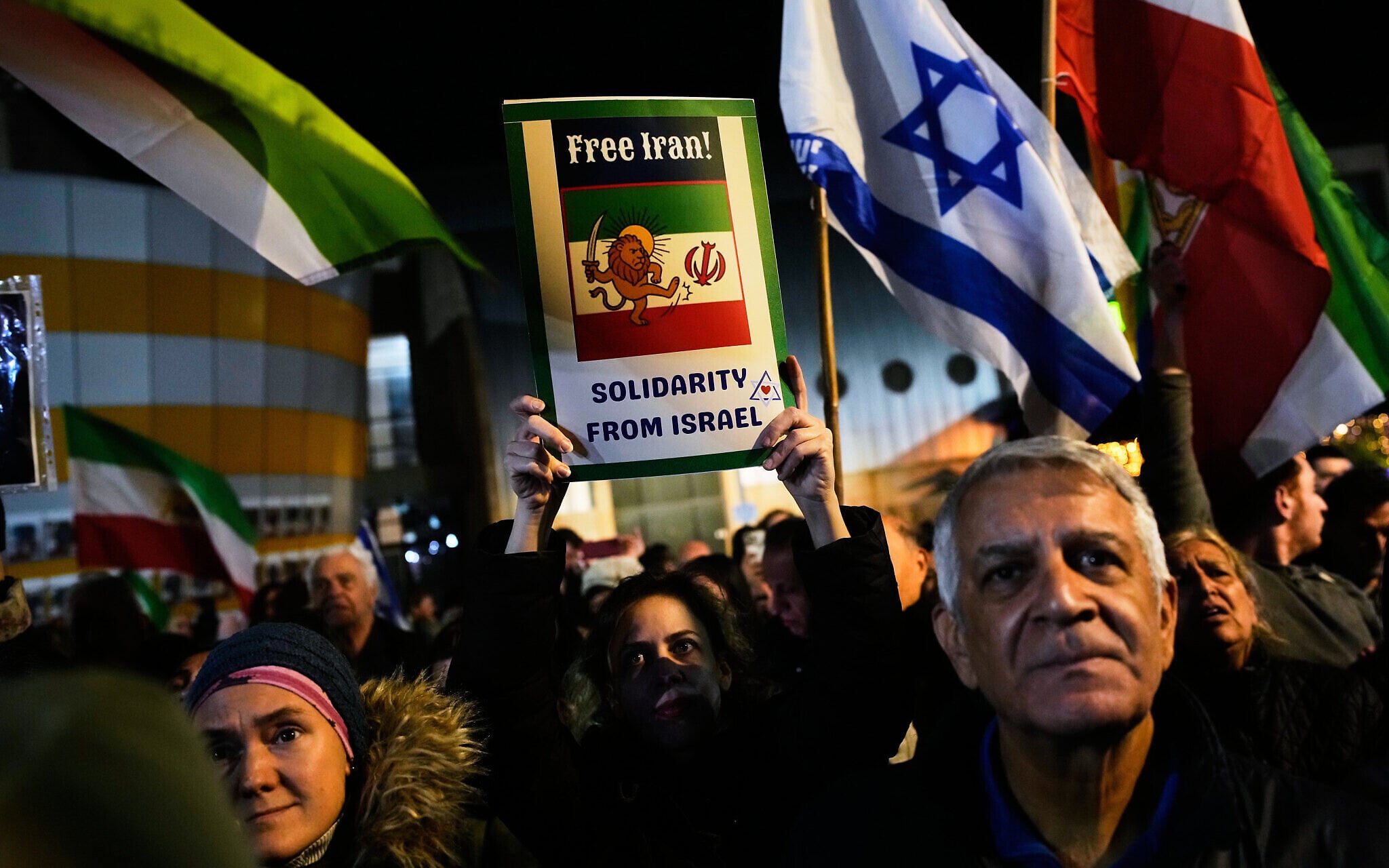
Demonstrators wave Israeli flags and pre-revolution Iran flags during a rally in support of Iran’s anti-government protests in Holon, January 14, 2026. (AP/Ohad Zwigenberg)
The two countries were not always arch foes. When Iran was ruled by the last shah, the two countries were allies and shared close, if sometimes tense, ties. Israel imported about 40% of its oil from Iran in exchange for weapons, technology, and agricultural produce.
The Islamic Revolution in 1979 ended that relationship. Today, Iran regularly threatens to destroy the Jewish nation, viewing the country as a powerful adversary allied with the United States and the Sunni countries in the region that oppose Tehran and its nuclear ambitions. However, many ordinary Iranians and Israelis hope for a return to friendly ties.
In the front of Barchorderi’s restaurant, the flag of pre-1979 Iran and the Israeli flag sit side by side, a display Barchorderi kept even as Iranian missiles rained down on Tel Aviv during the 12-day war launched by Israel in June. The flags are still there as geopolitical tensions threaten to spark another round of war between the two.
“The Iranian flag evokes a sense of nostalgia for everyone who sits down to eat, and to talk about what it was like in the good era,” said Barchorderi, who is married to an Iranian from Kurdistan and has two sons, one of whom served in the Israeli army. “People are sometimes disturbed and ask me why I am putting up the Israeli and Iranian flags next to each other, but I identify with both, and that’s that.”
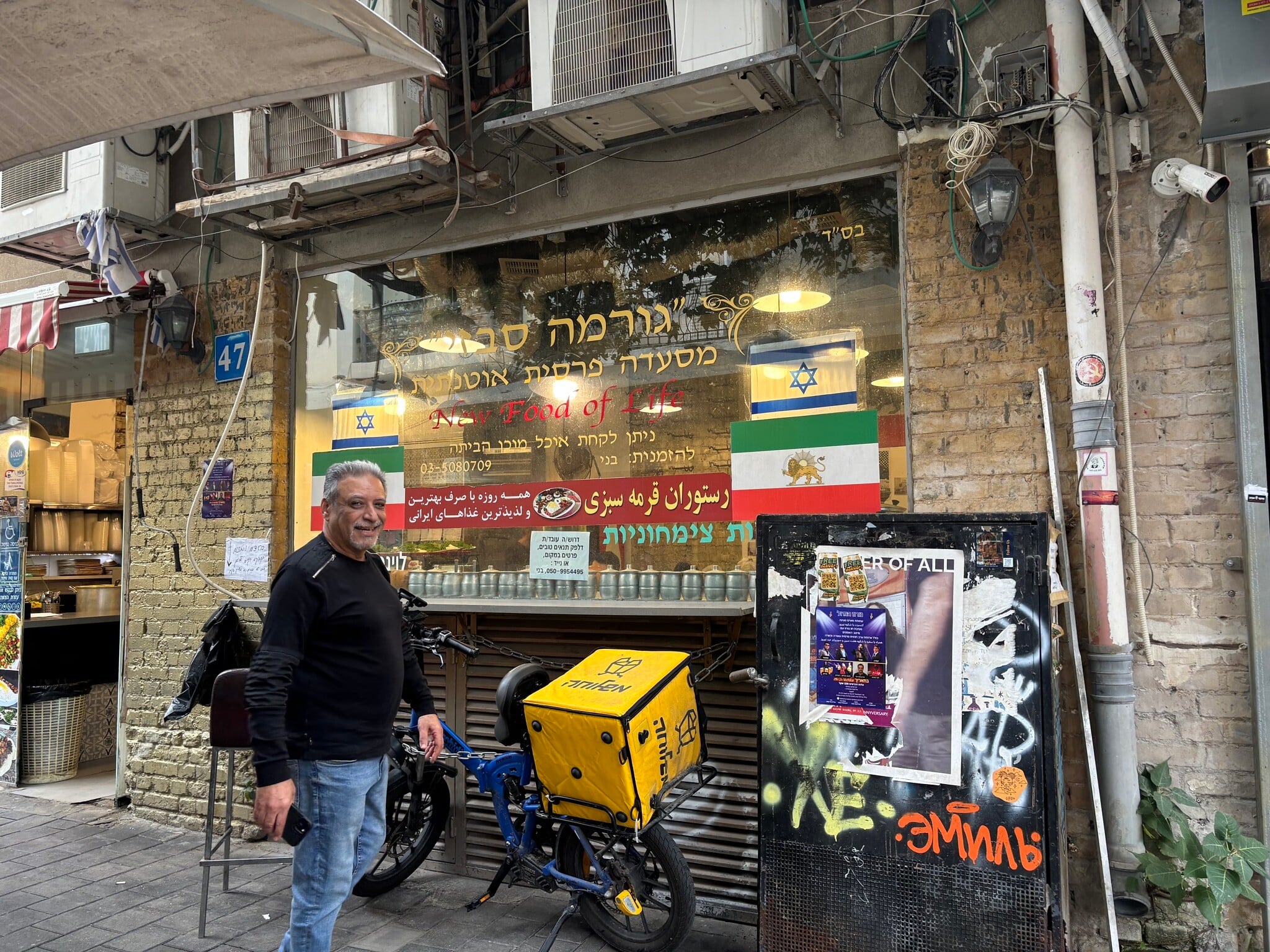
Bijan Barchorderi stands in front of his restaurant, Gourmet Sabzi, at South Tel Aviv’s Levinsky Market, January 22, 2026. (Sharon Wrobel/The Times of Israel)
A few storefronts down the pedestrian-only street, in the hustle and bustle of Levinsky Market, tucked between trendy and traditional bakeries, hip cafes, and rows of colorful stalls selling grains, nuts, legumes, spices, herbs, and dried fruit from open burlap sacks, is Simanian’s Arama Spices, also known as the queen of grandma’s remedies.
A range of wondrous spices, dried herbs, and salves line the walls and shelves of the store, hawked as ancient cures for everything from sore throats, high blood pressure, and infections to stomach aches.
“About 10% to 15% of the products we sell are made in Iran,” said Simanian, 55.
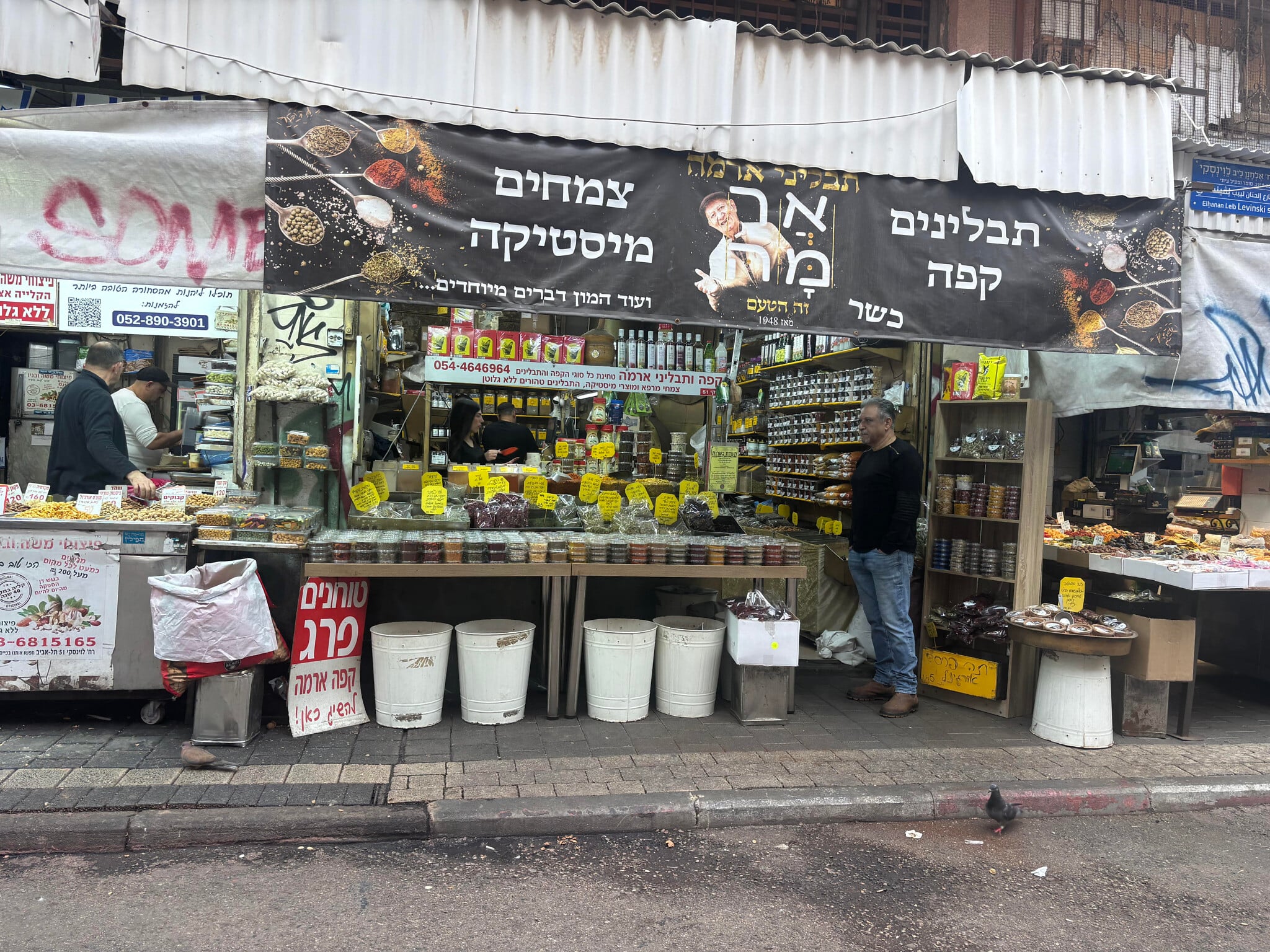
The Arama Spices store at Levinsky Market in south Tel Aviv, January 22, 2026. (Sharon Wrobel/ The Times of Israel)
Born in Israel to parents who emigrated from Iran in 1967, he spoke only Farsi until the age of 6, he said.
In addition to Iranian saffron and black dried lemons, Arama sells specialties such as dried barberries, known as “zereshk.” Often compared to cranberries, due to their similar color and sour taste, barberries are used as ingredients in traditional Persian rice dishes and in traditional medicine to treat throat and other infections, as well as skin conditions.
Another remedy that Simanian regularly sells is flixweed, also known in Iran as “khakshir”: small brown seeds that are used in traditional medicine to treat digestive issues, ease stomach pain, and soothe coughs.
“Instead of buying medicine like paracetamol when someone is sick, I remember my mother giving me Persian natural remedies, and this is what we sell here to our customers,” said Simanian.
Another specialty at Arama is a “Sefidab,” also known as “Rooshoor,” a traditional Persian natural chalk-like stone used for skin exfoliation.
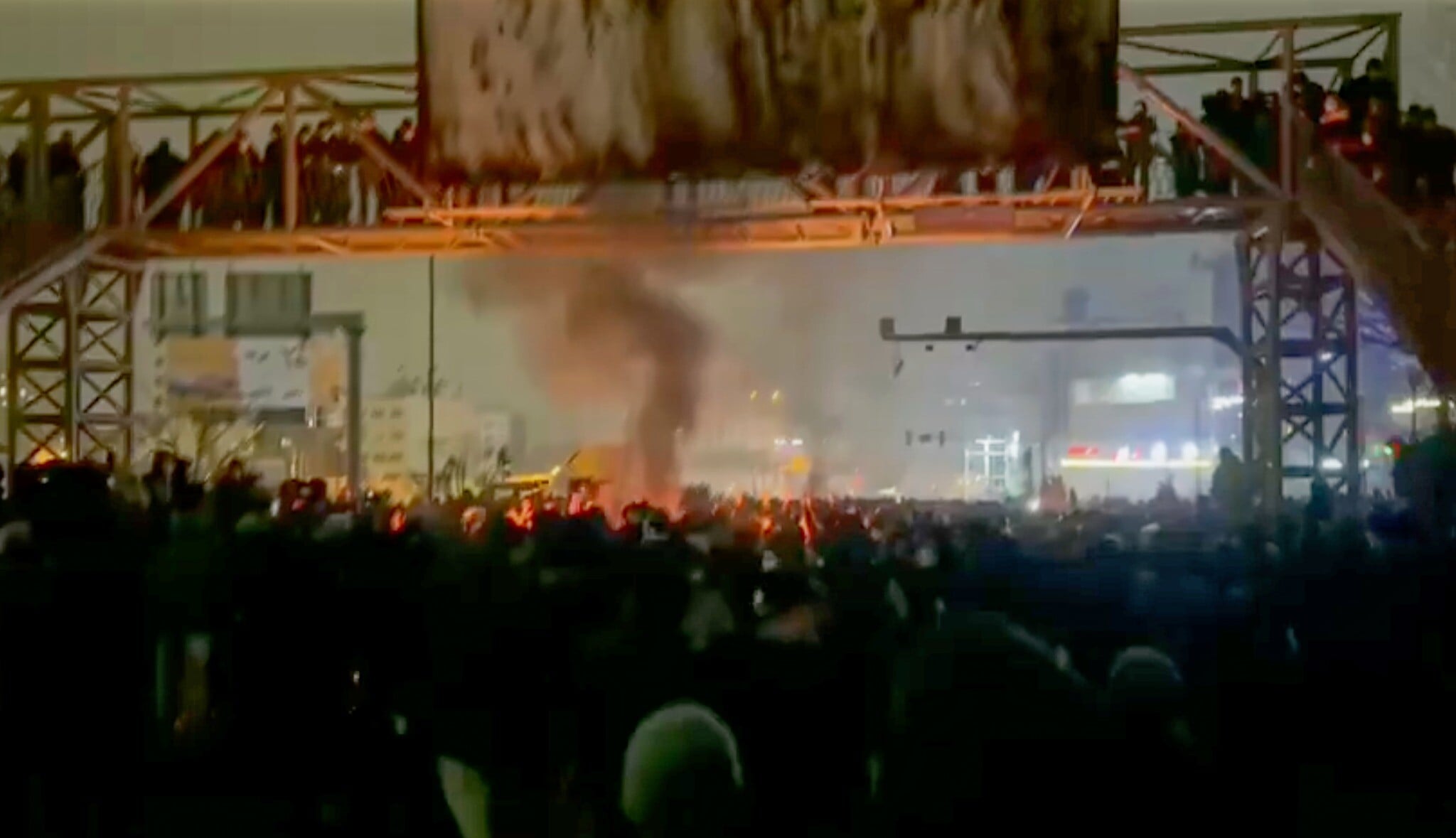
This frame grab from footage circulating on social media from Iran shows protesters taking to the streets despite an intensifying crackdown, as the Islamic Republic remains cut off from the rest of the world in Tehran, Iran, January 9, 2026. (UGC via AP)
Both Barchorderi and Simanian said they were in shock and heartbroken about Iran’s recent brutal crackdown on anti-regime protests, in which thousands of people were killed, and they expressed hope that action would be taken to assist in overthrowing the Islamic Republic.
“I love Israel, and I wouldn’t trade it for anywhere else, but, in retrospect, I also have a homeland that I was born in and people and culture I can’t forget,” said Barchorderi. “I dream that the craziness and chaos will finally end, peace will reign between Israel and Iran, and finally we will be able to return to visit Tehran with my family.”
“I hope to live to see the day I can go back at least to show my children the neighborhood I grew up in, where I played football, and where I went to school,” he said.