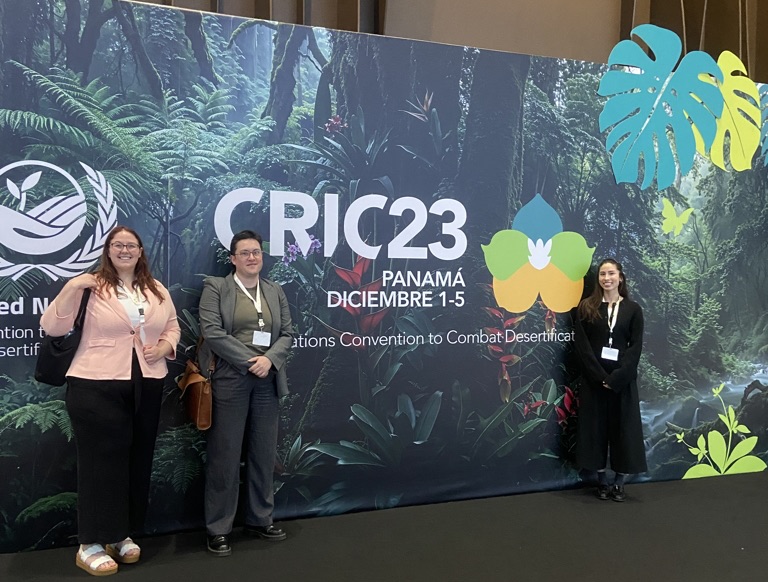
Binghamton University’s Kaschak Institute for Social Justice for Women and Girls is offering Binghamton students multiple opportunities to learn about gender–responsive climate action such as attending conventions, working on projects and gaining hands-on experience in the field.
In December, two students traveled to Panama to participate in the Committee for the Review of the Implementation of the Convention (CRIC). Laurie Kern, a graduate student studying sustainable communities, was one of the students who attended.
“Attending CRIC was a really eye-opening experience for me. Sitting in the sessions and hearing countries report on their progress, challenges, and priorities (around land degradation, drought and sustainable land management), it helped me understand just how much work goes into the review process behind the United Nations Convention to Combat Desertification (UNCCD),” she said. “I’ve learned about these topics in class within my major of Sustainable Communities, but never saw the real impacts.”
CRIC serves as a key forum for countries to discuss progress on targets, report on implementation and provide recommendations to improve land management and achieve Land Degradation Neutrality (LDN), within the UNCCD framework. While attending CRIC, students were able to follow the discussions, understand the priorities firsthand and bring the insights back to the women and communities they support.
“Within both Plenary and Side Events, it was interesting to see how themes like gender, community engagement, and adaptation kept coming up across different delegations. I’m extremely grateful to the Kaschak Institute for giving me this opportunity,” Kern said. “Actually being there in person, taking notes for our ongoing EbA project, and seeing how these discussions play out – it all gave me a clearer sense of the bigger picture of climate advocacy and resilience.”
CRIC’s focus on addressing land degradation and desertification is closely related to Kaschak’s Ecosystem-based Adaptation project, which is designed to reduce communities’ vulnerability to climate change through nature-based solutions. The EbA project is part of Kaschak’s initiative to promote gender-responsive climate action.
The EbA project works to enhance the negotiation and advocacy skills of gender negotiators involved in the United Nations conventions on climate change, desertification and biological diversity. The project teaches students to use software for qualitative data analysis to create a training guide that helps negotiators better understand how gender dimensions are incorporated into the decisions of previous UN conventions.
Lauren Gosse, a third-year psychology student at Harpur College of Arts and Sciences, was one of the students who got involved in the project and described the experience as extremely satisfying.
“Although I play a small part in managing data for this research project, being a part of something that ultimately is used to support women at such a high level and has the potential to impact such important decisions is a really cool and fulfilling feeling,” she said.
The project provides many students with new opportunities to learn and manage data to help aid gender-responsive climate action. Jerome Nenger, a PhD candidate in Community Research and Action (CRA) at the College of Community and Public Affairs (CCPA), also shared his thoughts on his experience working on this project.
“I managed data for further analysis by downloading, compiling and uploading previous COP decisions across regions and countries, which gave me hands-on experience with rigorous, policy-relevant research that I would not have easily accessed elsewhere at Binghamton. The projects I have worked on have reinforced how central gender is to effective climate action,” he said.
The information not only informs their strategies for gender advocacy at both the national and international levels but also provides them with critical information during tense negotiation processes, where accessible information can make a huge difference.