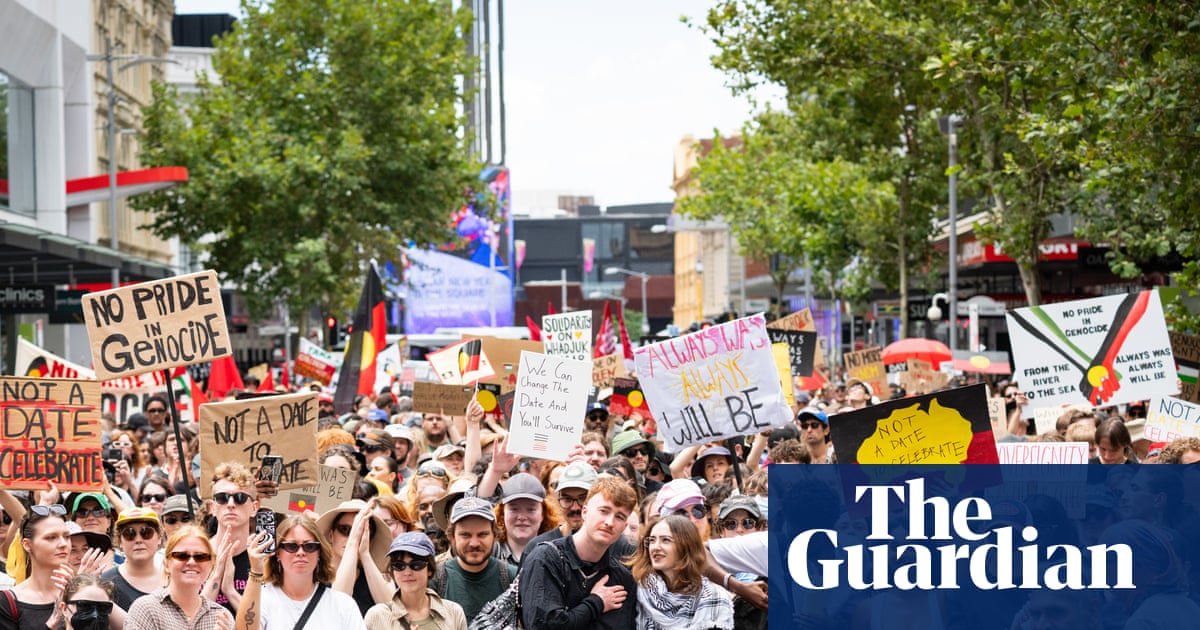
Police have charged a 31-year-old man with terrorism over the alleged attempted bombing of an Invasion Day protest in Perth, accusing the man of accessing “pro-white” material online and claiming the actions were motivated by “hate and racism”.
In a joint press conference on Thursday, the Western Australian premier, Roger Cook, said it was the first time such charges had been laid in that state, but the incident must be condemned “in the strongest possible terms and we must call this for what it is”.
“Last Monday on January 26, a man allegedly threw a homemade bomb into a crowd of people peacefully protesting in the heart of Perth city,” Cook said.
“Thankfully it did not detonate but for that we could have seen a mass casualty event with injuries and potential loss of life. It is an incident that shook all Western Australians, and all Australians, to the core.”
He continued: “This charge, which has been laid by the joint taskforce, alleges the attack on Aboriginal people and other peaceful protesters was motivated by hateful, racist ideology.”
About 2,500 people were at Forrest Place in the Perth CBD for the 26 January protest when a man allegedly threw what police have described as a homemade “fragment bomb” off a balcony of the nearby shopping centre into the crowd.
WA police have alleged the device was designed to explode on impact but had failed to explode.
Sign up: AU Breaking News email
The Australian federal police commissioner, Krissy Barrett, told reporters that the man allegedly threw the device into the crowd at 12.18pm on 26 January, and AFP and Asio were engaged to assist in the investigation 36 minutes later.
Barrett said the WA joint counter-terrorism team had combed through the man’s digital devices and did not believe there was any residual risk to the community.
The man from Perth’s northern suburbs was arrested at the protest and was initially charged with one count of committing an unlawful act or omission with intent to harm (endangering life, health or safety of any person) and one count of making or possession of explosives under suspicious circumstances.
He faced court on those charges last week and was remanded in custody to face court again on 17 February.
Barrett said there were three components needed to meet the threshold for a terrorism offence, including an action that “causes or threatens to cause serious harm to human life, serious damage to property, endangers life, creates a serious risk to public health and safety, or seriously interferes with critical infrastructure”; and that it is “done with the intention of advancing a political, religious or ideological cause”; and that it “is done with the intention of coercing or influencing a government by intimidation or intimidating the public or a section of the public”.
Barrett then directly addressed First Nations people at the rally, saying: “You have the right to peacefully protest in this country without facing threats of violence.
“The AFP, our security and law enforcement partners, will use all our powers, capabilities and resources to ensure hate and violence are not used as weapons to silence communities,” she said.
She added the press conference was “as much an update as a warning” on rising political instability.
“There are individuals and current and emerging groups across Australia, including in the west, which are eroding the country’s social fabric by advocating hatred, fear and humiliation, that is mobilising towards violence,” she said.
The WA police commissioner, Col Blanch, described the incident as “a terrorist attack on all Australians”.
“As police commissioner that saddens me, no doubt it saddens the rest of our country, that a fellow citizen would seek to cause harm to others in our community.”
He told reporters the fuse of the alleged bomb had been lit.
“It should have gone off,” he said. “It had a fuse that was lit – whether it fell out or failed, we allege it was lit. Whatever was looking over the people in that rally that day stopped it from going off. We should all be thankful that we don’t have deceased or seriously injured people in Western Australia today.”
Blanch thanked Noongar elders and community members for the leadership they had shown after the incident, saying he had met with them “on numerous occasions and will continue to meet with them” and called for the community to show unity.
“It is not a time for hate, it is not a time for blame, it’s a time for all leaders in our community to work together to make sure that we have no one – no one – in our country that seeks to do this level of harm to others,” he said.
“There’s one person responsible – a person who will have their day in court.”
Blanch said police would allege the man had accessed “pro-white” material online, but his online footprint did not show any discussion around planning the alleged attack.
He said the man was “self-radicalised, acting alone, [with] access to pro-white male, pro-white material online”. Asked by a reporter if the man had any links to the National Socialist Network or other far-right groups, Blanch said that ideology was “prevalent across his access to the internet”.
“We’re in the middle of the investigation, but at this point, we understand he’s accessing and participating in the ideology, but not having conversations about what was going to happen on January 26th,” he said.
Blanch said police would also allege the man had accessed information on bomb-making online.
Noongar elders and rally organisers were due to meet with police again on Thursday afternoon.
Blanch urged anyone in the community to come forward if they knew anyone in danger of becoming ideologically motivated.
“To be someone filled with hate and racism is unacceptable,” he said. “If you know about it, say something … We should never see this in our country, and we love our state here in Western Australia.”
Both Blanch and Barrett said it was the first incident meeting the threshold of a terrorism offence specifically targeting the Aboriginal and Torres Strait Islander community since those laws had been introduced.
Speaking in federal parliament on Thursday afternoon, the home affairs minister, Tony Burke, said it was “fortunate” the bomb did not detonate, “but be in no doubt it will be alleged in court that the intention was absolutely that the bomb would detonate”.
Burke also addressed community criticism over the time taken to announce the charge of a terrorist offence, saying police needed time to gather evidence.
“Terrorism is not defined simply by the action but also by the motivation … The motivation that will be alleged is a national racially motivated ideological cause,” he said.