
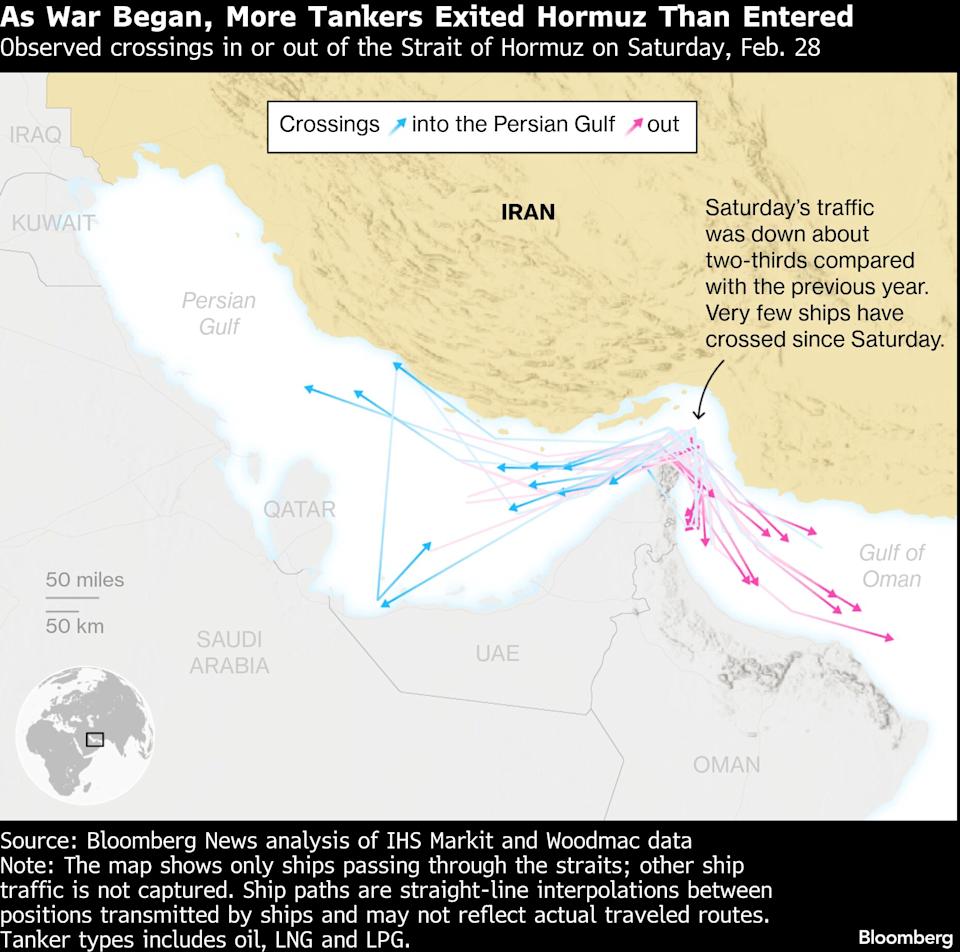
Bloomberg News analysis of IHS Markit and Woodmac data
(Bloomberg) — President Donald Trump says the US will ensure the free flow of energy through the Persian Gulf with insurance guarantees and even naval escorts. But the shipping industry sees it — at best — as only a partial solution to a historic crisis.
US and Israeli strikes on Iran over the weekend have triggered a spiraling regional conflict and multiple attacks on vessels have now effectively closed off the Strait of Hormuz. Without transit through the critical waterway, seaborne trade between some of the world’s biggest oil and gas producers and the rest of the world is all but cut off.
Most Read from Bloomberg
“Nothing is sure and we need immediate clarity,” said Khalid Hashim, managing director of Precious Shipping Pcl, a Thai firm that owns bulk carriers. “Lives are at risk, cargoes at are risk, ships are at risk. We need immediate cover that protects us from all this,” he said.
The company currently has some ships in the Persian Gulf, and has been struggling to secure war-risk cover before they sail from the region, he said.

With ships unable or unwilling to transit the strait, producers cannot export, supertanker costs are skyrocketing and storage at many Persian Gulf refineries is filling up fast. The world’s largest insurance mutuals have withdrawn war risk insurance cover for ships in the area.
“The core thing shipowners are thinking about is the real risk of loss,” said Karnan Thirupathy, partner at Kennedys Law LLP who specializes in the commodities, shipping and insurance sectors. “No one goes into the trade if the risk of loss is simply too high.”
The effects have been swift. Iraq, the biggest Middle Eastern oil producer after Saudi Arabia, has already begun huge cuts to output and faces even deeper reductions, in the clearest sign yet of stress on suppliers in the region.
Trump’s solution involves tapping the US International Development Finance Corporation — an institution that typically helps the private sector to provide finance for developing countries — which will in turn support charterers, shipowners and key maritime insurers.
“While President Trump’s comments about insurance and tanker escorts caused a pullback in oil prices, we question how much planning has been done on the insurance backstop thus far and think there could be a number of challenges in executing this plan quickly,” RBC Capital Markets LLC analysts said in a note.