Lenten campaign 2026
This content is free of charge, as are all our articles.
Support us with a donation and enable us to continue to reach millions of readers.
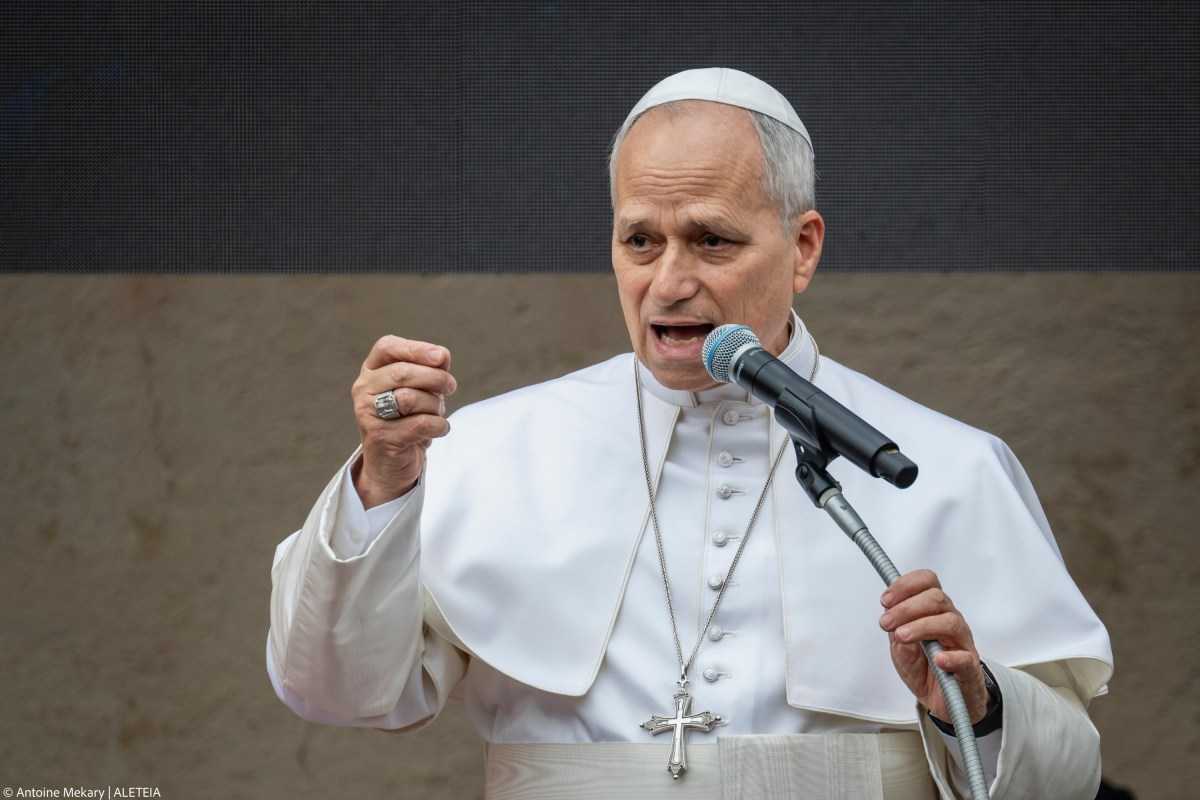
With less than a year as Successor of Peter, Pope Leo XIV is already establishing himself as a global voice in favor of the mission of journalists in a society based on human dignity.
The Pope has spoken to and about journalists a number of times and added to this number on March 16, when he spoke to staff and families of the Italian state RAI network, marking 50 years since its foundation.
Twice now, his meetings with journalists have included a moment of comedy. (See video in article below.)
“I greet the director general of Rai…” the Pope began, before being corrected: “He’s not here? Oh, first mistake! Tonight on the 8:30 pm news, I’ll see: ‘The Holy Father doesn’t know,'” he joked, provoking laughter from his audience. He concluded: “In any case, give him my regards.”
But the themes of the Holy Father’s brief address were serious. He warned about the dangers of ideology, and how important it is to stay open to facts.
We all know how difficult it is to allow ourselves to be surprised by facts, by encounters, by the gazes and voices of others; how strong the temptation is to seek out, see and listen only to what confirms our own opinions. But there can be no good communication, nor true freedom and healthy pluralism, without this openness.
Given the context of the world in which the journalists are working today, the Pope also spoke about the coverage of war.
It is up to you to show the sufferings that war always brings to the people; to show the face of war and to relate it through the eyes of the victims, so as not to transform it into a video game. It is not easy in the few minutes of a news programme and its in-depth segments. But this is the challenge.
Cardinals who have also warned of “video game” mentality
In using this image, the Pope echoes other Church leaders who have warned not only against media coverage of the war, but also the way it is fought “from distant command centers, [where] military operators stare at screens where maps, radar signals, and algorithm-generated targets move like icons in a computer game. A cursor moves. A coordinate is selected. A click is made. And a missile is launched,” Vatican News reported from Cardinal Pablo Virgilio David, vice president of the Federation of Asian Bishops’ Conferences, in the first week of the war.
On the ground are ordinary people, he said, “whose lives have nothing to do with the calculations of generals or the ambitions of politicians: children asleep in their beds, mothers preparing meals, elderly people who cannot run fast enough to reach a shelter.�
When missiles slip through air-defense systems, they do not disappear harmlessly in the sky. They explode “where people live — inside apartment blocks, hospitals, hotels, crowded streets.�
“And when the smoke clears, the casualties are not symbols on a screen. They are human beings,” said Cardinal David.
Similarly, from the United States, Chicago’s Cardinal Blaise Cupich released a statement on March 7 in response to social media posts from Washington. “A real war with real death and real suffering being treated like it’s a video game — it’s sickening.”
As more than 1,000 Iranian men, women and children lay dead after days of bombardment from U.S. and Israeli missiles, the official White House X account on Thursday evening posted a video of scenes from popular action movies spliced with actual strike footage from their war on Iran. The clip was captioned: “JUSTICE THE AMERICAN WAY.�
A real war with real death and real suffering being treated like it’s a video game — it’s sickening. Hundreds of people are dead, mothers and fathers, daughters and sons, including scores of children who made the fatal mistake of going to school that day. Six U.S. soldiers have been killed. They are also dishonored by that social media post. Hundreds of thousands displaced, and many millions more are terrified across the Middle East.
Pope’s words
Here is the full translation of the Pope’s brief reflection:
In the name of the Father, and of the Son, and of the Holy Spirit.
Peace be with you!
Good morning to you all, and welcome!
I extend my greetings to the Board of Directors, the Director and the editorial team of TG2, and offer my congratulations on this news programme reaching its fiftieth anniversary.
This “birthday� invites us to reflect on the journey you have made, as a paradigm of the challenges that television journalism has faced and those that still lie ahead. I am thinking of the transition from analogue to digital, in which you played a leading role in seizing the opportunities and understanding that no technological innovation can replace creativity, critical discernment, and freedom of thought. And if the challenge of our time is that of artificial intelligence, I think of the need to regulate communication according to the human paradigm and not the technological one. Which means, ultimately, knowing how to distinguish between the means and the ends.
The distinctive features that have characterized you from the very beginning are laicity and pluralism of information sources, even in state television. Laicity understood as a rejection of ideological preconceptions and as an open-minded view of reality. We all know how difficult it is to allow ourselves to be surprised by facts, by encounters, by the gazes and voices of others; how strong the temptation is to seek out, see and listen only to what confirms our own opinions. But there can be no good communication, nor true freedom and healthy pluralism, without this openness.
Throughout the history of TG2, diverse cultural perspectives have coexisted. This diversity, especially when animated by a spirit of friendship, has been an added value to your identity, a source of richness, an example of dialogue, which still has much to teach us today, in an age dominated by polarization, ideological closed-mindedness and slogans that prevent us from seeing and understanding the complexity of reality.
Always, but especially in the dramatic circumstances of war, such as those we are currently experiencing, the media must guard against the risk of becoming propaganda. And the task of journalists, in verifying the news so as not to become a mouthpiece for those in power, becomes even more urgent and delicate — I would say essential.
It is up to you to show the sufferings that war always brings to the people; to show the face of war and to relate it through the eyes of the victims, so as not to transform it into a video game. It is not easy in the few minutes of a news programme and its in-depth segments. But this is the challenge.
I thank you for your visit, I offer you my best wishes and I bless all of you and your work.
____________________________