“Remove grease from pans before putting them in the dishwasher!” and “never throw wet wipes in the toilet!” Most of us have heard this advice before, but without understanding where it came from and why.
This is exactly where the “Wat leeft?” (“what’s up?”) awareness-raising campaign comes in. It focuses on these everyday actions and shows why they are so important for our sewage and wastewater treatment system.
Environmental engineer Danièle Mousel knows all too well the small everyday mistakes that put a heavy strain on the sewage and wastewater treatment system. She works at the Syndicat Intercommunal pour l’Assainissement du bassin de la Chiers (Siach), a sewerage utility in southwestern Luxembourg.
Wastewater treatment has evolved significantly in recent decades, Mousel explained. The processes have become more and more efficient, but the requirements have also increased steadily. Climate change also plays a greater role nowadays.
Climate change puts a strain on wastewater treatment plants
When it rains heavily, large quantities of precipitation mixed with some wastewater arrive at the sewage treatment plant. Before it can be treated, the water is temporarily stored in stormwater overflows and stormwater overflow basins and preliminarily filtered.
At the other extreme, when there are prolonged periods of heat, there is less water flowing in waterways, which increases pressure on sewage treatment plants.
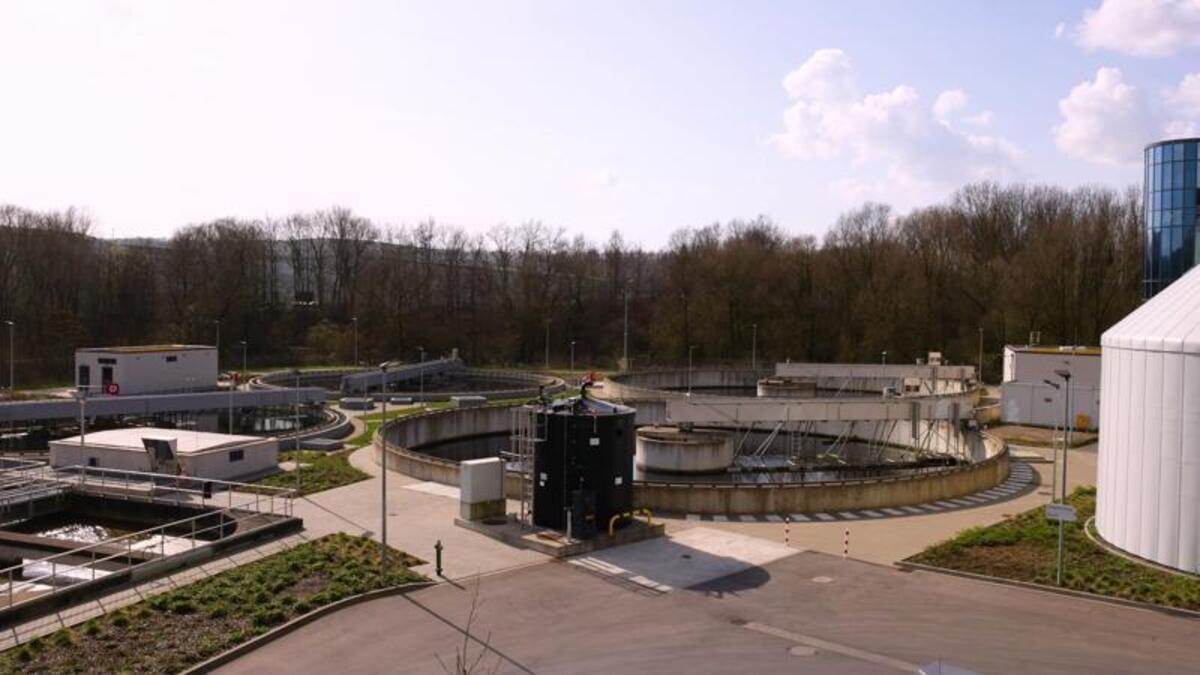
The wastewater treatment plant in Pétange is one of the largest in the country © Photo credit: Marc Wilwert
The sewage treatment plant in Pétange, where Mousel works, covers the municipalities of Pétange, Differdange and parts of Käerjeng and Sanem.
Serving a population equivalent to 115,000, the plant is one of the largest in the country. “But that doesn’t mean that there are 115,000 people,” explained the environmental engineer. The wastewater from industry and commerce is converted into population equivalents, i.e. the amount and type of wastewater that usually comes from one person.
What happens at a wastewater treatment plant?
A large proportion of the wastewater is transported to the treatment plant via the combined system, in which wastewater and rainwater end up in the same drainage pipes.
Wastewater passes through three different stages during treatment: a mechanical, a biological and a chemical stage. In the mechanical stage, contaminants are removed by sieving, settling or similar processes.
This initial filtering stage is not sufficient to return the water to streams and rivers. In the biological stage, microorganisms remove carbon, hydrogen and some phosphorus from the water.
In the last stage, the chemical stage, so-called precipitants are used. These convert soluble substances such as heavy metals, phosphates and organic substances into insoluble particles, which can then be filtered out. Once water has been separated from the sludge, it can be returned to a watercourse.
In future, some wastewater treatment plants are to be given a fourth treatment stage as part of the 2024 Urban Wastewater Directive. This will remove micropollutants, for example from medicines or cosmetics.
After treatment, wastewater can be returned to streams and rivers © Photo credit: Marc Wilwert
Cybersecurity, blackouts and growth
Mousel and her colleagues are concerned about cybersecurity, blackouts and, above all, the steady population growth. “Wastewater treatment plants are designed for a lifespan of 25 to 30 years, but if developments in zoning plans are subsequently adjusted, this can pose a challenge,” Mousel said. “The impact of industry and commerce, which indirectly discharge into the treatment plant, should also not be underestimated.“
Water treatment is expensive, and necessary, but residents can help to keep costs in check. However, there is a lack of important basic knowledge. As co-coordinator of the “Wat leeft?” awareness-raising campaign, Danièle aims to share this information.
“Wat leeft?” was launched by the Association luxembourgeoise des services d’eau (Aluseau), the Luxembourg association of water utilities, in collaboration with the Ministry of the Environment, Climate and Biodiversity and the Water Management Agency. The aim is to educate the public about wastewater disposal. Since 2 March the initiative has published easy-to-understand information on its website.
Danièle Mousel and her colleagues want to educate the public with the “Wat leeft?” (what’s up?) campaign. © Photo credit: Marc Wilwert
Social media as a stage
The coordinators are specifically focussing on social media as the main stage. “Our website is available in Luxembourgish, German, French, English and Portuguese.” Mousel said. “We are active on Instagram, Facebook and YouTube. We will show our reels there and take people on an exciting journey.” The campaign is set to run for three years.
“I believe that many people simply don’t ask themselves what happens once the water has disappeared down the drain,” Mousel said. She knows all too well the “aha” moments that many people have when they visit the sewage treatment plant. Among other things, there is a quiz online that explains in a playful way what needs to be considered when disposing of food and grease residues and personal hygiene products.
For Mousel, flushing wet wipes down the toilet is a classic mistake. She reported that some care homes have to remove and clean their pumps almost every week. Even if the packaging states that the wet wipes are biodegradable, this is not the case, according to the environmental engineer, at least not until they reach the sewage treatment plant.
“Although wet wipes have less of an impact on water quality, they significantly increase the costs of water treatment – costs that ultimately end up with the population,” Mousel said.

Personally, I’m always a bit tormented in films or series when people want to kick their addiction and flush the drugs down the toilet at a dramatic moment.
Danièle Mousel
Environmental engineer at the Siach wastewater treatment facility in Pétange
Even watching television, she can’t let go of her work. “Personally, I’m always a bit tormented in films or series when people want to kick their addiction and flush the drugs down the toilet at a dramatic moment. Then I just think to myself: ‘No!’ Because medication should either be taken back to the pharmacy or disposed of correctly at the recycling centre.”
Small mistakes in everyday life have a huge impact on the sewage treatment plant. © Photo credit: Marc Wilwert
Don’t wash cars at home
Many people are surprised to learn that cars should not be washed at home and that pain-relieving creams should be wiped off with a paper towel before showering.
Mousel said the water treatment system in Luxembourg can cope even without changes in people’s behaviour. However, increasing demands are already making cleaning more complicated and more expensive. By taking the right steps, everyone can help ensure that wastewater charges do not rise unnecessarily.
The “Wat leeft?” campaign wants to connect directly with people and see what they are particularly interested in at events such as the water festival at the Upper Sûre Nature Park on 17 May and the Siach open day on 6 June.
“We are open to suggestions and proposals” for participating in other events, Mousel said. “If you are interested, you can always contact us.”
(This article was originally published by the Luxemburger Wort. Translated with the aid of an AI tool and then reviewed and edited by Aaron Grunwald.)