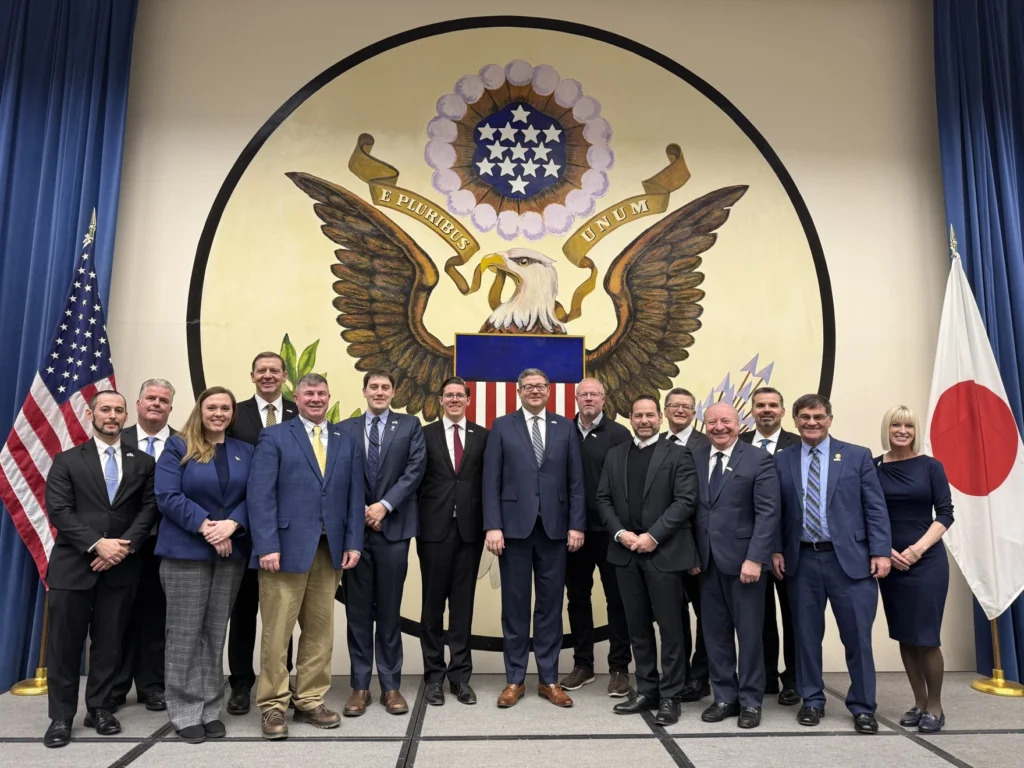
South Dakota officials are trying to strengthen trade relationships with Japan and South Korea as soybean farmers look to diversify beyond China, which has reduced its purchases.
Jerry Schmitz, executive director of the South Dakota Soybean Research and Promotion Council, was part of a delegation that visited the two countries earlier this month.
“Really, we’re laying the pathway for additional sales in the future,” he said.
The delegation also included Lt. Gov. Tony Venhuizen, South Dakota Trade President and CEO Jesse Fonkert, Governor’s Office of Economic Development Commissioner Bill Even, and state Agriculture and Natural Resources Secretary Hunter Roberts.

Jerry Schmitz, executive director of the South Dakota Soybean Research and Promotion Council, participates in a roundtable discussion hosted by Farmers for Free Trade on Sept. 6, 2025, at the Central States Fairgrounds in Rapid City. (Photo by Seth Tupper/South Dakota Searchlight)
Schmitz said Japan and South Korea are not new markets for South Dakota soybeans or soy-fed pork. He said the trade mission was less about signing immediate contracts and more about building trust with Chinese hog feed suppliers, grocery representatives and other buyers.
Schmitz said the long-term goal is a broader demand for soybeans and more value-added exports, such as pork raised on soybean feed, rather than simply shipping raw beans overseas.
The effort comes as soybean farmers watch China closely. The country continues to shift toward cheaper Brazilian beans.
“China has been a big buyer in the past. They will continue to be,” Schmitz said. “But we want to diversify.”
Last year, fallout from President Donald Trump’s higher tariffs affected soybean farmers. China announced retaliatory tariffs, including an additional tariff on soybeans, and suspended imports. The dispute effectively dried up the Chinese market for South Dakota growers, after China previously purchased about 30% of the state’s soybeans.
Then, China agreed to suspend the retaliatory tariffs and to buy at least 12 million metric tons of U.S. soybeans in the last two months of 2025, and at least 25 million metric tons per year from 2026 through 2028. The Trump administration then rolled out a $12 billion farm aid package to help offset farmers’ losses from trade disruptions.
Schmitz said China has so far bought what it agreed to buy, but that’s still about 10% less than previous levels. And because South Dakota is far from major ports and transportation costs are high, Schmitz said, federal trade assistance “has not made farmers here whole.”
Schmitz said the shortfall matters for farmers, who already face rising costs for fertilizer and fuel. That’s due in part to tariffs on imports and disruptions of markets for petroleum-based products caused by Trump’s war against Iran.
Lt. Gov. Venhuizen said the delegation also received embassy briefings and met with foreign affairs officials. He said the mission was about building relationships, exchanging information and identifying openings for future deals.
Venhuizen said one of the clearest opportunities is in food processing, which he said could help South Dakota create more value-added opportunities for South Dakota agricultural commodities.
With the state’s help, CJ Schwan’s is constructing a $550 million food production plant in Sioux Falls. The company, which is part of the South Korean global conglomerate CJ Group, has also opened an office in downtown Sioux Falls.
Venhuizen said the delegation met with CJ Schwan’s in South Korea to discuss the status of the project. He said the company’s presence in South Dakota helped give the state credibility with other Korean companies.
Following the trade mission, Fonkert announced his resignation from South Dakota Trade to “prioritize time with my family.” Fonkert, who held the job less than a year, succeeded Luke Lindberg, who now serves as U.S. Department of Agriculture undersecretary for trade and foreign affairs.
SUBSCRIBE: GET THE MORNING HEADLINES DELIVERED TO YOUR INBOX