This story has been updated.
By Gary Gately
When Israeli police prevented the two highest-ranking Catholic clerics in the Holy Land from celebrating Palm Sunday Mass at the Church of the Holy Sepulchre for the first time in centuries, the news spread throughout the world almost instantly.
Within a few hours of the Latin Patriarchate’s announcing the “manifestly unreasonable and grossly disproportionate measure” — and warning of a “grave precedent” — millions of people had read those words online.
Ultimately — amid mounting criticism from political and religious leaders and Christians worldwide — Israel pledged to ensure Holy Week and Easter celebrations would take place at the Church of the Holy Sepulcher, built in the fourth century on the site of Jesus’ crucifixion and resurrection.
On Monday, during a meeting with top Vatican diplomats, Israel’s ambassador to the Holy See expressed regret for what the Vatican’s press office called the “unfortunate incident.”
That followed Israeli President Isaac Herzog’s telephone call late Sunday night to Latin Patriarch of Jerusalem Cardinal Pierbattista Pizzaballa to express “great sorrow” that Israeli police had prevented Cardinal Pizzaballa and the custos of the Holy Land, Father Francesco Ielpo, the official guardian of the Church of the Holy Sepulchre, from entering the church to celebrate Palm Sunday Mass.
“I clarified that the incident stemmed from security concerns due to the continuous threat of missile attacks from the Iranian terror regime against the civilian population in Israel, following previous incidents in which Iranian missiles fell in the area of the Old City of Jerusalem in recent days,” Herzog said in a statement. “I reaffirmed the State of Israel’s unwavering commitment to freedom of religion for all faiths and to upholding the status quo at the holy sites of Jerusalem.”


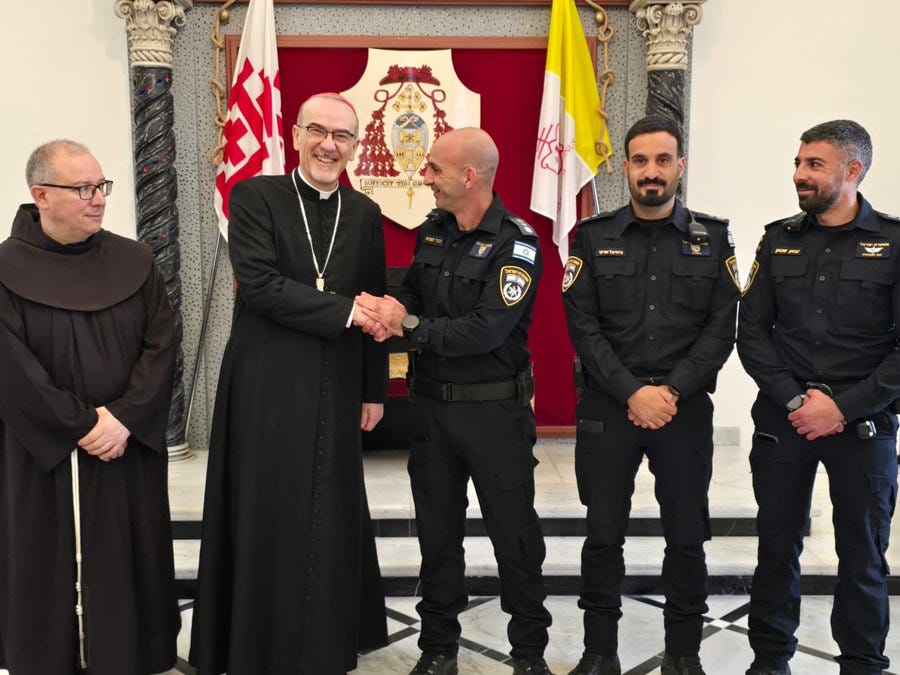
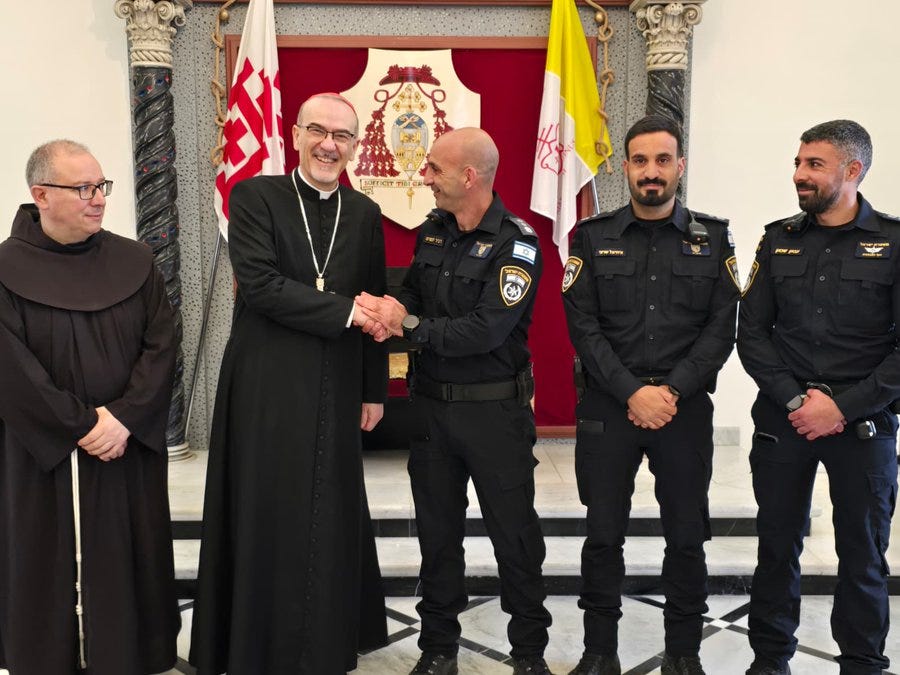
Israeli President Isaac Herzog (left) expressed “great sorrow” to Latin Patriarch of Jerusalem Cardinal Pierbattista Pizzaballa after Israeli police prevented the cardinal and the custos of the Holy Land, Father Francesco Ielpo, from celebrating Palm Sunday Mass at the Church of the Holy Sepulchre in Jerusalem. (Photos: Office of President Isaac Herzog; Latin Patriarchate of Jerusalem)
Just before the call — facing growing backlash from the governments of the U.S., Spain, Portugal, Germany, Canada, Hungary, France, Poland and Italy, along with influential bishops’ conferences and lay conservative and progressive Catholics alike — Israeli Prime Minister Benjamin Netanyahu abruptly reversed course.
In an X post that has attracted 7.1 million views, Netanyahu said he had
”instructed the authorities to enable the Patriarch to hold services as he wishes” and to grant Cardinal Pizzaballa “full and immediate access to the Church of the Holy Sepulchre in Jerusalem.”
Netanyahu did not apologize in the post, in which he said police took the measures “out of special concern” for Pizzaballa’s safety amid frequent Iranian missile attacks and noted that wartime restrictions on worshipers applied to Christian, Muslim and Jewish holy sites in Jerusalem.
That echoed statements throughout most of the day Sunday from the Netanyahu government defending banning the Catholic leaders from the Church of the Holy Sepulchre, citing safety measures applying to all faiths.
Responding to Netanyahu’s post, Mike Huckabee, the U.S. ambassador to Israel, said the prime minister “personally & promptly intervened to allow Cardinal Pizzaballa access to Church of Holy Sepulcher,” adding: “ALL holy sites have restrictions due to Iranian missiles & safety issues, but private access on Palm Sunday was reasonable & issue now resolved.”
Holy Land’s Catholic leaders announce agreement
On Monday, the Latin Patriarchate of Jerusalem and the Custody of the Holy Land announced in a joint statement the agreement with Israeli authorities allowing Church of the Holy Sepulcher Holy Week and Easter celebrations to take place.
In the statement, the Holy Land’s Catholic leaders expressed “sincere gratitude” to Herzog for his “prompt attention and valued intervention.” They also acknowledged that wartime restrictions would continue to limit gatherings and said liturgies and prayers would be broadcast live in the Holy Land and throughout the world.
“We wish to emphasize that religious faith constitutes a supreme human value,” the statement said. “Especially in times of hardship and conflict, such as those presently endured, safeguarding the freedom of worship remains a fundamental and shared duty.”
Criticism of Israel continued Monday.
In a letter to the UN Security Council, Palestine’s Mission to the United Nations accused Israel of “repeated infringement upon the sanctity of the Holy Sites, and attacks and restrictions against Christian and Muslim religious leaders and with the Israeli government espousing and promoting extremist discourse and behavior.”
Other critics noted that Cardinal Pizzabala and Father Ielpo had been walking, privately, without a procession, when police turned them back near the ancient Jerusalem Church and called that a gross infringement of religious liberties. The Catholic leaders had planned to celebrate a small private Mass with two other priests — well within the 50-person limit under Israeli wartime restrictions on Jerusalem worship services — and to broadcast it throughout the world.
White House expressed “concerns to Israel over holy sites being shut down”
At the White House, Press Secretary Karoline Leavitt told reporters Monday that Secretary of State Marco Rubio had confirmed that the U.S. had conveyed its “concerns with Israel with respect to these holy sites being shut down.” While saying the Trump administration understands the need for security in Jerusalem, Leavitt added, ”We want worshipers to be able to access these holy sites. Of course, safety is a top priority.”
As the U.S.-Israel-led Iran war that has killed over 5,000 people, wounded 30,000 others and displaced millions entered its second month, Leavitt, a Catholic, opened the briefing with the words: “Could you hear our ‘amen’ in there? We just had a little loud prayer as a team. In this Holy Week, President Trump and the First Lady are joining in prayer with Christians celebrating the resurrection of our Lord and Savior, Jesus Christ.”
To which prominent British Catholic journalist, author and commentator Austen Ivereigh responded in an X post: “Amazing. We haven’t even had the Last Supper, let alone the Passion, and already Trump is celebrating the Resurrection. No wonder they have no conception of the Via Crucis (‘Way of the Cross’) their war has inflicted on humanity.”
Leavittt, when asked to comment on Pope Leo XIV’s having said in his Palm Sunday homily “God does not listen to the prayer of those who wage war,” responded: “Our nation was a nation founded 250 years ago almost on Judeo-Christian values, and we have seen presidents, the leaders of the Department of War, and our troops go to prayer during the most turbulent times in our nation’s history. I don’t think there is anything wrong with our military leaders or with the President calling on the American people to pray for our service members overseas. If you talk to many service members, they appreciate the prayers and support from the commander in chief and his cabinet.”
For his part, Vice President JD Vance, a Catholic convert who has met at the Vatican with Pope Leo and his predecessor, the late Pope Francis, has not publicly commented on Jerusalem police turning away the Catholic leaders.
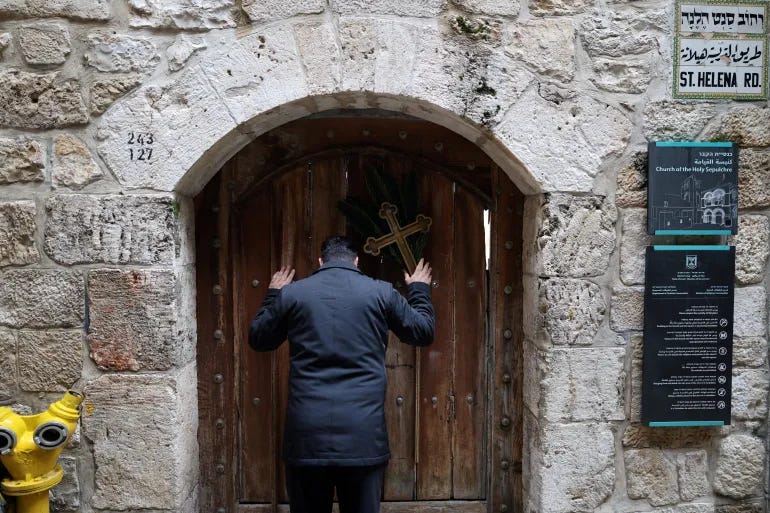
During his Angelus address after Palm Sunday Mass, Pope Leo lamented the long shadow the Iran war has cast on Christians in the Holy Land.
Jerusalem stood mostly empty and eerily quiet, in sharp contrast to the traditional Palm Sunday procession of tens thousands of pilgrims walking down the narrow, hilly streets toward the Old City.
“At the beginning of Holy Week, more than ever, we are close in prayer to the Christians of the Middle East who are suffering consequences of war during these holy days,” the leader of the 1.4 billion-member Catholic Church said.
“Precisely when the church contemplates the mystery of the Passion of the Lord, we cannot forget how many today participate in a real way in his suffering, Their suffering challenges the conscience of everyone.”
“Today Jesus weeps once more over Jerusalem.”
Hours later, Cardinal Pizzaballa, unable to celebrate Palm Sunday Mass at the Church of the Holy Sepulchre, led a solemn Palm Sunday celebration at the foot of the Mount of Olives, where Jesus prayed in the Garden of Gethsemane before his crucifixion.
Standing before the Basilica of All Nations in Gethsemane, Cardinal Pizzabella said: “Today Jesus weeps once more over Jerusalem. He weeps over this city, which remains a sign of both hope and sorrow, of grace and suffering. He weeps over this Holy Land, still unable to recognize the gift of peace. He weeps for all the victims of a war that seems without end: for divided families, for shattered hopes.
“But,” the cardinal reminded us, “the tears of Jesus are never fruitless. They open our eyes, challenge us and reveal the truth.”