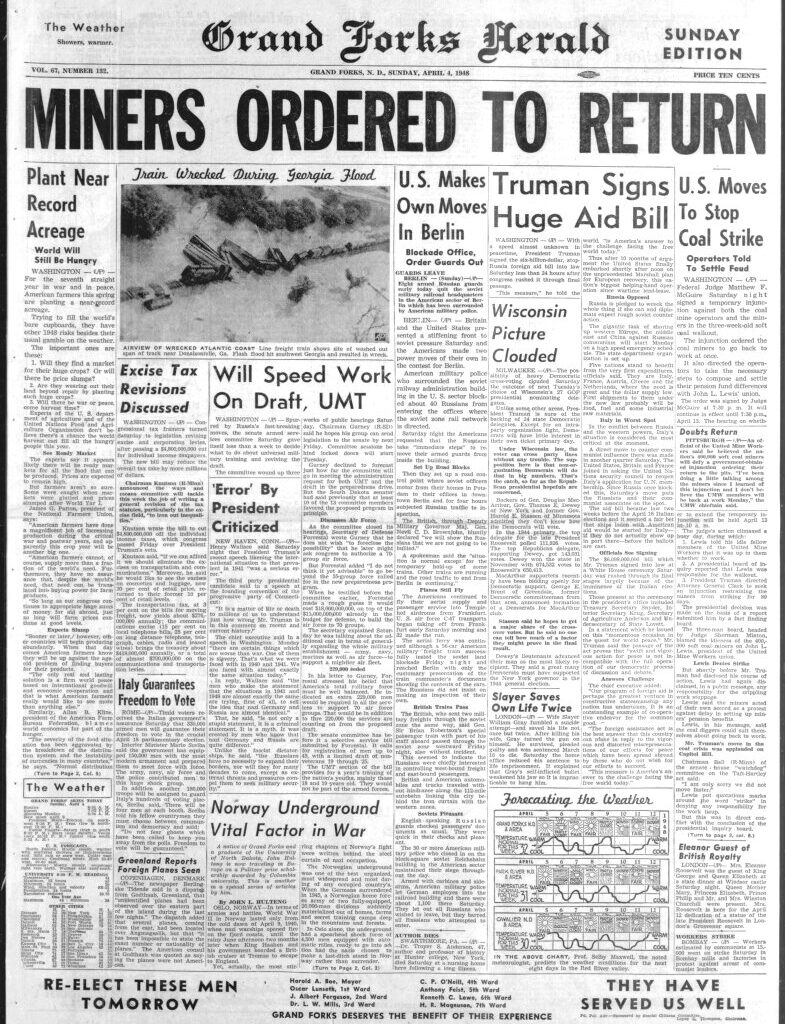
Today in History revisits the Sunday, April 4, 1948, edition of the Grand Forks Herald and highlights a story by John Hulteng, a Grand Forks native and UND graduate, who was spending time in Europe on a Pulitzer Prize scholarship. He writes of visiting Oslo, Norway, and learning of Norway’s formidable underground army during World War II.
Norway Underground Vital Factor in War
A native of Grand Forks and a graduate of the University of North Dakota, John Hulteng is now traveling in Europe on a Pulitzer prize scholarship awarded by Columbia university. This is another in a special series of articles by him.
By JOHN L. HULTENG
OSLO, NORWAY — In terms of armies and battles, World War II in Norway lasted only from the cold dawn of April 9, 1940, when nazi warships opened fire on the fjord coasts, until the rainy June afternoon two months later when King Haakon and his government boarded a British cruiser at Tromso to escape to England.
Yet, actually, the most stirring chapters of Norway’s fight were written behind the steel curtain of nazi occupation.
The Norwegian underground was one of the best organized, most widespread and most daring of any occupied country’s. When the Germans surrendered in 1945, a Norwegian home forces army of two fully-equipped, 20,000-man divisions suddenly materialized out of homes, farms and secret training camps deep in the mountains and forests.
In Oslo alone, the underground had a spearhead shock force of 4,500 men equipped with automatic rifles, ready to go into action had the nazis chosen to make a last-ditch stand in Norway rather than surrender.
While I have been in Oslo, I have talked with many of the leaders and workers of both the official underground and the vast, unorganized group of sympathizers and part-time helpers who took part in the never-ending fight against the occupation forces. The story of that fight is as amazing as it is inspiring.
There was “Sigurd,” for example, a slender, smiling man who during the occupation was chief of the underground intelligence division.
He told me of the hundreds of emergency caches of guns and ammunition hidden in apartments and homes scattered throughout the city, so that underground operatives on a mission could pick up their equipment near the scene of action and not risk going for long distances through the streets carrying weapons.
He told me how an order or an alarm could be spread down the interlocking echelons of the underground to each of its 7,000 Oslo agents within two hours.
And he told me of the Norwegian underground’s greatest exploits—the bottling up of a great nazi army for nearly a year when it was desperately needed on the collapsing front in Germany.
“We received an order from Eisenhower in 1944,” he explained, “to do our best to prevent the 450,000 German troops in Norway from getting back to Germany where they were wanted to bolster the two fronts.” The Norse underground’s success in this mission played an important part in the Allied victory the next spring.
First the Norwegian underground struck at the storages of gasoline and oil needed to fuel the trains, ships and planes that could transport the nazis back to Germany. Explosions and fires wiped out an enormous total of the vital supplies all over the country. Of one great train of 82 loaded tank cars, the Germans managed to save only four.
Then the underground bottled up the harbors, calling in Allied mine-laying planes to sow up the fjords with mines whenever a nazi troop transport was about to sail for the south.
Finally they paralyzed the country’s entire internal transport by blowing up rail terminals and strategic sections of track throughout the nation. One night, nearly simultaneously explosions wiped out 300 such points. Only a relatively small number of the German troop concentrations in Norway managed to get safely back to Germany and take part in the final battles against the advancing Allies.
And I also talked with “Miss Olson,” a graceful, lovely blonde who was a key figure in the underground. It was her enormously difficult task to establish friendly contact with gestapo and nazi army leaders and pump them for information—while enduring the bitter scorn of other Norwegians who misinterpreted her actions.
She told me how, when the Germans finally discovered her mission, she was forced to flee to Sweden along the escape routes the underground kept running day and night, despite nazi border patrols. She walked for 17 hours, over slush, snow and ice, helping along several French pilots who were also escaping but were in no condition to keep up the pace.
Then she came to Stockholm and saw the shops full of candy, food, flowers and dresses—all the things no one in Norway had seen in such abundance for four years.
She had only five Swedish crowns with her, she told me, as she stood in the midst of all this sudden plenty, but the first thing she did was to go into a florist’s shop and spend all her tiny capital on an armful of lovely, fresh blooms.
“I was so hungry for their beauty,â€� she smiled—this slender girl who had spent four years battling in the deadly tense war of the underground, with the threat of gestapo torture a daily companion.
But the leaders were not the only ones in Norway who helped fight the occupiers. An amazing percentage of the population was active in some way to aid the battle.
Elderly women carried underground literature in their stockings. Young girls strode blithely through the streets with ski knapsacks full of underground newspapers on their backs. Three such underground news sheets were published daily in the very offices of the government bureau of statistics. They were run off, a sheet at a time, on multigraph machines, mixed in with other, official material—and the nazis never did discover them.
The underground also maintained its own arms factories in the heart of the city. I was told that 3,000 automatic sten guns were assembled in a special plant in downtown Oslo, from parts made in scattered machine tool factories throughout the city. And underground papers were distributed inside covers printed to resemble travel folders, insurance advertisements and even official bulletins of the Quisling government.
The fire chief of a large Norwegian city told me how he would sit down with underground leaders to plan sabotage fires and explosions, showing the agents just where to plant their incendiaries and just how to cut water mains so that water pressure would fail. Then when the explosions came, he would lead his fire brigade to combat the fire and work diligently under the noses of the watchful nazis, who considered him a valuable colleague.
During the war the royal box at the national theater was never occupied, although the nazis tried hard to sell tickets for its seats and thus remove a constant reminder of the exiled king. One evening, however, a Quisling official and his party entered the box. There was an angry roar from the audience and every person in the theater rose and walked out. Thereafter the box stayed empty.
During the last days of the war, as the Allies pushed into Berlin and German armies all over the continent broke up, Norwegians were still anxious. There was considerable evidence that the nazi troops in Norway were planning to make a last stand up here, fighting their way through all the cities and countryside.
My hostess in Oslo told me how breathlessly everyone waited here, day after day. Finally, one afternoon, she called in some friends and brought out a bottle of wine she had been saving throughout the war for the day of victory.
“We sat around and waited, and waited—but no news came,” she related. “Finally I told everyone—’It must come, the peace simply must come,’ and I sat down at the piano and played ‘Ja, Vi Elsker…’, the Norwegian national anthem. Everyone stood, with tears in his eyes, but still it was not right.”
Then, only minutes later, came the flash broadcast from a Swedish station—the German armies in Norway had surrendered unconditionally.
“We were like mad ones,” my hostess told me, “It was a great day…”

Grand Forks Herald archive image of a Mork’s Shoes advertisement as published on April 4, 1948.
