For decades, the Australian Jewish community lived under a comfortable, yet slightly fragile, illusion. We were the “Lucky Country’s” greatest success story. A thriving, vibrant diaspora of 120,000 who had built schools, businesses, and lives in a nation that seemingly valued multicultural harmony above all else. But that illusion cracked after October 7, 2023; and was utterly incinerated on the night of December 14, 2025.
The “Bondi Massacre” – where 15 of our brothers and sisters were slaughtered by Islamist gunmen during a Chanukah celebration at Archer Park, was the deadliest antisemitic and terrorist atrocity in Australian history. It changed the DNA of Australian Jewry. It was the moment the vitriol of the lecture halls and the bile of social media transformed into cold, hard steel and bloody murder.
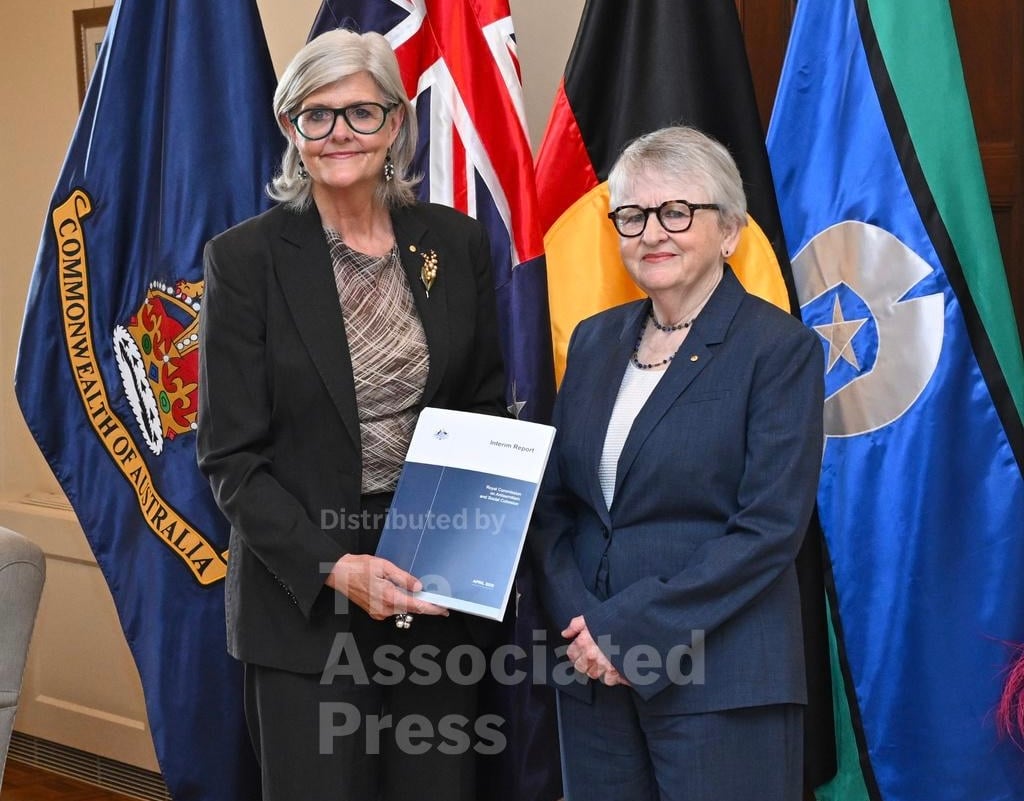
Yesterday, the Australian Royal Commission into Antisemitism and Social Cohesion (ASCRC) handed down its long-awaited Interim Report. Authored by Commissioner Virginia Bell AC SC, the 200-page document is a document born of rupture. It is the country’s first formal attempt to reckon with the violent shattering of its own national assumption: that Australia was somehow buffered from the darkest impulses and hate from the Old World that most in this community escaped. For a community still in mourning, yet simmering with a demand for accountability, this report is an opening argument – careful, constrained, and, at times, conspicuously incomplete. It offers a roadmap to safety, but for many, it feels like a blueprint for a bunker rather than a cultural autopsy.
The report in full can be seen here: https://asc.royalcommission.gov.au/system/files/2026-04/interim-report-ascrc.pdf

Australian Prime Minister Anthony Albanese holds up the report on Antisemitism and Social Cohesion during a press conference at the Commonwealth Parliamentary Offices in Sydney, Thursday, April 30, 2026. (Dan Himbrechts/AAP Image via AP)
A SHIELD OF GLASS: THE “4 VS. 1,000” SCANDAL
To understand the weight of this document, one must first look at the failures it uncovers. The most gut-wrenching revelation concerns the security arrangements – or lack thereof – on that fateful night in Bondi. The report confirms a detail that had been whispered in grief-stricken circles for months: only four NSW Police officers were assigned to monitor a crowd of 1,000 Jewish Australians celebrating Chanukah, visibly and publicly.
The discrepancy between the known threat environment and the resources deployed is, in hindsight, catastrophic, Commissioner Bell writes.
By August 2024, ASIO had already raised the National Terrorism Threat Level to ‘PROBABLE.’ Yet, when a thousand Jews gathered in a public park, the protection offered was negligible. This was not an absence of intelligence; it was an absence of movement. The report identifies that warnings existed, threat levels were understood, and Jewish events were recognized as vulnerable. But that awareness did not translate into decisive, coordinated action. It is a narrative of “Intelligence that didn’t travel” and information that failed to move fast enough or far enough to change outcomes.
THE FINDINGS: SYSTEMS VS. SOUL
The Commission does not equivocate on one central, uncomfortable point: the problem was not primarily a lack of laws. Australia already possessed the legal tools necessary to prevent and respond to such an attack. If the laws were sufficient, the failure lies in the machinery of the state. Three major themes emerge from the findings:
1. Intelligence Fragmentation: Breakdowns within Joint Counter-Terrorism Teams meant that specific threats were siloed rather than shared.
2. Inconsistent Protection: Security measures routinely deployed for major Jewish holidays were not consistently applied to other high-profile events. The system treated Jewish risk as episodic rather than systemic.
3. Institutional Unpreparedness: Counter-terror frameworks had not kept pace with evolving threats, leaving a gap that was exposed the moment crisis hit. For the Jewish community, this distinction is jarring. We are being told that the system worked on paper, but failed in practice.
The report feels like a forensic audit of a building that has already burned down.

Prime Minister Anthony Albanese has said the commission would focus on four key areas: tackling antisemitism, including its key drivers; assisting agencies to respond to antisemitism; examining the circumstances of the Bondi terror attack; and strengthening social cohesion. Source: AAP / Lukas Coch
EXPECTATIONS VS. REALITY: THE “BUNKER” COMPROMISE
In the aftermath of Bondi, the Jewish community expected a reckoning with the culture of antisemitism. We wanted a direct confrontation with the “anti-Zionist” rhetoric that serves as a mask for Jew-hatred, and a “naming and shaming” of the institutions – from universities to media outlets that sanitized extremist narratives. What we received instead was a high-level security upgrade.
What We Expected vs What Was Delivered
Condemnation of “Anti-Zionist” Antisemitism → A focus on physical infrastructure and “hardening” targets.
Mandates for University expulsions/firings → Vague “Codes of Conduct” for academic freedom.
Direct accountability for Police leadership → A “systems-focused” diagnosis of coordination failures.
A cultural autopsy of Australian Jewry’s safety → 14 technical recommendations for better “machinery.”
This gap between expectation and delivery is not necessarily a failure of the Commission, but a reflection of the legal and procedural reality of an inquiry still in motion and very much in uncharted waters, under intense scrutiny and time frames. However, for those seeking resolution, finding a “framework” instead of “justice” can feel like a hollow victory or not one at all.
THE 14 RECOMMENDATIONS: FIXING THE MACHINERY
The interim report puts forward 14 recommendations, five of which remain classified. The public pillars focus on “fixing the machinery” of the Australian state and include:
1. Consistent Security Protocols: Extending heightened security beyond the High Holy Days to ensure all Jewish public gatherings are protected.
2. The CASHE Bill 2026: Fast-tracking the Countering Antisemitism and Social Hostility Bill, which seeks to criminalize the public promotion of hatred and the display of extremist symbols.
3. National Coordination Overhaul: The potential creation of a permanent National Counter-Terrorism Coordinator to bridge the gap between state and federal agencies.
4. Gun Reform: A renewed call for nationally consistent firearms laws and a buyback scheme, acknowledging the lethal means used in the Bondi attack.
5. Simulation & Preparedness: A striking recommendation that senior political leaders, including the Prime Minister, participate in regular counter-terrorism simulations to ensure preparedness at the highest decision-making levels.
While these measures are immediately actionable, they are, by design, incremental. They improve systems, but they do not yet explain the deeper forces that produced the crisis those systems failed to contain.

FILE – A woman stands at a flower tribute at Bondi Beach on Dec. 16, 2025, following Sunday’s shooting in Sydney, Australia. (AP Photo/Mark Baker, File)
THE “SILENCES” THAT LINGER
If the report is defined by its findings, it is equally defined by its silences. Most notably, it does not yet offer a comprehensive analysis of antisemitism itself as a social force. There is a curious lack of engagement with the surge in incidents following October 7, 2023. There is little exploration of how global conflicts are reshaping local tensions or how the “digital ecosystem” – specifically social media algorithms – is accelerating radicalization in suburban Australia. Furthermore, the report remains quiet on institutional antisemitism. There is no deep dive (just one vague line) into the university system, which many see as the “nursery” for the radicalization that eventually spills onto the streets. There is also a silence regarding the role of the media in framing the Middle East conflict in a way that weaponizes local Jewish identity.
These are not peripheral questions. They are central to the “Social Cohesion” part of the Commission’s mandate, yet they have been largely deferred and seemingly purposefully ambiguous.
ANALYSIS FROM THE FRONT LINES: EXPERT WEIGH-IN
Early analysis from the Jewish community is measured but tinged with an undercurrent of frustration.
Professor Mark Leibler AC, a titan of the Australian Jewish legal community, notes the report’s pragmatic limitations: “The Commission has correctly identified that the state has failed in its primary duty to keep Jewish citizens safe. But the solutions offered are reactive. We are treating the wound without removing the shrapnel”.
Dr. Naomi Zuroff, a sociologist specializing in diaspora studies, is more critical: “The Interim Report treats antisemitism like a misunderstanding that can be solved with a brochure or a better police radio. It isn’t a misunderstanding; it is a motivated, ideological movement. Until the Commission recommends de-funding institutions that provide a platform for this ideology, the tide will not turn.”
Other critics point to the “classified recommendations”. Expressing that while secrecy may protect national security, it also limits public trust. If we cannot know the full extent of the failures or the proposed fixes, how can we truly feel safe?
When asked for his thoughts on the report. Former Chief Justice of New South Wales, The Honorable James Spigelman AC KC, expressed that “calm is needed”. He reiterated the immeasurable pressure and constraints that the commission faces. Instead of delving into the minutia of the report he almost felt them irrelevant to the bigger picture. He explained, that the government and parties mentioned will of course agree to the findings and recommendations but wont truly act upon them until the final report is delivered at the end of the year. With that in mind, he continued – it is best for the community “to stay calm and try to trust the process”. (A far more measured and eloquent response than mine!)

The royal commission will look into drivers of antisemitism in institutions and Australian society in the lead up the Bondi attack and how it’s affected Jewish Australians. Credit: Jacob Chantarat/AAP
THE ROAD AHEAD
This is of course, an Interim Report – a beginning, not an answer. The real test of the Royal Commission’s legacy begins on May 4, when public hearings commence in Sydney. These hearings will bring forward the voices that have been largely absent from the formal record: the victims, the survivors, and the families who lost everything at Archer Park. We will also see the cross-examination of institutional leaders – police brass, vice-chancellors, and bureaucrats – who will hopefully be forced to explain the “mechanics of failure” in the light of day. The final report, due at the end of 2026, is expected to go further and must go further. It must move beyond policing and into education, policy, and culture. It must answer the “Why” that this interim report has deferred.
A Shield Is Not a Strategy
This report matters. It formalizes what many already knew: antisemitism in Australia is no longer marginal – It is a national issue and a security issue – but recognition is not resolution.
What this report offers is a shield:
• Stronger security
• Better coordination
• Improved response
What it does not offer is a strategy to dismantle the ideology driving the threat. And until it does, the question remains: What exactly is Australia prepared to confront – and what is it still afraid to name and uproot? Because a country that cannot define antisemitism clearly cannot defeat it. Building a shield is great…in theory. However, I would point out that their would be no need for such an expansive shield if the attacking weapons were neutralized.
For a community that must live behind reinforced walls we have been forced to accept something we should never have had to:
That safety is no longer assumed…It is negotiated.
Australia has begun its reckoning…But it has not yet found its courage. I sincerely hope in the fullness of time this “lucky country” through this commission find its moral clarity and confronts even the most difficult of questions.

Prince Harry, and Meghan, the Duke and Duchess of Sussex, meet Elon Zizer, Bondi beach terror attack survivor, as they meet volunteer first responders from Bondi Surf Bathers’ Life Saving Club, during a visit to Bondi Beach, Australia, Friday, April 17, 2026. (Jonathan Brady/Pool Photo via AP)