
Laundering dirty money via car sales is favoured by organised crime because the transactions are often so large. Drug money, for example, can be turned into an asset valued at €100,000 or more in single transactions by purchasing a luxury vehicle.
This rarely raises any red flags and the asset can be sold, and turned back into cash, anywhere and at any time.
Using the motor trade in this way is very different from the much cruder “smurfing” and “layering” modus operandi of thousands of others now involved in money laundering in Ireland.
In the Republic at present, cleaning and disguising the origins of criminal money has permeated every type of business imaginable.
“You’re talking about beauty salons, tanning shops, barber shops, dry cleaners, pubs, fast-food restaurants, you name it,” said one Garda source. He added once a business has an inward flow of cash, criminal money can be mixed in and passed off as legitimate trading income.
Money laundering is a lucrative endeavour. A diverse, and growing, cohort of people across the country is involved or currently stands accused.
Dublin Central byelection candidate Gerry Hutch, the veteran criminal known as the Monk, is at the centre of a big money-laundering investigation in Spain.
Others who have recently been charged in court, or been convicted, and in some cases jailed, include those on the breadline and middle-class professionals, Irish citizens and immigrants, teenagers and pensioners.
In 2017, just 53 money-laundering offences were recorded in the Republic’s official crime data. That increased to 996 offences in 2024 before surging to 2,768 such crimes last year. And that’s just the cases we know about.

The Criminal Assets Bureau with the assistance of Garda teams conducting a search operation in March 2019. Photograph: Cab/Facebook
So many of these crimes have been reported to the Garda; they have a backlog of tens of thousands waiting to be opened and examined.
When gardaí began looking into a Co Limerick garage it was already doing €8 million in car sales a year. None of the individuals involved in the motor dealership has been prosecuted through the courts for the criminal offence of money laundering.
The Criminal Assets Bureau (Cab) had gathered intelligence about the Limerick garage and the men behind it. But at some point they needed to burst in and raid the place. That day came seven years ago, though the tail end of this case has only just played out.
On a March morning in 2019, a huge team of gardaí mustered near the premises on the Old Ballysimon Road, on the outskirts of the city, before striking. Members of the Emergency Response Unit, with their firearms drawn, took up position around the perimeter as dawn was breaking.

The Criminal Assets Bureau (Cab) with the assistance of Garda teams conducting a search operation on the Limerick garage in March 2019. Photograph: Cab/Facebook
One of their colleagues used an angle grinder, sparks flying from it, to cut open the locks. The Garda team eventually burst inside, swarming the premises. So many vehicles were seized there – 115 in all – that it made for one of the biggest operations in Cab’s near 30-year history.
The garage was Stephen Bawn Motors Limited and its main shareholder Stephen O’Sullivan, a 43-year-old from Farrehy, Broadford, Co Limerick. He was later charged with paying a Garda member €20,000 for information about the Cab’s investigation into his business. But in February, that case collapsed in court.
[ Money laundering surges to unprecedented levels in RepublicOpens in new window ]
However, the Cab went to the High Court to pursue one of its assets confiscation cases. The vehicles had a combined estimated value of €2 million when seized and the bureau wanted the entire fleet declared the proceeds of crime.
The Cab’s officers contended O’Sullivan and his associates – Mike Nash and Shane Curtin, both from Newcastle West, Co Limerick – “ran this business and were in league with criminals”.
When the men came together in late 2015 to take a lease on the garage, they had been selling cars individually, making less than €25,000 each annually. They weren’t much good at this and had no money to invest in their new venture. They were only ever extended €75,000 in bank loans, a pittance in the motor trade.
Yet in their first financial year trading, they boasted a turnover of €5.3 million, exceeding €8 million the following year. So where did all this money suddenly come from?
“Much of the company’s capital to trade in cars was funded from unknown sources. Proceeds of sale of many cars sold by the company disappeared,” the High Court concluded in ruling almost all of the seized cars were the proceeds of crime.

Stephen O’Sullivan was charged with paying a Garda member €20,000 for information about the Cab’s investigation into his business. But in February, the case collapsed in court. Photograph: Collins Courts
It found the garage “was an engine of fraud, fuelled by money laundering”. It wasn’t a good business gone bad, it was bad from the start. Its apparent success as a genuine motor trade company was “illusory”.
In the first year of trading alone, the business made cash purchases of vehicles to the tune of €946,921. The origins of that money were unknown and remain unexplained. In that first year, withdrawals reached €879,523, some €459,432 of it in cash.
Curtin and Nash were suspected of having control of the business, especially Nash, and both were linked to drug trafficking in Cab’s evidence to the High Court. Another man – John O’Donoghue from Rathkeale, Co Limerick – was also alleged to be involved in running the garage.
Cab told the court O’Donoghue had links to the Keane drugs gang in Limerick and the Kinahan cartel. Meanwhile, Curtin was linked – through an unnamed associate – to the McCarthy-Dundon gang.
The Keanes and the McCarthy-Dundons are the biggest drugs gangs in Limerick. They are bitter enemies and once engaged in a decade-long feud, to 2010, linked to as many as 20 murders. There is no suggestion whatsoever that any of the men linked to the garage were involved in that feud.
Most of the members of both gangs live in council houses on Limerick’s most impoverished estates. Yet these rival groupings were linked to the same money laundering operation with an €8 million annual turnover.
Criminal money from Ireland was being used to buy cars in Britain, via shady collaborators there working as car dealers. The vehicles were then imported into Ireland, where they were sold and the proceeds withdrawn from Bawn Motors.
And that’s perhaps what most people envisage when they think of money laundering. Dirty money, generated from crime, going into a business – often by sleight of hand – and coming out the other end clean; at least purporting to be clean.
But the reality is often quite different as even some street drug dealers are now refusing to take cash and insist on electronic payments, with knock-on implications for money laundering.
The Central Bank defines money laundering as “the process by which the proceeds of crime are processed – ‘washed’ – through the financial system in an effort to disguise their illegal origin”. It says the process typically involves three stages; placement, layering and integration.
Placement is when “the cash proceeds of criminal activity enter into the financial system”. Layering involves the movement of money – often multiple times, including via another jurisdiction. This creates “layers of financial transactions to thwart the audit trail so as to cut the link with the original crime”.
The final stage is “integration” – the reintroduction of previously tainted money into the legitimate economy – so it “does not draw casting eyes to its origins” and “gives off an appearance of legitimacy”.
The Central Bank stresses all three stages do not have to be present in order for money laundering to occur. Crucially, it says any stage in isolation represents money laundering.
[ Why is money laundering on the rise in Ireland?Opens in new window ]
Gardaí and legal sources point out that means the simple movement of criminal funds in a bid to distance it from its true origins is a money laundering offence. Even moving a very modest sum derived from crime, and doing that just once, constitutes money laundering.
Under the Criminal Justice (Money Laundering and Terrorist Financing) Act 2010, people can be charged with money laundering even if a predicate offence – the crime that generated the money – is unproven or unidentified.
Furthermore, gardaí do not even have to prove a suspect knew the money they were moving derived from crime. Instead, if the suspect was “reckless as to whether or not” the money was the proceeds of crime they are, under law, “presumed” to have known.
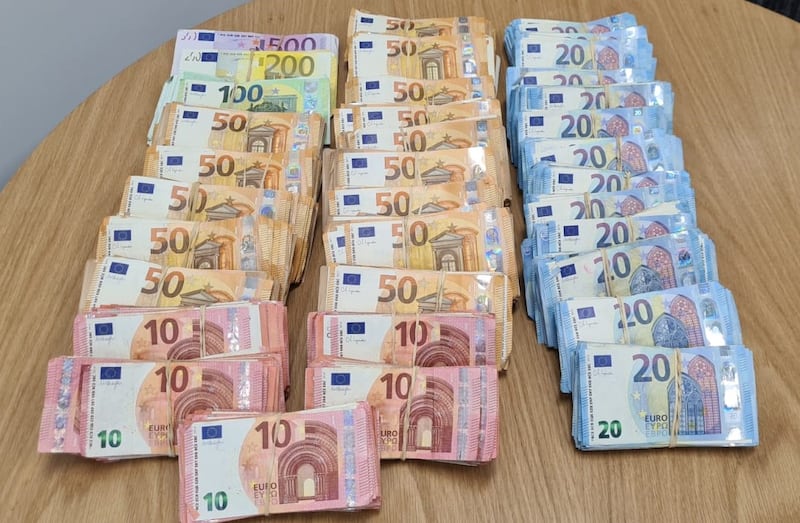
Cash seized during searches across Dublin and Meath by the Criminal Assets Bureau. Photograph: Cab/Facebook
In past eras, most crimes generated hard cash; bank robberies, drug crime, selling stolen property. That cash had to be mixed with the legitimate cash income of businesses for the purposes of laundering it.
However, the face of crime has changed, with a lot of offending now taking place online. And that has fundamentally changed money laundering. Oftentimes in Ireland, laundering is not the process of washing dirty money to make it clean. It is simply moving the money about in online account transfers to distance it from its true origin.
Europol’s latest EU Serious and Organised Crime Threat Assessment said “the internet has become the primary theatre for organised crime”. As technology has evolved and proliferated – smartphones, internet banking, online retailing, online bill payment, online investing and cryptocurrency – new opportunities have been created to perpetrate thefts, scams and frauds.
This includes scams conducted via bogus texts, calls and emails which became so common in Ireland during the pandemic years and have endured. These are often designed to trick victims into sharing codes required to access their online bank accounts, so their money can be stolen.
The proceeds of those online bank account robberies must be moved electronically, into accounts controlled by the fraudsters. And every single transfer is a money laundering crime.
Other forms of online crimes include exploiting vulnerable people – often older women using dating apps – in romance frauds; tricking these women into paying over sums of money to fraudsters posing as romantic interests online.
Gardaí said perhaps the fastest growing online crime type is investment fraud. Victims are duped online into “buying” non-existent cryptocurrency or bogus stocks and shares via fake trading platforms. These platforms are created by the criminals and are usually sophisticated and very convincing.
All of these offences – collectively known as cyber-enabled crime – have one thing in common. The money is always being stolen online; electronically accessed by the fraudsters or transferred by the victims on the internet.
And that means the perpetrators constantly need access to accounts in other people’s names to take receipt of the initial sum stolen or scammed. Then, they need many more accounts to disperse that money quickly in a bid to conceal its origins. This dispersal is a form of “layering”, also known as “smurfing”.
The people recruited into allowing their accounts be used for this purpose, usually on the promise of a commission fee, are known as “money mules”.

Garda Commissioner Justin Kelly says the rise in money laundering in Ireland is ‘obviously concerning’. Photograph: Stephen Collins/Collins Photos
This week Garda Commissioner Justin Kelly told The Irish Times the increase in money-laundering crimes in the Republic, especially last year’s surge, was “obviously concerning”.
Specialist training had been extended to gardaí in a bid to identify and combat laundering as part of organised crime, with prosecutions arising. But laundering could also be linked to terrorist financing, he said.
“We’ve had success with prosecutions on both sides and we’ve seen actors here trying to support terrorist organisations through finance raising. We’ve conducted extensive investigations [into money laundering] but obviously we are concerned about the rise in it.”
Det Supt Micheal Cryan of the Garda National Economic Crime Bureau (GNECB), the specialist unit that investigates money laundering, has repeatedly warned of an “explosion” in the recruitment of money mules. This gained pace in Ireland during the pandemic years as online scams took off.
He said young people getting involved need to be aware once their accounts were used as mule accounts, it left an easily discoverable trail. This could lead to prosecution, with the risk of imprisonment, and even being placed on a terrorist watch list.
The Black Axe gang has come to dominate the cyber-enabled crime space in Ireland. It originally began in Nigeria but has an active cell in Ireland, with a five-tier structure.
That includes recruiters, who focus exclusively on convincing people to allow their accounts to be used for transactions. Students are often approached on campuses, or at parties, on the promise of a fee.
The Black Axe, the biggest fraud gang in Ireland, is suspected of stealing or laundering up to €100 million since 2020. In 2024 alone, the value of the main cyber-enabled fraud types, committed by a variety of criminals and gangs, reported to the Garda exceeded €80 million.
Gardaí have arrested close to 700 suspects during investigations into Black Axe activities; over 100 management figures and almost 600 mules.
“The money mule will usually do one of three things after the money is moved into their account,” said a detective.
“The mule will withdraw it in cash, or the criminal withdraws it in cash if they have the mule’s bank card. The mule can also transfer the money into another account. Then the third option is buying high value goods with the money, which are then handed over to the criminal.”
He added, more recently, a fourth money mule action had been detected; the transferring of the stolen funds into cryptocurrency. The Black Axe’s operations have been so extensive, the network of mule accounts used so vast, it is a key reason for the increase in money laundering crimes recorded by the Garda in recent years.

Gardaí recovered a number of clothing items which are believed to denote affiliation, rank and loyalty in the Black Axe organized crime group. Photograph: An Garda Síochána
A total of 27 Black Axe members have been prosecuted for gangland offences, meaning they had management roles in the gang. The Garda’s Operation Skein, focused on the Black Axe gang, is led by Cryan of the GNECB.
Last month, Ejike Francis Ogubefi (42), Clonard Road, Crumlin, Dublin 12 and Steven Silvester (32), The Paddocks, Morristown, Newbridge, Co Kildare, became the first Black Axe senior managers convicted for directing organised crime. They were also convicted of money laundering, after being linked to €6 million in stolen and laundered money, and jailed for nine and seven years.
While about 1,500 money mules linked to the Black Axe gang have been identified in Ireland, gardaí believe the true number is more likely above 10,000, maybe well above. And gardaí are now seeing Black Axe tactics seeping into other crime types.
“The money mules are not just being used for the cyber-enabled crimes, we’re seeing it in drugs crime now,” said a source of street-level dealers selling to drug users. “These guys won’t take cash off you. They’ll tell you to Revolut the money to an account. But it’ll be an account in someone else’s name that they have control over.
“They don’t want to be handling cash because if they’re caught by the guards, a few grand in cash in their pockets would be taken off them. And they don’t want it going through their own accounts.”
Experienced officers also point out there has been a cultural shift in the way the criminal justice system – mainly the Director of Public Prosecutions (DPP) office and the Garda – now treats money laundering.
As online crime has exploded, the electronic bank transfers needed to facilitate it have come sharply into focus. The DPP is now treating each transfer as a money laundering offence.
In what Garda sources say is a new departure, the DPP’s office is now much more willing, indeed very keen, to prosecute those involved. And that includes people with no previous convictions and who may have agreed to allow their accounts be used for one transaction.
Another Garda source believed the hand of the DPP and Garda had been forced by changes in crime trends. He believed the explosion in the number of electronic movements of criminal money, and the sums involved, left the criminal justice system with no choice but to “recalibrate” its approach.
Because the DPP had changed its posture, gardaí – in stations across the country and in specialist units – were now more willing to invest time investigating those cases, Garda sources said.
At the same time, financial institutions, at the Garda’s insistence, have finally begun to report to gardaí more of the money laundering crimes they are detecting.
Garda Headquarters also pointed out that many gardaí are now “trained on an annual basis in the process of identifying and investigating incidents of money laundering”. Gardaí were also “actively encouraged to consider the financial flows behind every investigation and to ‘follow the money’”.
This, it said, had contributed to the greater number of money laundering offences being discovered and recorded for investigation.
[ Money laundering in Ireland: Can Gardaí cope?Opens in new window ]
“In the past, if guards on a drugs raid found a kilo of heroin and, say, €40,000 in cash, the suspect would be charged over the drugs. The money would be confiscated, but it wouldn’t lead to a charge,” said one source. “But now he’d be charged over the drugs and he’d be charged with money laundering over the cash.”
Others agreed the same change was under way with online transactions. Previously, an irregular or unexplained transfer of funds, especially a small amount, would have been regarded as an indicator of a predicate crime.
It would have effectively been treated as intelligence pointing towards another, more serious offence. But now it is being treated as a stand-alone money laundering offence. And the DPP is also getting creative.
Last October, Richard Treacy (37), who was involved in gang feuding in Limerick, was jailed by the Special Criminal Court for two years and eight months. He had pleaded guilty to money laundering by spending €100,000, the proceeds of crime, on “grandiose” renovations at his home on Downey Street, Garryowen in Limerick. He did this while he had no legitimate income and no work history.
“The DPP’s office has really changed their view on money laundering, mainly driven by us [the Garda],” said one source of prosecutions like Treacy’s, which would never have been even considered until relatively recently.
The source said the previously a lack of understanding across the criminal justice system about what was required to prosecute for money laundering.
“It was believed the suspect had to physically have the money and the predicate offence had to be proven, things like that.
“But really, it’s a very straightforward thing. You have money, or you had control if it at some point, and you can’t explain where it came from. It’s as simple as that. If you move criminal money or you convert it into any other asset, that’s money laundering.”
In reply to queries, the DPP said its “approach to decision-making for all offences has not changed”. Its decisions around prosecuting a case, or not, were based on whether the evidence was strong enough and whether bringing a case to court was in the public interest.
It added “any increase in money laundering prosecutions may be driven by a range of factors”. This included “greater societal awareness of money laundering, leading to greater detection and investigation of these offences”.
It also included “ongoing close co-operation and collaboration across the criminal justice system, including investigation agencies” as well as “training and support” for key personnel dealing with such cases.