

One of the workers’ protests in Venezuela was met with heavy police repression. Photo by Daniel Echeverría, 2026. Used with permission.
From Caracas to Santiago, workers filled the streets this May Day to demand higher wages, safer conditions and political accountability amid economic uncertainty across Latin America. Demonstrations in Venezuela, Chile, Cuba, Mexico, Colombia and Ecuador reflected both shared frustrations and distinct national crises, with unions, students and grassroots movements rallying against inequality and government inaction.
In some countries, marches remained peaceful celebrations of labor solidarity; in others, protesters clashed with police as tensions over inflation, repression and social rights intensified. Together, the region’s May Day mobilizations underscored the enduring power of organized labor and the urgency of economic justice.
Venezuela: A difficult minimum wage
More than 2,000 workers took to the streets of Caracas on April 30 and May 1, protesting a recently announced wage increase they called insufficient and misleading. On April 30, the protest was met with police repression against workers, guilds and collectives.
The government raised the so-called “comprehensive minimum income” from USD 190 to 240 per month, but the increase is largely based on bonuses rather than a real salary adjustment. Because these bonuses do not count toward pensions or other benefits, protesters argue the measure does little to improve long-term economic security. Chanting “a bonus is not a salary,” workers marched through the city as police blocked some roads without clashes.
The protests reflect broader frustration with Venezuela’s economic crisis, where the official minimum wage has remained frozen since 2022, and is currently valued at around USD 0.30 per month amid high inflation. Many say the new income still falls far short of basic needs, with a family food basket estimated at about USD 700 monthly.
Union leaders denounce the policy as deceptive, arguing workers are bearing the burden of a crisis they did not create. Demonstrations have spread beyond Caracas, and women have played a key role, highlighting how feminized sectors like caregiving remain excluded from labor discussions.
Cuba: Co-opted workers’ rights
May Day in Cuba occurs at a moment of extreme strain and uncertainty. Cubans face a severe economic, political, and social crisis driven by an authoritarian communist regime that resists structural change. At the same time, statements from figures like President Donald Trump and other senior U.S. officials have fueled talk of a possible American intervention. The atmosphere feels tense, layered with both internal hardship and external pressure.
Yet, May 1 has never been an ordinary day on the island. In many countries, it offers workers a chance to raise demands and spotlight their needs; in Cuba, it has long served the government as a way to project strength and popular support. For decades, large-scale marches have followed the same script. Weeks in advance, workplaces plan mandatory attendance. On the eve of the march, people stay awake through the night, waiting to be transported by buses to Havana’s Revolution Square — the symbolic heart of political power. There, crowds exceeding a million people march for five hours under the watchful gaze of the country’s elite.
But that era has faded, and participation has dropped sharply. The ongoing crisis, combined with public disillusionment, has weakened the pull of these mobilizations. For many, the pressure to attend — whether through fear of losing a job or part of a USD 15 monthly salary — no longer carries the same weight. In response, the government has moved the event to a smaller location near the U.S. Embassy. The scale has changed, but the intent remains: to preserve the image of unity, even as the reality on the ground grows more complex.
Chile: Workers vs. neoliberal public policies
For an inattentive observer, this May Day was like any other in recent Chilean history. Workers demonstrated peacefully in the country’s main cities, social media spread messages about wage justice, and Avenida Libertador Bernardo O’Higgins, Santiago’s most important thoroughfare, was the setting for a customary march led by the Central Unitaria de Trabajadores (CUT), joined by the Central Autónoma de Trabajadores (CAT) and the Central Clasista de Trabajadores y Trabajadoras.
But something changed radically in recent months. The government of José Antonio Kast, who assumed the presidency on March 11, is pushing forward a series of controversial measures in the management of the state, including fiscal cuts in education, a minimum wage adjustment, and a National Reconstruction Plan that, with the aim of encouraging private investment, pursues a gradual reduction of the corporate tax rate from 27 to 23 percent.
The May Day marches are considered part of a nascent protest movement against Kast, a far-right leader who won the December 2025 presidential election by a wide margin. “It is a democratic government; more than seven million workers voted for them,” acknowledged José Manuel Díaz, president of the CUT. “We have to go after those votes, raise awareness among them, talk to them.”
Colombia: Decent work, not precarious jobs
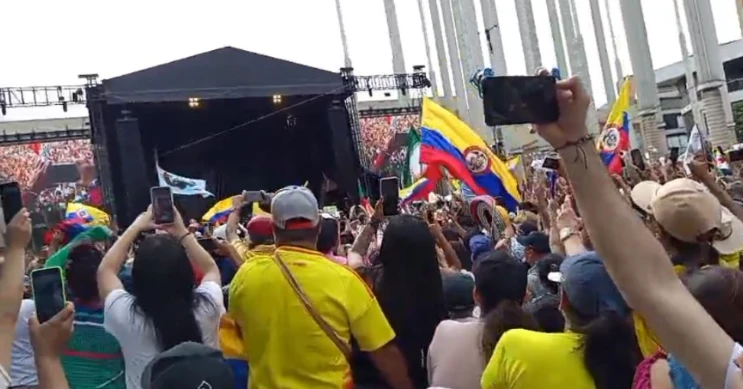
Photo of the gathering in Medellín, Colombia. By Simón Cabrera for Global Voices. Used with permission.
May Day 2026 in Colombia became a key political test ahead of the presidential elections later this month. The day broke with tradition when President Gustavo Petro moved his main speech to Medellín, the country’s strongest opposition stronghold and home to many of his fiercest critics.
Speaking after the marches before large crowds that enthusiastically supported him, Petro used the public gathering to promote a campaign for a National Constituent Assembly, aiming to bypass congressional resistance to his proposed reforms. His appearance heightened tensions with local authorities and intensified national political debate.
Across Colombia’s major cities, the government sought to demonstrate its mobilizing power while opposition groups dominated social media and news coverage with criticism of Petro’s constitutional proposal.
Labor unions backed the historic increase of the minimum wage to 2 million Colombian pesos (approximately USD 533), while continuing to demand an end to precarious work conditions and full overtime compensation. Women’s organizations called for recognition of unpaid care work, pensioners defended the “Solidarity Pillar,” and Indigenous and campesino communities denounced violence from armed groups and demanded access to fertile land.
Despite its electoral undertones, the day preserved its traditional spirit, with unions, rural communities, Indigenous groups, and social movements leading massive demonstrations nationwide.
México: More humanity, less World Cup
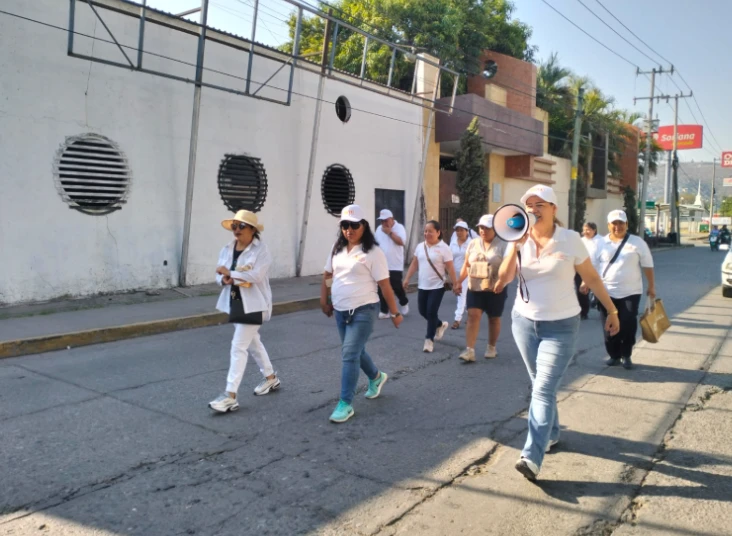
Sindicate leaders from Iguala, Mexico, 2026. Photo by Karla Ivette Méndez used with permission.
In Mexico, thousands of workers protested across multiple states amid a climate shaped by labor reforms and longstanding grievances. Although the government has introduced significant measures (including raising the minimum wage, gradually reducing the workweek, and implementing the “Chair Law” aimed at improving workplace conditions), many Mexicans argue that these changes still fall short of truly dignifying labor.
The marches reflected that tension. Under the slogan “More Humanity, Less World Cup,” education workers protested unpaid wages, excessive taxation, and reforms they say seriously threaten pensions, retirement security, and access to healthcare. Healthcare workers also joined the demonstrations, denouncing severe medication shortages and staffing deficits.
What distinguished the 2026 protests was the visible leadership of women from regions considered high-risk. In Iguala, Guerrero — a city operating under active Violet Alert and Gender Violence Alert protocols — unionized female teachers mobilized to demand respect for their labor rights and an end to the constant harassment, mistreatment, and discrimination they say they face from the director of their workplace.
Their protest highlighted that while labor rights may be advancing on paper, structural abuse, especially against women and in vulnerable territories, remains an unresolved reality.
Ecuador: The impact of violence in workers’ lives

The flag featuring the skull wearing a hat became a symbol of rebellion, resistance, and freedom during the 2025 protests in Nepal. In Ecuador, the same symbol appeared during the May 1 march as a reference to respecting the Constitution, which does not allow electoral processes to be advanced at the will of the Executive. The photo on the right reads: “Our homeland needs us united. Out with Noboa”. Photo by Gina Yauri for Global Voices.
In Quito, Ecuador’s capital, May Day brought together thousands of people who flooded Avenida 10 de Agosto in a march stretching more than one kilometer. Labor unions, social and environmental organizations, anti-mining groups, women’s collectives, artists, youth movements, LGBTQ+ communities, and other citizens joined together in a powerful demonstration against worsening labor precarity and the declining living conditions faced by much of the population.
Under the chant “Noboa out, out,” protesters expressed their rejection of the rising cost of living caused by the increase of the value-added tax (VAT) from 12 to 15 percent, as well as escalating violence and insecurity, insufficient investment in healthcare and education, and the sudden dismissal of doctors, teachers, and public servants. Demonstrators also denounced what they described as growing signs of authoritarianism, which are preventing the state from functioning effectively.
The organized groups that marched in Quito on May 1 made clear that protecting existing rights — and preventing further deterioration — depends on political change and the end of a government they believe continues to act against the interests of ordinary people.