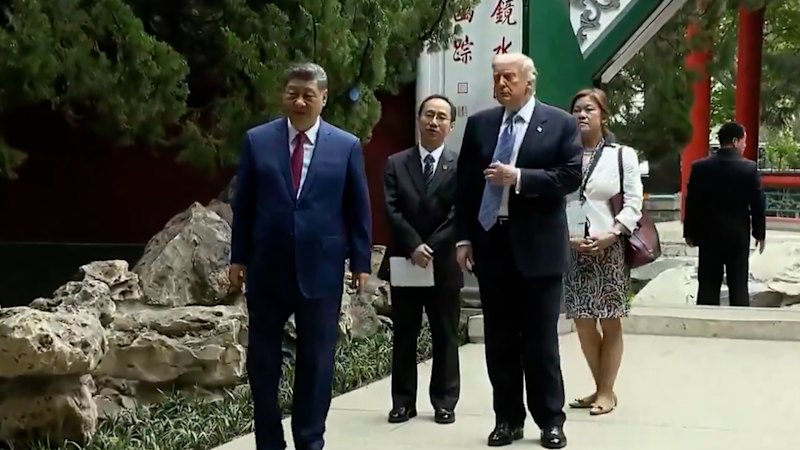
United States President Donald Trump arrived in Beijing this week harboring ambitions of leveraging a decisive victory in the Middle East to extract massive economic concessions from China. However, according to deep geopolitical analysis and prominent financial commentators, the reality of a stalled, intractable war with Iran has fundamentally altered the diplomatic calculus. Instead of entering the Great Hall of the People as an undisputed global peacemaker, Trump faces a complex negotiation where the ongoing blockade of the Strait of Hormuz serves as both a weapon and a liability.
The intricate dance between the world’s two largest economies is currently overshadowed by the smoke rising from the Persian Gulf. The 73-day conflict, initiated by a series of aggressive strikes by the United States and Israel against Iranian assets, was intended to force Tehran into immediate submission regarding its nuclear program. Instead, the resulting war of attrition has triggered a global energy crisis, proving yet again that military interventions in the Middle East rarely adhere to political timetables.
The Illusion of Rapid Victory
Analysts monitoring the situation, including leading voices on Bloomberg’s global network, note that the Trump administration deeply underestimated Iranian resilience. The president had reportedly hoped to utilize a pacified, compliant Iran as a primary bargaining chip against Chinese leader Xi Jinping. China relies heavily on deeply discounted Iranian crude oil to fuel its massive manufacturing sector. By cutting off that supply and then offering to restore it under American terms, Trump sought absolute leverage.
However, the ceasefire brokered weeks ago is now officially on life support. Tehran recently submitted a multi-page peace proposal that Washington immediately rejected, citing a complete lack of concessions regarding uranium enrichment. Trump’s subsequent threats to unleash total military destruction upon Iran indicate a profound frustration with the diplomatic stalemate. The failure to secure a rapid capitulation means the global oil market remains entirely captive to the whims of the conflict.
The Economic Chokepoint
The true battlefield is no longer just the skies over Tehran, but the shipping lanes of the Strait of Hormuz. The blockade tactics employed in the region have effectively paralyzed international maritime trade. The economic fallout is captured in several stark metrics:
Kharg Island Shutdown: Satellite intelligence reveals that Iran’s primary oil export terminal has seen zero vessel traffic for weeks, forcing the nation to stockpile crude in rapidly filling land-based facilities.Chinese Strategic Reserves: Deprived of cheap Iranian oil, Beijing has been forced to tap into its strategic reserves, making Xi Jinping highly motivated to see the shipping lanes reopened immediately.Global Inflationary Pressure: The artificial constriction of the oil supply is driving up transport and manufacturing costs globally, threatening post-pandemic economic recoveries in vulnerable emerging markets from South America to East Africa.Secondary Sanctions: The United States Treasury has aggressively targeted Chinese logistics and technology firms attempting to circumvent the blockade, adding another layer of friction to the Beijing summit.Xi Jinping’s Strategic Patience
While Trump requires a rapid foreign policy triumph ahead of looming domestic political battles, Xi Jinping appears willing to play a longer game. Chinese diplomats are privately urging de-escalation while quietly ensuring that the Iranian regime does not collapse entirely. For Beijing, a sovereign Iran serves as a vital strategic counterweight to American dominance in the region. If Trump completely decimates the Iranian military infrastructure, China loses a crucial geopolitical asset.
Experts warn that Xi may use the summit to offer superficial trade concessions in exchange for a United States commitment to dial back the military aggression in the Gulf. The Chinese leadership understands that the longer the Strait of Hormuz remains contested, the more the American military is bogged down in a regional quagmire, detracting from its strategic pivot toward the Indo-Pacific.
A Dangerous Game of Brinkmanship
The narrative of an imminent American victory has evaporated, replaced by the grim reality of a protracted economic siege. President Trump must now navigate a highly volatile environment where a single miscalculation by naval forces in the Persian Gulf could ignite a regional conflagration that no superpower can control.
As negotiations continue behind closed doors in Beijing, the global economy holds its collective breath. The illusion that military dominance directly translates to diplomatic leverage has been severely tested. What emerges from the Trump-Xi summit will likely dictate the price of energy, the stability of the Middle East, and the hierarchy of the global order for the remainder of the decade.