
Bernice Mendez was brought to the United States from Mexico as a toddler. She always celebrated July 4 for the opportunities she’d found in her adopted home.
But Mendez felt wary as the holiday approached this year.
Her prospects in this country had broadened under temporary protections granted to undocumented immigrants who arrived in the U.S. as minors, which allowed her to work and gave her temporary relief from deportation.
But efforts to weaken the program have worried Mendez.
“I feel uneasy,” she said of her complicated feelings about the country’s 250th birthday.
Mendez is one of millions of immigrants who have made the United States home since its founding on July 4, 1776, seeking promises of freedom, work and economic stability, education and safety, and whose experiences and contributions are woven into the historical, cultural and political fabric of the country.
But the landmark semiquincentennial comes at a time of deep discord in America. The White House seeks to reshape who should be included and excluded from this giant melting pot, pushing to restrict immigration and carry out a sweeping domestic enforcement crackdown that has sent ripples through immigrant communities.
“With everything the current administration is doing, instead of uniting our nation, they are dividing everybody,” Mendez said.
Kaleb Asfaha, a naturalized citizen who immigrated from Ethiopia as a child, still believes the American dream is alive.
“It’s not perfect, but everybody has these opportunities in the U.S. that aren’t available anywhere else in the world. I can truly say that,” he said.
The Press Democrat spoke to members of Sonoma County’s diverse immigrant communities and those who work to advocate for them about their experience in the United States and how they’re marking the occasion.
Berenice Mendez: ‘Where do I fit in?’
Mendez, who immigrated from Guadalajara, Mexico, at 2 years old with her parents, lost her job in April after her status as a beneficiary of the Deferred Action for Childhood Arrivals policy, or DACA, lapsed, despite filing renewal paperwork within the timeframe suggested by the government.
Though she had been proud to contribute to her community legally after being granted temporary protections under the Obama-era policy, the recent setback upended her life.
To Mendez, 28, the delay felt like a targeted effort by the current administration to jeopardize the status of the roughly half-million people in the country just like her.
The Rohnert Park resident no longer feels welcome in the country she considers home. Despite DACA recipients earning degrees, joining the workforce, and paying taxes, the government does not treat them with the respect any member of society deserves, she said.
“By delaying our renewals, they are making us leave work and making us lose income,” she said. “It’s a way of saying, ‘We don’t care about DACA recipients.’”
 Berenice Mendez holds her certificate during the graduation ceremony for Cohort 1 of Los Cien’s BRIDGE program in Santa Rosa on June 12, 2025. The program aims to increase diversity on nonprofit boards and government commissions throughout Sonoma County. (Courtesy Berenice Mendez)
According to the Justice Action Center (JAC), a Los Angeles-based legal advocacy nonprofit, DACA recipients have reported dramatic slowdowns in renewal processing times for several months. Despite submitting applications on time, many have been left unable to work and vulnerable to deportation.
On June 25, JAC filed a lawsuit against the U.S. Department of Homeland Security on behalf of Bay Area immigrant rights organizations over the mounting delays in renewal applications, which beneficiaries must submit every two years.
Mendez said after a frightening period of uncertainty, she finally received her renewal and was able to return to work in June as a case manager and mental health advocate for Marin County’s Department of Health and Human Services. However, she remains deeply concerned about other program beneficiaries — especially single parents or those who rely solely on themselves — who are losing their work authorization and deportation protections because of these processing backlogs.
Mendez, a graduate of Sonoma Valley High School, does not see America’s 250th birthday as an occasion to celebrate its reputation as a land of opportunity and refuge for immigrants.
“I honestly feel the country doesn’t uphold those values right now,” she said. “When I was a young child, my parents were more hopeful for opportunities, for advancement, to accomplish the American dream.”
Mendez, who earned a bachelor’s degree from Sacramento State University, said that not having a direct legal pathway to citizenship makes her feel like she’s “not really from here, nor from there.”
“So, where do I fit in?”
Anna Rosen: ‘Everyone is trying to help’
Anna Rosen fled her home country of Ukraine with her teenage daughter after the full-scale Russian invasion began in February 2022.
Rosen arrived in San Francisco six months later through Uniting for Ukraine, a federal program that helped families escape a war that has left a civilian death toll of at least 16,000, according to United Nations estimates.
Rosen, 37, is deeply grateful to the United States and the host family that took her and Yeva, 16, into their Santa Rosa home.
 Anna Rosen and her daughter, Yeva, in Sausalito California, in February, 2024. (Courtesy Anna Rosen)
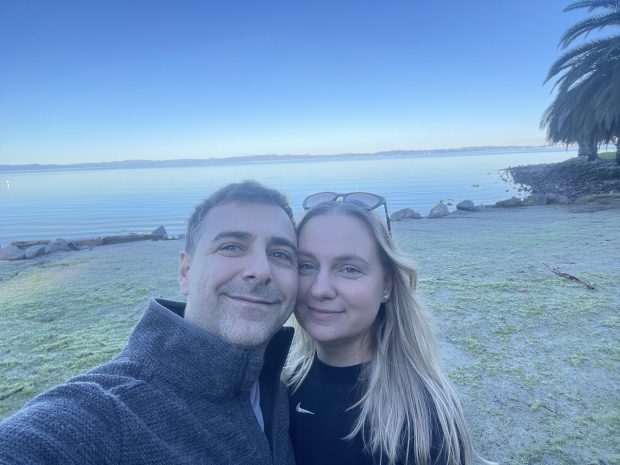 Anna Rosen and her husband, Aaron Rosen, in San Raphael, California, in January, 2025. (Courtesy Anna Rosen)
“I appreciate the opportunity to work, to meet new people,” she said. “The same with my daughter. I’m really happy that she is a part of the community, that she is doing really great at high school.”
Rosen later met her husband, a California native, and sees the United States as a true country of immigrants. For her, it offers a level of equal opportunity she feels is missing back home.
“It’s not how it works in my country,” she said. “And people are super-friendly here; everyone is trying to help.”
She knows her experience isn’t universal, pointing to other Ukrainian refugees who are struggling to navigate the immigration system.
Through connecting with the local Ukrainian diaspora in Sonoma County and across California, Rosen has met many who fled the war but face widespread delays in obtaining or renewing their work permits.
“There’s no way for us to leave,” she said. “It would be nice if the government figured things out for them.”
She said several acquaintances have already abandoned their lives in the United States, moving back to Europe to seek humanitarian relief in places where they can legally work and support themselves immediately.
“It is very difficult,” she said. “They are ready to work.”
Rosen’s mother and other family members remain in Ukraine. She feels discouraged that there is no clear path to end the war initiated by Russian President Vladimir Putin.
“I think it’s going to last for a while,” she added. “It’s just like a big political game.”
Now working as a compliance analyst, Rosen finds hope in the country that welcomed her. Even though she has only been here for four years, the United States’ 250th anniversary is deeply significant to her because she knows what it means to the community she now belongs to.
This July Fourth, she is excited to celebrate with her husband and daughter by watching the historic fireworks display launched directly from the towers of the Golden Gate Bridge. Local officials have highlighted the rarity of the spectacle, as San Francisco traditionally sets off its pyrotechnics from waterfront barges.
“Things are really good for us and I’m really grateful for that,” she said.
Carlos Mayerstein: ‘Spanish has turned into a language of resistance’
For Carlos Mayerstein, a Spanish teacher and Mexican immigrant who owns a local language academy, this year’s July Fourth celebration brings deep reflection. To him, the traditional idea of the American melting pot feels like a myth. As the nation marks its 250th birthday, he views the milestone as a critical turning point.
“The U.S. is going through a rough patch right now,” he said. “Many do not feel welcome. I only hope these myths help it regain energy and keep moving forward. That’s part of the challenge.”
Mayerstein, 46, of Santa Rosa, said the concept of the United States as a nation of immigrants and a sanctuary for those fleeing their home countries does not exist at this moment.
“(The government is) actively investing against it,” he said. “It’s actively regressing.”
Mayerstein’s academic program at California Bilingüe includes heritage learners; those who identify as Latino but aren’t fluent in Spanish. While he considers California to be almost a bilingual state, he notes the language faces deep historical and modern challenges. As when past generations were forced to assimilate and hide their roots, in today’s environment some people are concerned speaking Spanish publicly can trigger immigration enforcement activity.
According to U.S. Census data, Spanish is the second-most spoken language in California after English, accounting for roughly 27% of the population in 2021.
“Spanish has turned into a language of resistance,” he said. “And other minority languages. It is an act of resistance to speak another language.”
Mayerstein said the imposition of a language can become a hurdle for immigrants who wish to learn English while juggling two or three jobs. He added that many immigrants couldn’t go to school in their home countries because of poverty or they were fleeing violence. So beyond learning English, newcomers also need technological tools, guidance on how to learn, and the time to practice.
Mayerstein, who recognized his own U.S. immigration process 17 years ago was privileged in comparison to millions of others, said people in a position to fight for civil rights must stay committed.
“All democracies require work,” he said. “Even with a regression, we have to keep going.”
For him, the nation’s founding myths can create cohesion and motivation as the country celebrates 250 years of U.S. independence — but he believes it’s equally important to remain realistic.
“It’s a bit dangerous to fetishize the concepts of freedom, opportunity, and the American dream,” he said. “They aren’t that clear-cut.”
Mayerstein is married to a Northern California native, with whom he has a daughter and another child on the way. He said it’s crucial as a family man and in his role as an educator to help build a stronger community through better relationships.
“We need more empathy,” he said. “We must learn how to smooth over our rough edges. That is part of language.”
Jose and Luz: ‘We are just happy to be here’
“Jose” and “Luz,” who used aliases for this interview out of fear of immigration retaliation, said they prefer living in Sonoma County to their home countries because they have found peace with their modest resources.
Though they didn’t know each other at the time, both arrived in the United States in 2005. Jose arrived in Merced to work in the fields, while Luz took a factory job in Los Angeles.
Jose, 62, left his small town of San Lorenzo Texmelucan in Oaxaca to pick almonds, apricots, peaches, and apples in the Central Valley. He works with the same contractor who hired him in Merced over 20 years ago, but he now spends longer periods of time in Cloverdale with Luz, his life partner.
“They say that here in the United States money grows on trees,” Jose said. “But the truth is, earning money here is very hard work.”
Luz, 63, is from Guatemala. After leaving Los Angeles, she moved to Fresno and eventually to Cloverdale to find steady work. Over a decade ago, she was incapacitated by an accident when she fell from a 12-foot ladder while picking oranges. Her vision was severely affected.
“I partially recovered for a while,” she said. “But five years ago my eyes worsened and I couldn’t go back to work.”
Both said they keep a low profile to avoid deportation, though they insist they don’t live in fear.
“We only go out to the doctor or for groceries,” Jose said. “We live peacefully.”
Well aware of the upcoming U.S. 250th anniversary, they won’t be going out to celebrate, despite their appreciation and respect for the U.S. and the people who have helped them. Local nonprofit La Familia Sana made the arrangements that allowed them to find affordable housing in the community.
“We are just happy to be here,” Luz said.
Allen Nishikawa: ‘What gives me hope is the people’
When Allen Nishikawa, 72, thinks of the country’s 250th birthday, he considers the 52-word preamble to the Constitution that speaks to the aspirations of the founding fathers.
The goals of creating a system of fairness and equity, social harmony and general wellbeing has drawn people to the United States for generations, but creating a perfect union remains a work in progress, he said.
“Our history has been one of advancements and setbacks,” he said. “Sometimes things can be going very well and other times things seem to be going backward and, for me, that is something that personally I really feel right now.”
 Allen Nishikawa is a third generation Japanese American. Nishikawa is part of a task force with Asian American Pacific Islander Coalition that works with various Asian immigrant communities in the North Bay, helping connect them to services and aid. Photo taken at Juilliard Park in Santa Rosa on Tuesday, June 30, 2026. (Christopher Chung/The Press Democrat)
The third-generation Japanese American, or sansei, drew comparisons between Japanese internment during World War II and mass deportation efforts since President Donald Trump resumed office in January 2025.
Anti-immigrant sentiment has caused widespread concern, regardless of people’s legal status in the country, he said.
A member of the local chapter of the Asian American Pacific Islander Coalition, Nishikawa is part of a task force working with Fijian, Nepalese, Chinese and other immigrant communities in the North Bay, helping them understand their rights and connect to legal services.
“People are very worried about what’s happening,” he said.
“What gives me hope is the people,” he said. “Even during the second World War there were people who said ‘This is not the America that I believe in, that I aspire to.’ And I see that today, people who look at what’s happening and say, ‘I’m willing to stand against that.’”
Kaleb Asfaha: Idea of the American Dream ‘will live on forever’
 Naturalized citizen Kaleb Asfaha immigrated to the United States with his mom and four siblings when he was 8 years-old in 1992, following a coup in Ethiopia and lives in Santa Rosa. (Kent Porter / The Press Democrat)
, 42, who this year took over Abyssinia Ethiopian Restaurant, the Santa Rosa restaurant his mother founded some 18 years ago, immigrated to the United States as an 8-year-old with his mother and four siblings in 1992 following a coup that ousted the government.
The family landed in Washington, D.C., as part of one of the first waves of Ethiopian immigrants to the area. It was a tough transition for Asfaha, who said he and his family left behind family members and a good life in search of stability and were confronted here with language barriers, culture shock and even, at times, animosity.
Feeling somewhat out of place growing up, he said he found fellowship among those on the outskirts.
Higher education helped expand his horizons — introducing him not just to professors and researchers who helped nurture his interest in biochemistry but also allowing him to grow his understanding of his adopted home.
“When I went to college at UC Santa Barbara I saw that there was more to this society than what you see from the outside,” he said.
He became a naturalized citizen about a decade ago and today considers himself “very patriotic.”
“I think the idea of getting an education, living a happy and healthy life and pursuing your dreams whatever they may be is what makes America so beautiful and I think that idea will forever live on,” he said.
Now, he’s looking to give back to the country he considers home. He recently completed his first semester at Empire Law School, is involved with the Sebastopol Community Cultural Center and one day hopes to run for office in hopes of increasing representation of immigrants and people of color in leadership positions.