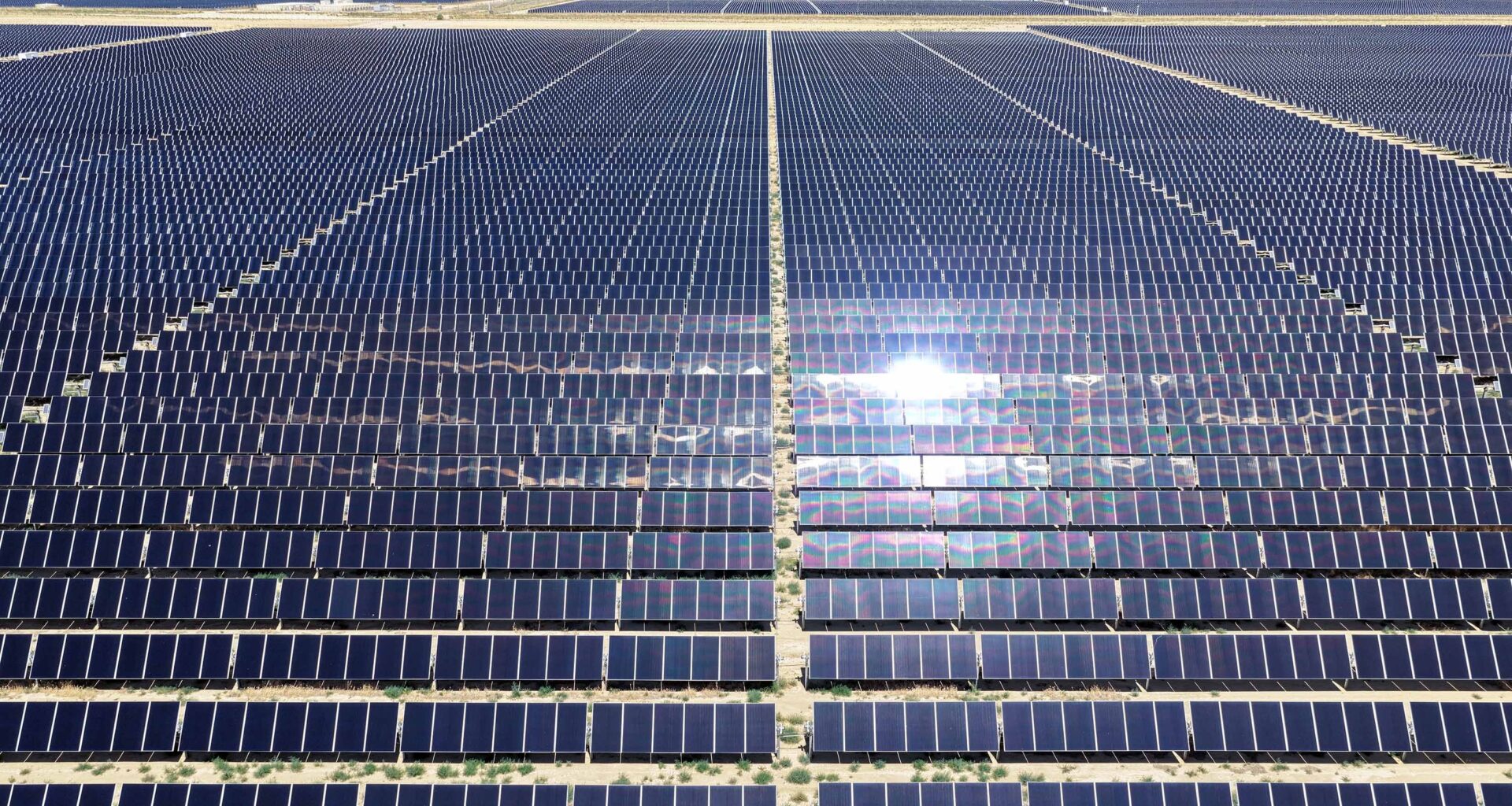
As power demand surges, analysts and investors say it may no longer be accurate to describe the US energy market as in a state of transition.
Renewables remain the fastest-growing energy source in the US, but rising power demand has prompted an increased interest in gas. US electricity demand grew by 9 per cent above 2020 levels last year, while total energy supply increased by around 2.2 per cent.
One estimate suggests demand could grow by 32 per cent by the end of this decade, buoyed by the AI boom and broader electrification across the economy.
The amount of private capital flowing into US power infrastructure, largely due to the growth of data centres, is comparable only with the construction of the railways in the 19th century, says Mark Patel, senior partner at McKinsey in San Francisco. This is particularly significant because global energy demand growth has been “basically flat” for the past decade, he tells Sustainable Views.
“From a demand signal perspective, there’s no better time to be [working] in power than today,” says Mark Rostafin, co-chief executive of solar developer Vesper Energy. “The year-on-year, system-wide average growth in power demand is higher than I’ve seen at any point in my career.”
The rush for power, coupled with the Donald Trump administration’s assault on clean energy, saw gas grow by 1.6 per cent year-on-year in 2025, and new gas turbines are largely sold out until the end of this decade.
Renewables still driving growth
While President Trump has made clear his priorities lie with oil, gas and coal, power generation growth is overwhelmingly being driven by solar, storage and wind. More than 90 per cent of new utility-scale generating capacity added in 2025 came from renewable sources, says the federal Energy Information Administration. In May, solar overtook coal to become the third-largest source of electricity generation in the US.
The “magnetic force” of the market is increasingly favouring renewables, which beat fossil-powered sources on both cost and speed to market, Patel explains.
Daniel de Boer, chief executive of renewable energy investor Greenbacker Capital, says solar and battery storage can deliver the same benefits as gas without the long wait time for turbines. “But gas is prolific in the US and given the infrastructure that exists here, we haven’t seen the same increases in pricing as in other parts of the world,” he adds. “There remains an inherent comfort with gas here that probably doesn’t exist elsewhere.”
Amazon has long been known as one of the world’s biggest buyers of renewable energy — and it still is. But Chris Roe, the company’s global director of sustainable operations, says despite heavy investments in solar, wind and battery storage, “operating at our scale demands grid-level reliability, and grid infrastructure doesn’t always move at the pace we’d like”.
“We’re building a broad energy portfolio, including nuclear, and exploring options like natural gas as a bridge until more carbon-free capacity is available,” he adds. “Our focus is carbon-free energy at scale, and we’ll invest across every pathway that gets us there.”
All power is good power?
As large power consumers broaden their procurement strategies, investors say the consequences could extend across the US power sector.
“We’re paying close attention to whether decarbonisation gives way to recarbonisation in some cases,” says Jonathan Pragel, utilities and clean energy executive director at Calvert, Morgan Stanley’s responsible investment arm. “Building renewables is obviously a good thing in terms of decarbonisation, but building renewables doesn’t lower overall grid emissions. You actually need to retire fossil units.”
In a 2026 study, the World Resources Institute said that while 90 per cent of new energy capacity in the US in 2025 was from renewable sources, fossil fuels are also growing. And in the US specifically, planned retirements of coal and gas-fired generation are below the 10-year average, finds S&P Global.
Developers argue the reality is less a replacement of fossil fuels than an expansion of the overall electricity system.
“Because demand growth is outpacing new generation, you can’t retire old assets, whether they’re inefficient or polluting,” says Rostafin. “This is going to be a very long energy transition because we’re going to need to build a lot of gas-fired generation to get to a future that might be more renewable.”