 Technical inspections of freight railcars in Europe are set to become much more frequent following the accident in the Gotthard Base Tunnel in 2023. The new measures, strongly championed by Switzerland, provide for checks based on the type of wheels after approximately 50,000–300,000 km, compared with intervals that could previously be as long as 660,000 km.
The serious accident that occurred three years ago in the Gotthard Base Tunnel is changing the safety regulations for European rail freight transport.
The authorities and the rail industry have agreed on harmonised measures involving more frequent inspections of railcars and, in particular, their wheels, after investigations into the derailment in August 2023 revealed the risk of cracks and fractures.
The measures were developed within the Joint Network Secretariat (JNS), a mechanism coordinated by the European Union Agency for Railways (ERA), specifically created to harmonise the European rail sector’s response following accidents and incidents. The procedure relating to the Gotthard accident and the broken wheels began in December 2023 and was formally closed in December 2025, with updated measures for 2026.
From 660,000 km to much more frequent inspections
According to information provided by the Swiss authorities, the new inspection intervals are set to range from approximately 50,000 to 300,000 km, depending on the type of wheels.
The difference from current practice is significant. In some cases, the technical inspection of the axles could only be carried out after eight years or 660,000 km. The Swiss investigation into the Gotthard accident had shown that the wheel that failed had travelled only approximately 50,000 km, although, according to the existing interval, it was a long way from the time of a scheduled inspection.
The ERA/JNS measures applicable from 2026 already provide for additional visual checks, inspections for cracks and signs of overheating, and, in certain situations, inspections every 50,000 km. The focus is particularly on wheels with brake pads on the running surface and certain types considered comparable to those involved in the breakage cases investigated in recent years.
Switzerland pushed for a European solution
The impetus for tightening the checks came largely from Switzerland.
Following the publication of the final report on the accident, the Federal Office of Transport (BAV) decided in 2025 to introduce its own, stricter measures for railcars operating within the country. These included shorter and more systematic inspection intervals, an increase in the minimum permitted diameter for certain wheels, and additional checks following overheating incidents.
At the same time, the Swiss authority pressed for a Europe-wide solution, arguing that rail freight transport is by its very nature cross-border and that differing rules from one country to another would create interoperability issues.
“This shows that we in Switzerland, too, can set standards in Europe,” said Christa Hostettler, Director of the Federal Office of Transport, speaking on Swiss public television.
Switzerland now wants to transpose the European solution into its own binding framework and is analysing the legal means by which the new requirements can be introduced.
It is not yet an automatically binding ‘EU regulation’
There is, however, an important distinction.
The results of the JNS procedure coordinated by ERA are of a recommendatory nature, and responsibility for implementing and supervising the measures remains with the railway operators and the competent national authorities. ERA states that the harmonised measures are specifically intended to prevent the emergence of national solutions that are incompatible with one another.
In the case of Switzerland, the BAV wants the industry to adopt the new measures as quickly as possible, without waiting for the transition periods originally envisaged.
The legal situation is further complicated by the fact that the stricter measures previously introduced unilaterally by the Swiss authority were challenged by railcar owners, with the case reaching the Federal Administrative Court.
A broken wheel caused the Gotthard accident
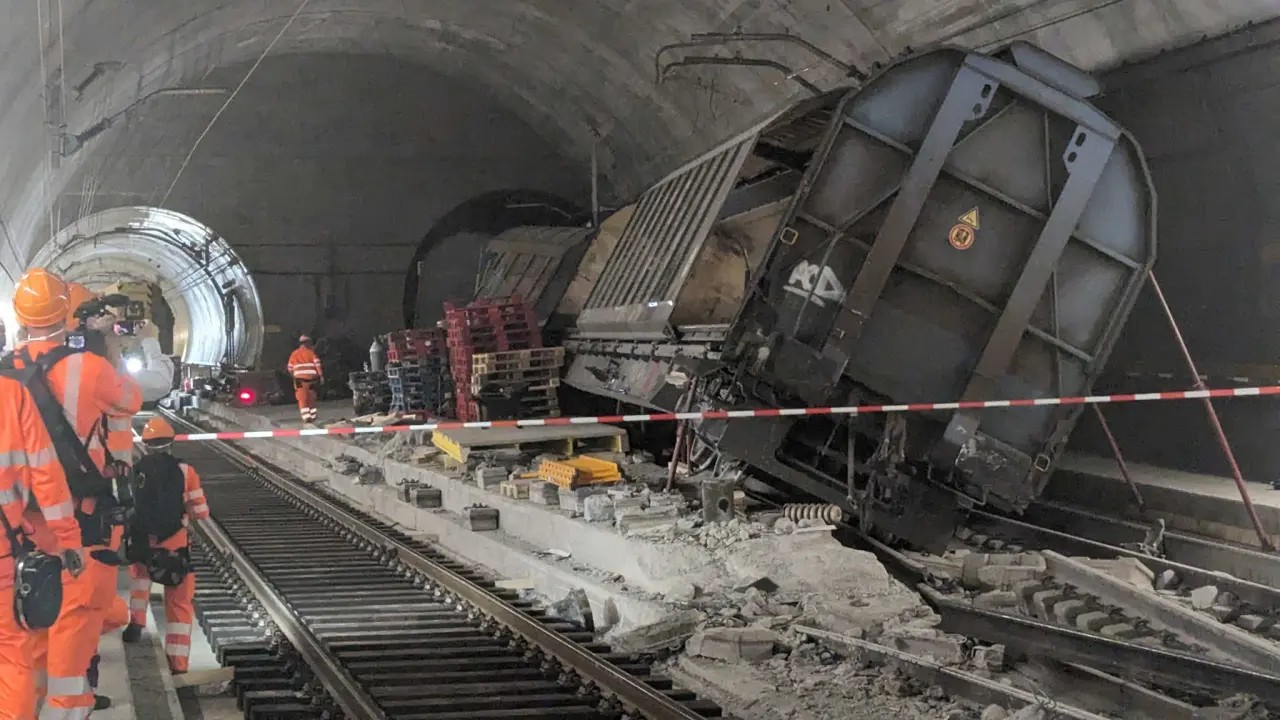
The measures stem from the accident that occurred on 10 August 2023, when a freight train derailed in the Gotthard Base Tunnel.
Investigations established that the accident was triggered by a wheel breaking on the 11th railcar. After the wheel failed, the train continued to travel for several kilometres, after which 16 railcars derailed.
ERA estimates the damage to infrastructure and rolling stock at approximately 150 million Swiss francs, equivalent to around 160 EUR million at the time of the assessment. One of the tunnel’s two tubes remained closed for more than a year, severely disrupting transalpine rail traffic.
The Swiss investigation subsequently concluded that the use of composite brake blocks can, under certain conditions, pose a systemic risk of overheating, cracking and breakage of the wheels on railcars.
The issue of liability remains unresolved
One issue that has not yet been resolved is liability in the event of defects and accidents.
Christa Hostettler believes that clearly defining responsibilities is essential for safety measures to be effectively implemented by railcar owners, railway operators and maintenance organisations.
Discussions are continuing between the authorities and industry representatives, whilst new European measures aim to prevent a repeat of an accident on the scale of the one that blocked part of the world’s longest railway tunnel for over a year.
Share on: 


