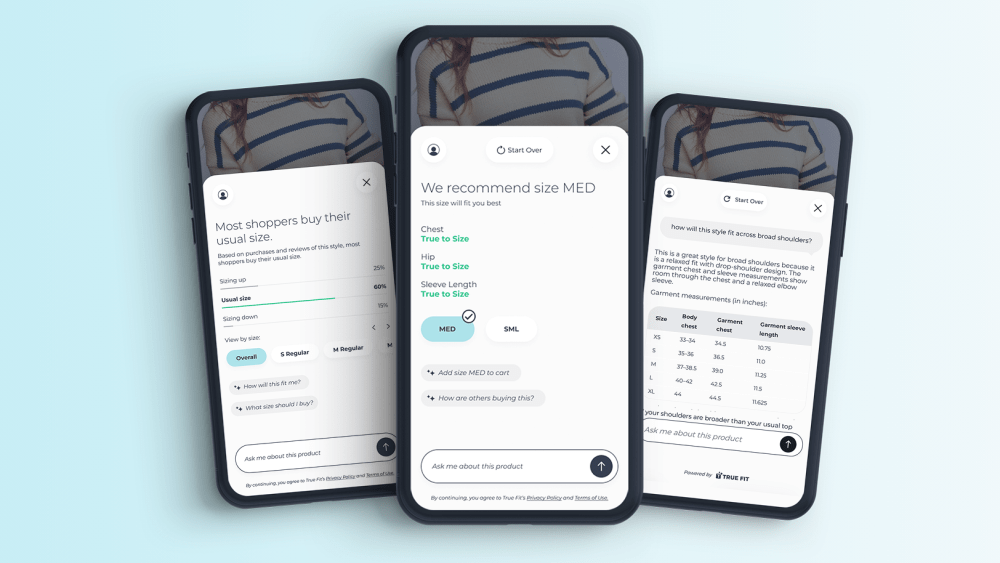
In fashion’s race toward agentic commerce, the industry has quickly discovered that intelligence alone isn’t enough. Reliability and trust — especially around fit and sizing — have emerged as a key constraint.
For True Fit, this has become the opportunity. Earlier this year, the company introduced its “Fit Intelligence Layer,” a new architecture designed to power artificial intelligence shopping agents built on real outcomes. True Fit’s proprietary data moat is powered by nearly two decades of enriched shopper profiles, enriched clothing and footwear profiles and purchase and returns data. Now, True Fit is bringing that architecture into production, with deployments live at enterprise retailers including Lands’ End.
Why Fit Is Crucial for AI in Fashion
Agentic commerce, AI systems that guide, recommend and act on behalf of shoppers, has rapidly moved from concept to priority across retail organizations. But still, fashion presents a difficult challenge.
Unlike other categories, the core purchase question isn’t just what to buy, it’s will this fit me, which carries real financial consequences. Returns continue to erode margins across the industry, with fit and sizing consistently cited as the primary driver of purchase hesitation and post-purchase dissatisfaction. Internally, True Fit’s analysis of real shopper interactions with AI systems shows that most fashion-related queries are about fit and sizing.

True Fit internal research.
Courtesy of True Fit
“Agentic commerce is fundamentally about helping customers make decisions,” said Jessica Murphy, chief executive officer of True Fit. “Every shopping journey, no matter how sophisticated, ultimately collapses into a single question in the shopper’s mind: ‘Will this fit me?’ If that question is not resolved with confidence, the downstream effects are measurable and consequential.”
From Static Tools to Conversational Intelligence
Historically, fit technology has been constrained by rigid interfaces: size charts, filters and static recommendations that reduce a complex, personal decision into a binary outcome or map one shopper’s review to another shopper’s experience — regardless of how different the two shoppers are. The shift to conversational AI changes that dynamic.
True Fit’s shopping agent, powered by nearly 20 years of purchase and return data, introduces a more fluid model. Instead of forcing a single answer, the system engages in dialogue, refining recommendations based on preferences, context and behavioral patterns. The system is designed to mimic aspects of an in-store associate by providing context and tailored sizing suggestions in real time.
“Fit is deeply personal and preferences are unique to every shopper,” Murphy added. “Our job is to translate real-world outcomes into guidance people can trust.”
From Concept to Category: The Fit Intelligence Layer
While many companies are racing to introduce AI agents into the shopping journey, True Fit is bringing the fit intelligence layer that those agents can depend on.
Retailers aren’t short on options: The market is crowded with sizing widgets, virtual fitting tools and measurement-led platforms, each promising fewer returns and higher conversion.
But as shopping interfaces shift from filters and charts to conversational agents, the differentiator is moving upstream: not the front-end experience — but the quality of the fit signal behind it and how consistently it can translate a shopper’s context into an actionable size and fit recommendation and explain why in language a customer trusts.
At the core of this strategy is Model Context Protocol, which allows True Fit’s Fit Intelligence Layer to work across the ecosystem of AI agents, orchestration layers and custom enterprise agents built on frameworks.
The difference comes down to data. Its scale, its quality and how it’s applied. While many newer agents rely on the same readily available product-page content, including descriptions, reviews and size charts, True Fit’s Fit Intelligence Layer uses two decades of proprietary purchase and returns data, structured, enriched and updated in real time to support consistent, repeatable decision-making at scale.
True Fit also reports that its dataset spans hundreds of millions of shoppers and tens of millions of products, forming an extensive decision-grade intelligence graph for fit in the market.
For example, True Fit has more market share than all other fit-tech companies combined, according to Datanyze, which tracks the market share of fit-tech companies. This scale and cross-market connectivity enables True Fit’s dataset to power a robust understanding of the relationship between shoppers and the clothes and shoes they buy and actually keep.
In an agentic environment, having structured data helps bridge the gap between general information retrieval and actionable buying guidance.
“Understanding data is table stakes,” Murphy said. “What matters is whether an AI system can act on that data with confidence, trust and reliability at scale. That’s what decision-grade fit intelligence enables.”
Lands’ End Brings Fit Intelligence to Market
By integrating True Fit’s Fit Intelligence Layer, Lands’ End is operationalizing fit intelligence directly within its digital experience, addressing customer uncertainty at the point of decision. This new phase of partnership with Lands’ End provides an early look at how this model is moving from theory to reality.
Courtesy of True Fit
“At Lands’ End, delivering confidence to our customers has always been core to our brand,” said Kym Maas, president of consumer and chief creative officer at Lands’ End. “From our roots in catalogue to becoming an early leader in e-commerce, we’ve consistently focused on meeting customers wherever they shop. We’ve partnered with True Fit for years because they are the best-in-class for size and fit. As shopping becomes more conversational and personalized, this next evolution allows us to bring that fit intelligence directly into the experience, helping customers make confident decisions in the moment.”
For Lands’ End, the shift is less about novelty than eliminating the most common point of friction in online apparel.
A Layered Future, Not a Fragmented One
The proliferation of AI tools across retail has led to a growing tension. Every SaaS provider is building its own agent, but retailers can’t realistically deploy dozens of competing assistants across a single customer journey. Hence, True Fit’s answer is a layered model.
For retailers early in their AI adoption, the company offers a shopping agent optimized specifically for fit and sizing, a significant and ongoing challenge in digital retail.
With more advanced organizations building their own agentic ecosystems, the Fit Intelligence Layer integrates directly via MCP, enabling existing systems to integrate fit-related logic and guidance. It’s a strategy designed to align with how agentic commerce is likely to evolve — not as a collection of isolated tools, but as a coordinated system of interoperable intelligence layers.
Data as the Last Defensible Moat
As AI capabilities continue to commoditize, differentiation is shifting toward data, specifically decision-grade data that is proprietary, structured, enriched, with real-time feedback loops for continued learning and improvement. This kind of living data graph built on real outcomes is a specialized dataset built over nearly two decades.
True Fit’s dataset, spanning more than $500 billion in transactions, tens of millions of products, hundreds of millions of shoppers and a global network of retailers, is one of the industry’s most extensive datasets for fit intelligence.
In an environment where many AI systems are trained on similar public information, this volume of historical behavioral data is a key differentiator for the platform.
“The systems that win in agentic commerce won’t just be the most intelligent,” Murphy said. “They’ll be the most trusted. And trust is built on understanding, powered by rich data and outcome memory or context.”
Redefining How Fashion Is Bought
If the early wave of e-commerce was about access and the mobile era was about convenience, the next phase, agentic commerce, will be defined by confidence. Confidence that what you’re buying is right. Confidence that it will fit. Confidence that you won’t have to return it.
By defining and operationalizing the Fit Intelligence Layer, True Fit is making a clear bet on how the industry will evolve. Not just smarter interfaces, but smarter decisions. And in fashion, that may be the difference that matters most.
This article is supplied by True Fit.