A 6,500-year-old ritual center near Chleby in the Czech Republic was built more than 1,000 years before Stonehenge, new research shows. The large enclosure appears to have been planned around key movements of the Sun and Moon.
 View of the remains of the sanctuary. Credit: University of West Bohemia in Pilsen
Archaeologists from the University of West Bohemia led several excavation campaigns at the site. Their work revealed an almost circular enclosure about 230 meters across. A ditch more than 2.5 meters deep once marked the outer edge, with twelve entrances placed at uneven intervals.
The layout first caught the team’s attention because circular enclosures from this period are unknown in the region. A closer study of the entrances showed a planned pattern rather than random placement. Two main sight lines link parts of the enclosure with major points in solar and lunar cycles.
One set of positions relates to the Moon’s most distant points on the horizon during an approximately 18-year cycle. Another links sunrise at the summer solstice with sunset at the winter solstice. Researchers say the second alignment has a close parallel at Stonehenge, where a main axis also relates to the solstices.
 Circular enclosures were previously unknown in the region for this period. Credit: University of West Bohemia in Pilsen
Organic remains from Chleby provide dates placing the structure more than a millennium before Stonehenge. The finding pushes back the known use of large ceremonial enclosures in Central Europe and adds a much older site to the history of planned solar and lunar observations.
The enclosure also held signs of ritual activity. Archaeologists found bull skulls and horns in the ditch near several entrances. Such remains suggest the animals formed part of the site’s ceremonial use. Bull worship was an important religious practice among some early farming groups across prehistoric Europe.
Human remains add another part to the long history of the site. Earlier work found a Bronze Age burial linked to the Únětice culture. About 18 people were buried in the ditch over time, showing continued use of the area long after the original enclosure was built.
Researchers now think the site’s role changed during later periods. By the Iron Age, the old sanctuary seems to have lost its religious purpose. The ditch was gradually filled, and a settlement grew across the former ceremonial area.
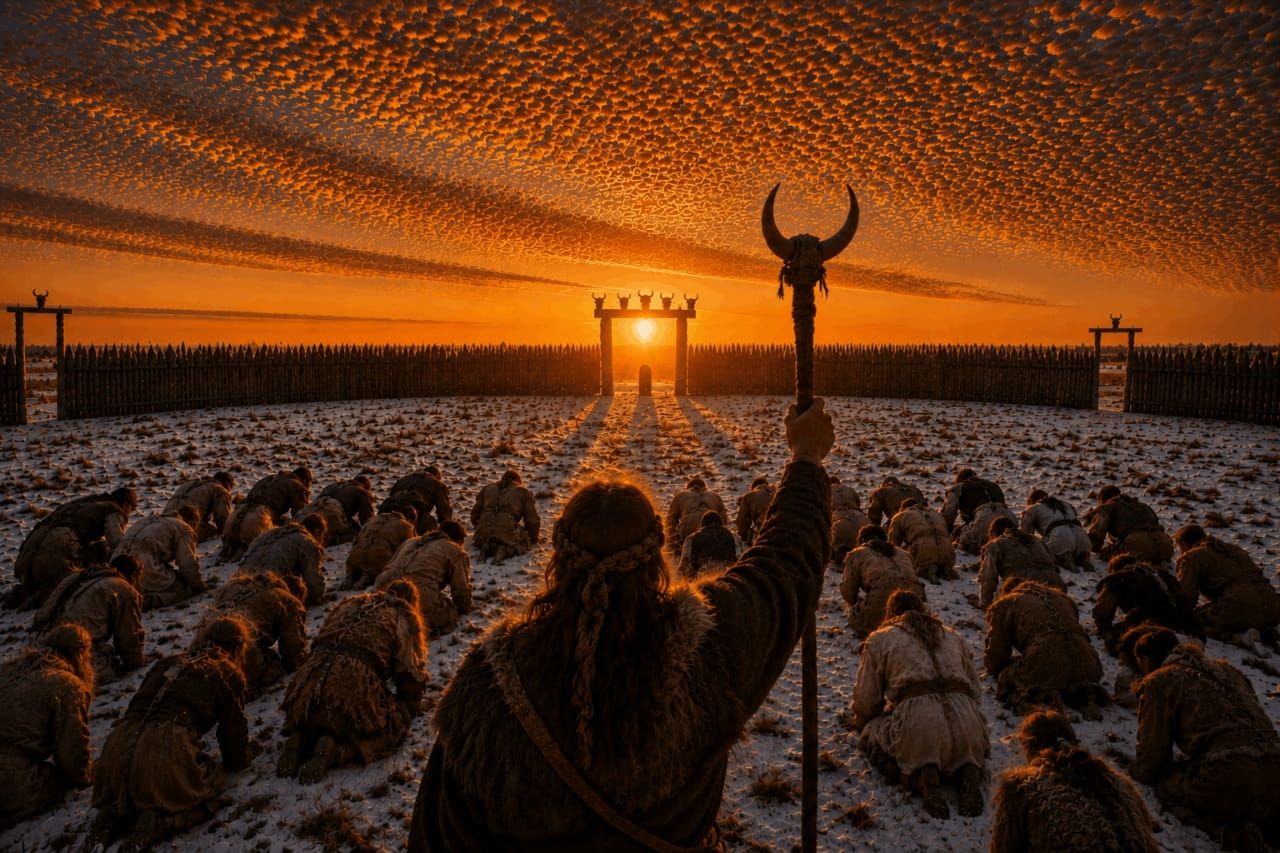 Artistic reconstruction of the sanctuary. Credit: University of West Bohemia in Pilsen
The team is also studying soil from the enclosure and nearby land. Chemical traces left in soil by past human activity could help show how different parts of the site were used over time.
The Chleby enclosure offers a rare look at how early farming communities organized large spaces for ritual purposes. Its size, carefully placed entrances, and links to the Sun and Moon point to a shared knowledge of seasonal and lunar cycles. The new dates also show such planning began much earlier in Central Europe than Stonehenge.
The site also adds to a wider picture of Neolithic ritual sites in Europe. Chleby appears to have combined ritual activity with close attention to the sky. The layout gives researchers clues about how people approached and used the enclosure.
Evidence from the Bronze Age and Iron Age points to shifts in how later communities treated the old monument. Those changes offer a record of how ritual places gained, lost, and changed their meaning over time.
More information: University of West Bohemia in Pilsen