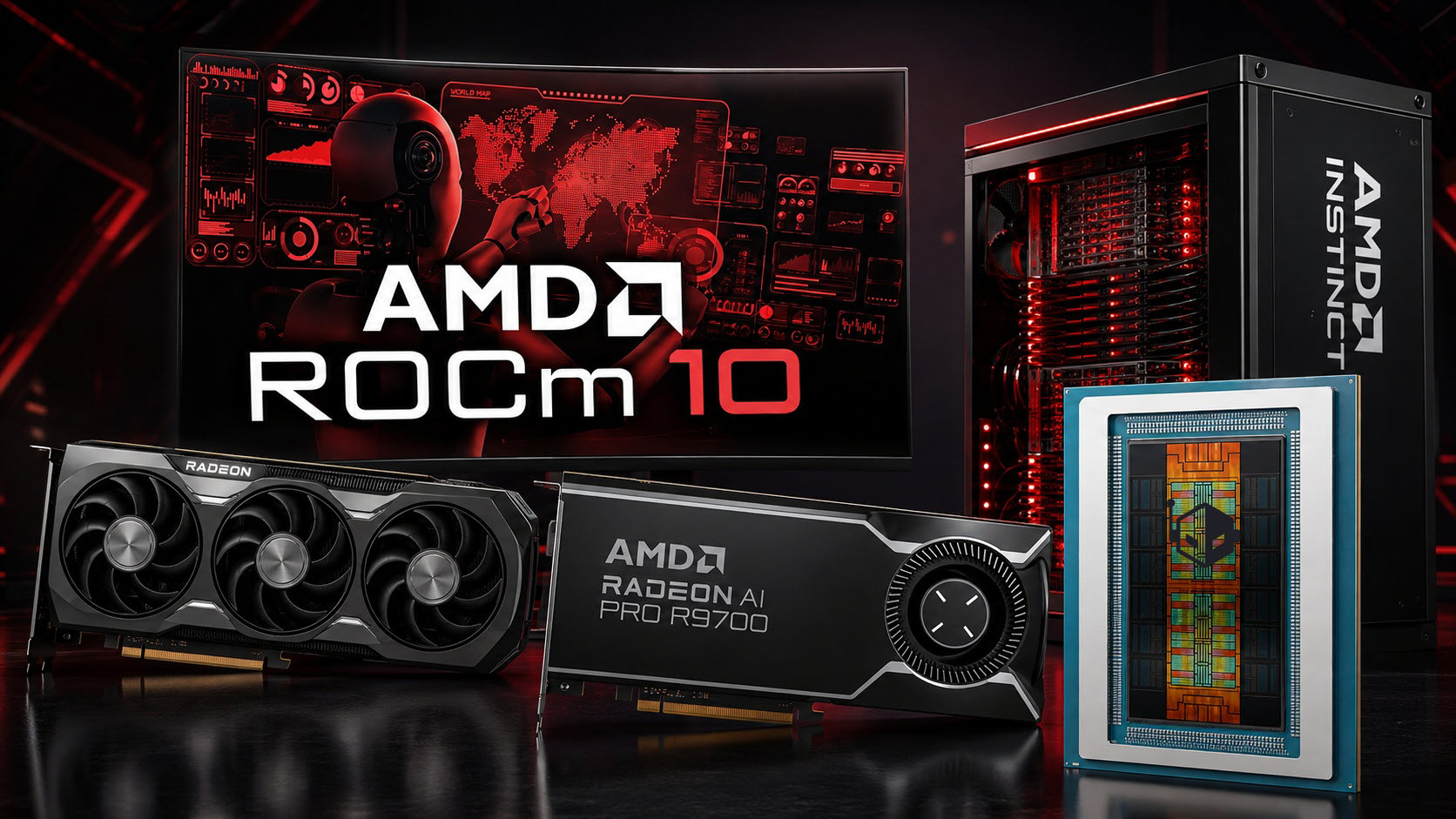
AMD celebrates 10 years of ROCm with the release of ROCm 10, bringing the most advanced AI features and toolsets to developers.
AMD Just Released Its Biggest ROCm Update Yet, ROCm 10, Offering Developers Several New Features & Performance Updates
The first ROCm 1.0 release was shipped in April 2016, and 10 years later, AMD is releasing its ROCm 10, the latest version of the open-source compute and AI platform. With ROCm 10, theRock now serves as the foundation and also delivers native Agentic AI developer experiences with ROCm.AI. ROCm.AI builds upon the new feature set, which includes ROCm CLI, AMD Skills, and Hyperloom.
The latest ROCm 10 release and its ROCm Core SDK 10.0 are supported across the full GPU stack, which covers Instinct Accelerators, Radeon graphics cards, and Ryzen Integrated graphics on both Windows & Linux platforms.
With the ROCm 10 update, systems configured with ROCm.AI offer an average 3.3x increase in inference performance and a 2.4x increase in training performance versus ROCm 7.
Testing by AMD Performance Labs as of July 7, 2026, measuring the inference performance in tokens per second (TPS) of a system configured with an AMD Instinct MI355x 8x GPU platform and AMD ROCm 7.0 software vs a similarly configured system using a preview version of AMD ROCm.ai (ROCm 7.2.2 with optimizations such as Optimized Kernels, Parallelism and Scheduling) running GLM-5, Kimi-K2.5, and DeepSeekk-R1-0528 models.
ROCm.AI: An AI-Native Developer Experience
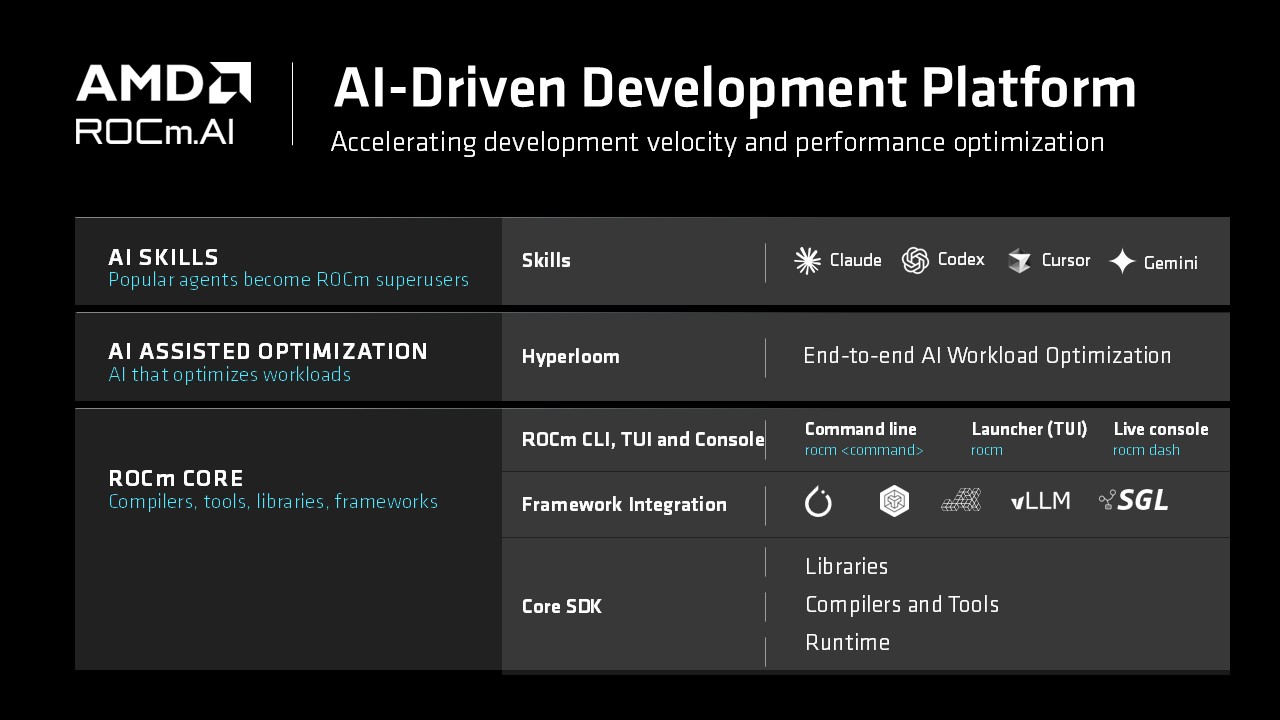
The headline of ROCm 10.0 is ROCm.AI, AMD’s new AI-native developer experience. Where past ROCm releases mainly gave you better primitives and libraries to build with, ROCm.AI focuses on the workflow around those primitives: installing, validating, serving, and optimizing AI workloads on AMD hardware with far less manual toil. It’s built from three pieces that ship together in ROCm 10.0 — the ROCm CLI, AMD Skills, and Hyperloom.

ROCm CLI
The ROCm CLI is a single, unified command-line tool for installing, validating, serving, updating, and troubleshooting AI workloads on AMD platforms, replacing what used to be a collection of separate scripts and manual steps. It ships as a tech preview in ROCm 10.0 — treat it as early access and expect the interface to keep evolving. rocm serve spins up a model for inference on top of PyTorch, rocm examine diagnoses environment and driver problems, and the CLI supports air-gapped environments by letting its dependencies be downloaded as a self-contained bundle alongside the binary.
AMD Skills
AMD Skills bring AMD-validated ROCm knowledge directly into the AI coding assistants developers already use — Claude, Cursor, Codex — through the Agent Skills format, as shown in Figure 1. The official catalog lives in the amd/skills GitHub repository as a federated collection of skills, compatible with the standard skill directories those tools already look in (~/.claude/skills/, ~/.cursor/skills/, .claude/skills/), with a companion marketplace that packages skills built by AMD teams for one-command installation.

Hyperloom: Closing the Optimization Loop
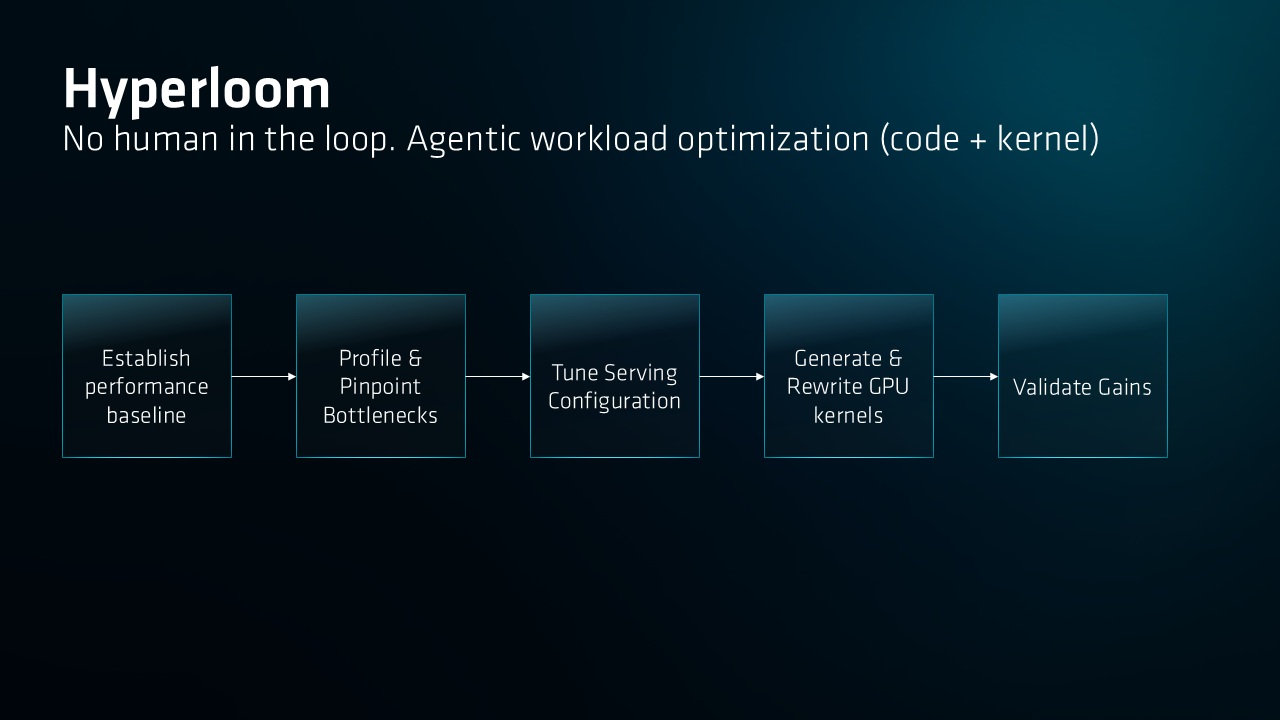
Hyperloom is the third piece of ROCm.AI, and the one that goes furthest toward taking the human out of the loop entirely. It’s a new open-source, agentic system that automates end-to-end inference workload optimization — profiling a workload, analyzing the results, planning changes, applying them, and validating correctness, on repeat, without an engineer manually driving each cycle. AMD reports that Hyperloom cuts what used to be weeks of manual optimization work down to hours, while exploring far more of the solution space than a human would attempt under time pressure.
ROCm 10 marks a clear shift from raw platform plumbing to a more complete AI workflow on AMD hardware. Instinct accelerators, Radeon GPUs, and Ryzen integrated graphics now sit under one AI-focused stack on both Windows and Linux, with ROCm.AI as the center of that experience.
The performance story is straightforward: systems running ROCm.AI delivered about 3.3× higher inference throughput and 2.4× higher training performance versus ROCm 7 in AMD’s July 2026 tests on an Instinct MI355X 8-GPU platform, using models such as GLM-5, Kimi-K2.5, and DeepSeek-R1-0528.
That gain is paired with a simpler developer path. The ROCm CLI consolidates install, validation, serving, and troubleshooting into one tool. AMD Skills put validated ROCm guidance inside assistants like Claude, Cursor, and Codex. Hyperloom then automates the optimization loop itself, profile, plan, apply, and verify, so work that once took weeks can finish in hours. Taken together, ROCm 10 is less a library update than a bid to make AMD platforms easier to stand up, serve, and tune for AI.

About the author: A Software Engineer by training and a PC enthusiast by passion, Hassan Mujtaba serves as Wccftech’s Senior Editor for hardware section. With years of experience in the industry, he specializes in deep-dive technical analysis of next-generation CPU and GPU architectures, motherboards, and cooling solutions. His work involves not only breaking news on upcoming technologies but also extensive hands-on reviews and benchmarking.
Follow Wccftech on Google to get more of our news coverage in your feeds.