
Moldova marked 35 years of independence this week with a military parade, high-level visits and a trilateral meeting with the presidents of Romania and Ukraine. The anniversary came against the backdrop of continued security concerns linked to Russia’s war against Ukraine, with five Russian drones entering Moldovan airspace on Independence Day, while President Maia Sandu traveled to Kyiv earlier in the week to reaffirm Moldova’s support for Ukraine.
At home, several high-profile court cases remained in the spotlight, including the “Kuliok” case involving former president Igor Dodon and the appeal proceedings of convicted former oligarch Vladimir Plahotniuc. The government also announced a cabinet reshuffle and new measures for the energy sector, while ZdG released a documentary examining Moldova’s difficult 35-year effort to turn its formally proclaimed independence from the Soviet Union into independence exercised in practice.
Moldova and Ukraine mark 35 years of independence amid continued security concerns
President Maia Sandu traveled to Kyiv on August 24 to attend events marking the 35th anniversary of Ukraine’s independence, alongside leaders of the Coalition of the Willing. During the meeting, Sandu called for strengthening Ukraine’s air defenses ahead of winter. Ukrainian President Volodymyr Zelensky also awarded her the Order of Princess Olga, First Class, one of Ukraine’s highest state honors.
Security concerns linked to Russia’s war against Ukraine continued later in the week. Moldova’s airspace was crossed without authorization by five Russian drones during the night of August 27, as the country celebrated its own Independence Day. A flying object was also found on the ground near the Chișinău-Basarabeasca road after a citizen alerted police.
 President Maia Sandu at the Coalition of the Willing
Moldova celebrates 35 years since declaring independence
Moldova marked 35 years since proclaiming its independence on August 27, with a military parade and other events in Chișinău attended by the presidents of Romania and Ukraine. The three heads of state also held a Moldova-Romania-Ukraine trilateral meeting.
Moldova declared independence from the Soviet Union on August 27, 1991, when 278 lawmakers signed the Declaration of Independence, which also called for the withdrawal of Soviet troops from the country. Romania became the first state to recognize Moldova’s independence, while Moldova joined the United Nations in 1992. Thirty-five years later, accession to the European Union is now enshrined as a strategic objective in the Constitution.
The anniversary also brought an unusual development involving Moldova’s two Orthodox metropolitan churches. Metropolitan Antonie of Bessarabia and Metropolitan Vladimir of Chișinău and All Moldova attended a solemn meeting dedicated to the anniversary and held what the Metropolis of Bessarabia described as an “open” discussion about the need to initiate institutional dialogue between the two churches.

 Volodimir Zelenski, Maia Sandu and Nicușor Dan
ZdG documentary examines Moldova’s 35-year struggle for independence from Russian influence
To mark the anniversary, Ziarul de Gardă released a documentary examining how Moldova’s formally proclaimed independence from the Soviet Union in 1991 was followed by a decades-long effort to reduce Moscow’s influence over the country.
The documentary looks at the instruments Russia has used over the past 35 years to keep Moldova within its sphere of influence, including support for Transnistrian separatism and the continued Russian military presence, dependence on Russian gas and markets, political and media influence, embargoes, propaganda, opaque financing, espionage and electoral interference.
At the same time, it traces Moldova’s gradual attempts to distance itself from Moscow by restoring national symbols and identity markers, diversifying markets and energy sources, and developing mechanisms to protect its information space and democratic processes. The documentary, signed by Alina Radu, journalist and director of Ziarul de Garda, examines how Moldova has sought to transform the independence declared in 1991 into one exercised in practice.
 Alina Radu, journalist and director of Ziarul de Garda
Dodon and Plahotniuc cases return to the courtroom
Former parliament speaker and Socialist Party leader Zinaida Greceanîi testified as a defense witness before the Supreme Court of Justice in the “Kuliok” case against former president and current Socialist MP Igor Dodon. Her testimony focused on the political negotiations that followed the 2019 parliamentary elections and discussions between the Socialists and the Democratic Party, then led by Vladimir Plahotniuc.
Greceanîi said that while discussions took place with different political parties, there were no concrete negotiations to form a coalition with the Democrats. She nevertheless confirmed that Ion Ceban and Vlad Bătrîncea had been appointed as PSRM negotiators and acknowledged asking Dodon to hold discussions with PDM representatives about a possible coalition.
Meanwhile, the Court of Appeal began examining Plahotniuc’s challenge to his 19-year prison sentence for creating and leading a criminal organization, fraud and money laundering. The first hearing was postponed because of a bomb threat. At the second hearing, Plahotniuc asked to be physically escorted from Prison No. 13 to each court session, arguing that he could not clearly hear proceedings or properly communicate with his lawyers by video. The court rejected the request, meaning he will continue participating by videoconference.
 Vladimir Plahotniuc
Government reshuffle brings former Romanian minister into Moldova’s cabinet
Prime Minister Vasile Tofan announced changes to his cabinet, with Eugeniu Osmochescu moving from the Ministry of Economic Development and Digitalization to head the Ministry of Agriculture and Food Industry. Claudiu Năsui, a Romanian USR lawmaker and former Romanian economy minister, was named minister of Economic Development and Digitalization. President Maia Sandu granted Năsui Moldovan citizenship by presidential decree on August 25, and the two ministers were sworn in on Friday. Năsui said reducing bureaucracy and supporting entrepreneurs would be among his priorities.
The government also announced plans to gradually introduce VAT and excise duties from September 1 for certain goods brought into Moldova by businesses based in the Transnistrian region. Authorities said the measure is intended to ensure uniform application of tax and customs legislation, create fairer competition and gradually integrate Transnistrian businesses into Moldova’s national fiscal and customs system.
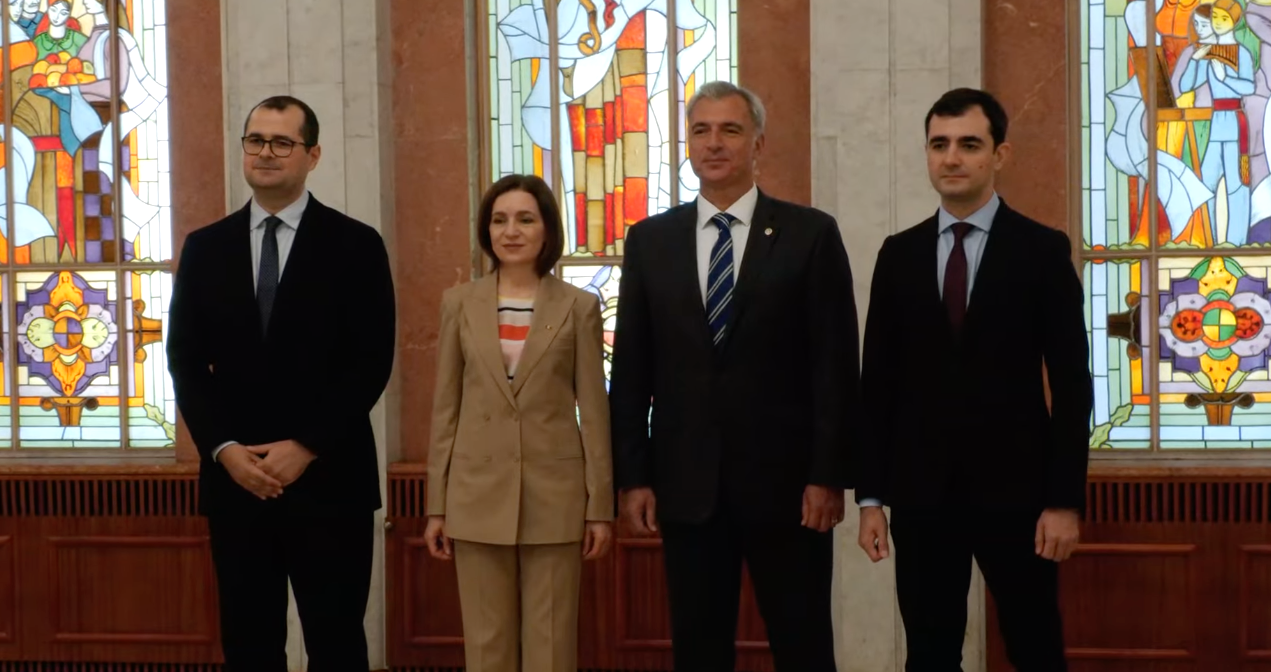 Premier Vasile Tofan, president Maia Sandu and the two new ministers: Eugeniu Osmochescu and Claudiu Năsui
Energy and hydrological alerts extended as authorities introduce new measures
Moldova extended its energy-sector and hydrological alerts for another 30 days from August 27 amid continued risks. Authorities described the extension as a preventive measure allowing them to respond more quickly if conditions in Moldova or the wider region deteriorate.
The National Crisis Management Commission also approved measures aimed at accelerating domestic electricity generation and storage capacity amid worsening conditions on regional and international energy markets. Local authorities will be required to reduce electricity consumption for public lighting by at least 50%, while irrigation of public green spaces will be permitted only when strictly necessary.
Meanwhile, Eugeniu Buzatu was selected as the new director general of state energy trader Energocom. In 2025, he received almost 1.2 million lei in salary, bonuses and allowances from the company — approximately 99,650 lei per month — in addition to travel allowances and meal vouchers. Separately, deputy head of the Briceni Police Inspectorate Vasile Cociurca was detained in connection with a suspected illegal hunting case, according to ZdG sources.
 Premier Vasile Tofan