

I attended Pommern’s annual Roman and Celtic Festival where thousands of years of the city’s history came to life at the Martberg temple complex. (Designed by Stripes Staff)
In my four years living in Germany, the quaint wine village of Pommern did not hit my radar until recently when I attended Pommern’s annual Roman and Celtic Festival where thousands of years of the city’s history came to life at the Martberg temple complex.
History of Pommern
Celtic-speaking people settled in the city over 2,000 years ago as a local tribe known to the Romans as “Treveri,” and the Martberg Gallo-Roman temple complex was a central place of importance for their tribe, according to archeological evidence found at the site.
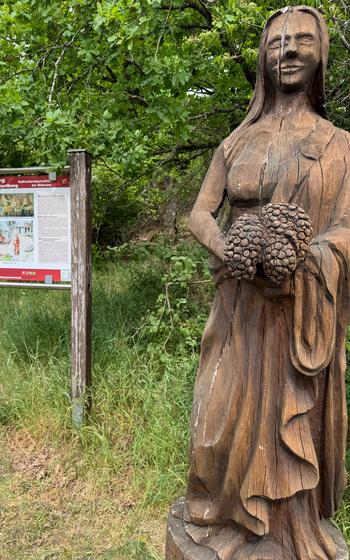
The name Pommern comes from the Latin word “pomum” meaning “fruit.” It is also closely tied to the Roman goddess, Pomona. (Tamala Malerk)
When the Romans came to the area, they grew tropical fruit and cultivated wine, establishing Pommern as one of the “oldest wine villages on the Mosel.” This was also the inspiration for the village’s name. The name Pommern comes from the Latin word “pomum” meaning “fruit.” It is also closely tied to the Roman goddess, Pomona.
Today, Pommern is home to about 500 people.
The Annual Celtic and Roman Fest at the Martberg
Every year, during the first weekend of May, the Martberg hosts this small Roman and Celtic-themed market that is worth checking out if you love history as well as local cuisine and wine.
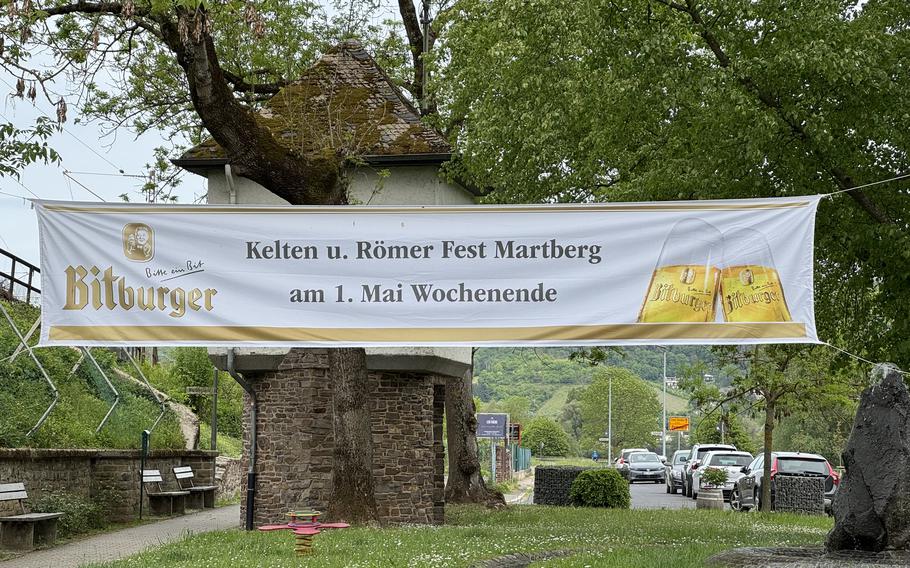
Every year, during the first weekend of May, the Martberg hosts this small Roman and Celtic-themed market that is worth checking out if you love history as well as local cuisine and wine. (Tamala Malerk)
You can get to the market in a variety of ways. For fitness enthusiasts, or a barely in-shape writer who thought “surely this cannot be uphill the entire way,” you can park at the Parkplatz along the Mosel River. Then, a walk along the wine vineyards and through the forested path (uphill) will take about 35 minutes. To shorten the time, you can also bike this path. This is a gorgeous option; however, even on a cool, spring day, I was sweating. You can also drive right up to the festival where there are parking options. No matter how you get there, note that the roads are tiny and winding.
Once at the festival, you will find reenactors in their camps. The Romans have one camp; the Celts have another. On the day we attended, there was a great blend of reenactments and rest time to check out everything onsite.
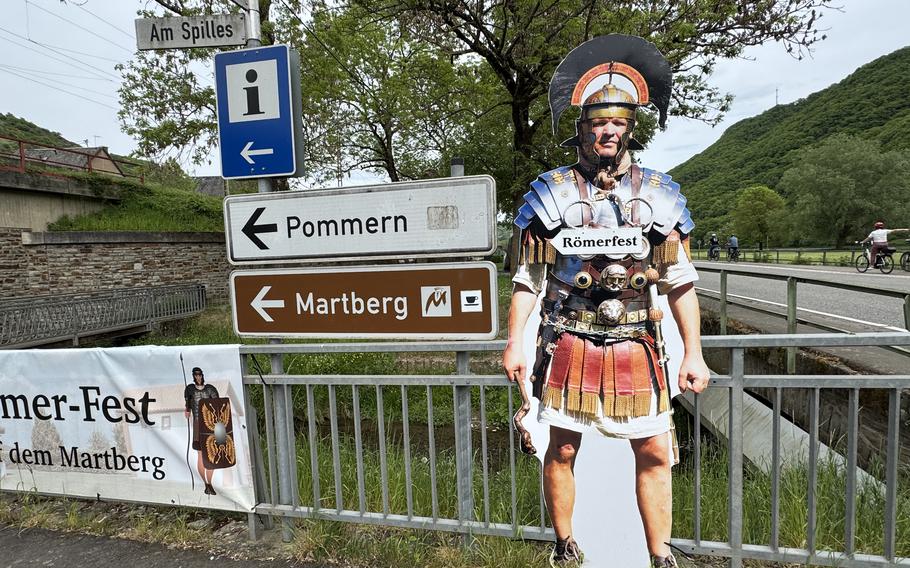
You can get to the market in a variety of ways. (Tamala Malerk)
Our first stop was the food area where someone was grilling large brats and a giant vat of Roman soup kept hot over a fire. I can highly recommend both. My spouse even went back for a second brat before we left later that day.
While eating, we watched the actors in their respective camps: a Celtic man allowing a child to try on chainmail, and a Roman legionary getting chastised by the centurian. Then, over the loudspeaker, a German voice announced that a reenactment would occur in a few minutes.
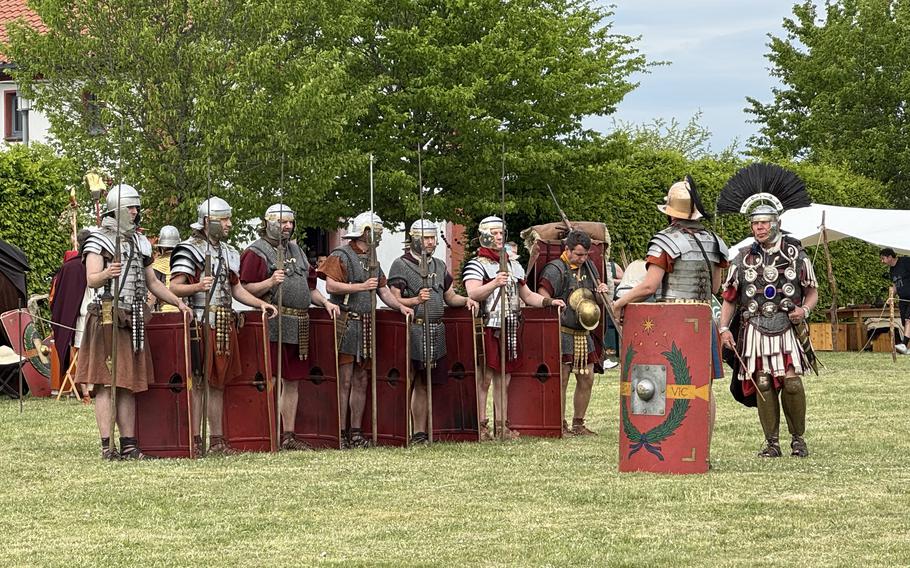
Over the loudspeaker, a German voice announced that a reenactment would occur in a few minutes. (Tamala Malerk)
The small crowd made our way to see where the reenactment of a post-victory ceremony occurred in Latin with German commentary. Speaking neither German nor Latin, I still got the gist of what was happening. After the ceremony, we enjoyed some coffee and cake. Finally, we were corralled into a larger field area to watch Roman legionaries train for battle for roughly half an hour before we headed back into town.
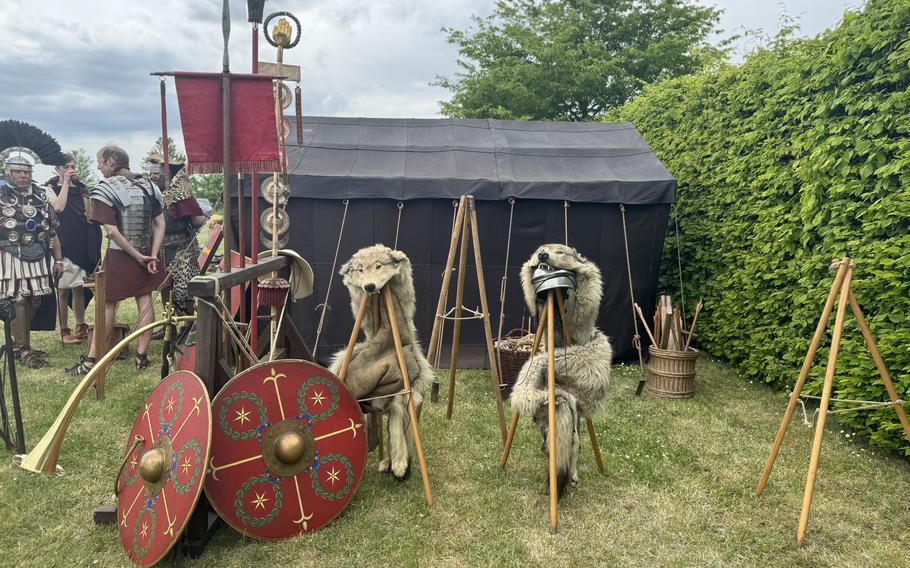
The Romans have one camp; the Celts have another. (Tamala Malerk)
The walk back down into town was much easier than the walk up, and before heading home we spent a few minutes enjoying a drink at one of the many benches along the Mosel River.
If you cannot make it to the annual festival, the Martberg temple complex is open to visitors from April to October, and you can see many of the ancient artifacts unearthed there at the nearby Stiftsmuseum of Treis-Karden. To learn more, visit martberg-pommern.de.