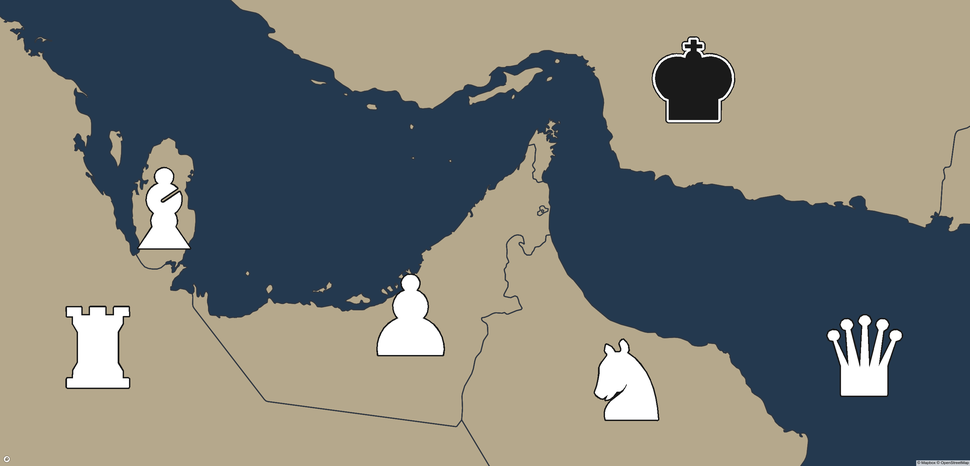
The Strait of Hormuz has traditionally been understood through a simple logic: whoever can threaten to close it can disrupt a substantial share of the world’s energy flows. That logic remains important, but the 2026 crisis suggests it is no longer sufficient. Hormuz’s strategic significance now lies not only in the possibility of physical closure but in the ability to shape the conditions under which commercial traffic moves.
That distinction changes the game. Hormuz is not merely a geographical chokepoint between Iran and the Persian Gulf states, nor simply another arena in the US–Iran confrontation. Hormuz is a strategic space in which several games operate at once. Iran seeks to convert geography into political leverage. Gulf states seek predictable energy exports with reduced vulnerability. The United States seeks to preserve maritime freedom and its regional security role. China seeks to protect energy access while maintaining ties to both Iran and the Gulf monarchies. No actor controls the game, and none can calculate its outcome independently of the others.
The central variable, therefore, is not whether the strait is physically open. It is whether access remains predictable.
What makes Hormuz different from a conventional chokepoint is that its power is relational. A narrow waterway becomes consequential because others depend on its continued accessibility. In 2024, roughly 20 million barrels per day passed through Hormuz, equivalent to about one-fifth of global petroleum liquids consumption, and approximately one-fifth of global LNG trade also transited the strait. The resulting dependence is not merely on geography but on a set of expectations: that vessels can pass, insurance remains available, cargoes can be financed, schedules remain predictable, and risk stays commercially manageable. The central variable, therefore, is not whether the strait is physically open. It is whether access remains predictable.
The events of 2026 demonstrate the difference. By September 24, the International Maritime Organization had recorded 85 confirmed incidents involving commercial shipping in and around the strait, with 24 seafarers killed since the conflict began on February 28. Yet the strait had not disappeared from commerce. Oil continued to move, though at radically reduced levels. Preliminary Kpler data for the week ending September 25 showed only nine vessels had transited the strait, against a pre-conflict level of roughly 125 large commercial vessels per day. On September 22, only three commodity vessels crossed, down from four the previous day. On September 21, the figure was just two vessels.
This is neither a conventional open strait nor a conventional closed strait. It is a condition of managed uncertainty.
Free Analysis in Your Inbox
Start with this week’s Geopolitics Weekly for free.
From Closure to Conditional Access
The conventional model of Hormuz is binary: open or closed. Under that model, the principal question is whether Iran or any actor capable of disruption can physically prevent passage. The Iran war suggests the more consequential question is different: Who can determine the conditions under which passage takes place?
Chokepoint power can operate below the threshold of outright closure.
Traditional chokepoint power rests on denial. A state threatens to stop movement and thereby imposes costs on everyone dependent on the route. But chokepoint power can operate below the threshold of outright closure. If vessels face uncertainty about whether they will be attacked, whether they need additional coordination, whether their route will remain available, whether insurance will cover the voyage, or whether one category of vessel will be treated differently from another, the commercial value of the route can deteriorate long before the waterway is physically sealed.
The distinction between physical openness and commercial openness is therefore crucial. A strait may remain navigable while becoming commercially unreliable, and that difference transforms uncertainty itself into a strategic instrument.
Shipping data makes this mechanism visible. From the start of regional conflict on February 28 through late September, the IMO confirmed 85 maritime incidents, including attacks on the bulk carrier CAPE DAO on September 23, and the tankers AL MARYAH and LR STEPHANIE on September 21. Some Middle Eastern oil exports have continued through Hormuz even as visible commercial traffic collapsed, while some vessels have used methods intended to reduce their visibility. Passage exists; predictable passage becomes much harder.
From a game-theoretic perspective, this changes the payoff structure before any formal closure occurs. Consider a simplified game. Iran can maintain relatively predictable access, impose selective restrictions, or pursue more extensive disruption. Other actors must then decide whether to keep using Hormuz, seek alternatives, increase military protection, absorb higher insurance and transport costs, or pursue diplomatic arrangements that reduce uncertainty.
The key point is that Iran does not need to maximize disruption to maximize leverage. The opposite may be true. If disruption becomes total and permanent, other players gain a powerful incentive to invest in alternatives, diversify infrastructure, expand reserves, alter shipping patterns, and seek new security arrangements. Iran’s immediate leverage may rise, but the dependency that generates it may decline. This produces a fundamental paradox of chokepoint power: the more aggressively a chokepoint is weaponized, the stronger the incentives for others to escape dependence on it. The optimal strategic position may therefore lie between complete openness and complete closure: maintaining enough access to preserve the route’s economic importance while retaining enough uncertainty to influence others’ calculations.
That is a different form of power. It is the power to alter the expected payoff of passage.
Five Players, Multiple Games
Once Hormuz is understood this way, the five principal actors cannot be placed into two fixed camps. They occupy different positions in overlapping games.
The regional security game involves Iran, the Arab Gulf states, and Israel. Iran seeks strategic depth against a hostile regional environment. Gulf governments seek territorial security, infrastructure protection, and commercial continuity. Actions elsewhere in the region can change the perceived risks surrounding the strait, making Hormuz a transmission mechanism: a confrontation beginning outside the waterway can alter the calculations of actors inside it.
The maritime security game involves Iran, the United States, and the Gulf states. Washington’s concern is not simply Hormuz’s geography but the broader principle of freedom of navigation and the credibility of maritime security arrangements. Gulf states depend on external security guarantees while seeking greater strategic autonomy. Iran’s leverage derives from geography and its ability to raise the costs of maintaining maritime security.
The great power game between the United States and China is especially important because China is simultaneously a major consumer of Gulf energy and a state with extensive relationships across the region. In 2024, 84 percent of crude oil and condensate flowed through Hormuz to Asian markets, with China, India, Japan, and South Korea accounting for 69 percent of all Hormuz crude flows. Iran has explicitly asked China to play a greater mediation role between Tehran and Washington, a request Beijing has reportedly accepted.
The energy game rests on mutual dependence rather than hierarchy. Qatar’s energy minister has rejected the notion that Hormuz is becoming obsolete, stressing that the waterway “carries trade in all products, not only oil and gas” and that LNG “cannot be transported via pipelines” as a viable alternative. Attacks on Qatar’s Ras Laffan facility damaged two LNG trains and a GTL plant, with the GTL train repairs expected by Q1 2027 and the LNG trains requiring three years. Qatar’s North Field East expansion is now projected for the first half of 2027.
The access game cuts across all the others. Here the central question is no longer “who can close Hormuz?” but “who can determine the conditions under which Hormuz remains accessible?” This is where the strategic meaning of the Iran war may prove more significant than the temporary reduction in traffic. Iran has moved decisively toward institutionalizing access control. Tehran has launched a Bitcoin-backed shipping insurance service called “Hormuz Safe,” which its government claims could generate more than $10 billion in revenue. The Iranian government and IRGC have allowed some vessels to transit via a designated route close to Iran’s coast, sometimes after requesting payments of as much as $2 million. Iran’s parliamentary national security commission has stated that “only commercial vessels and parties cooperating with Iran will benefit” from the mechanism. A Persian Gulf Strait Authority has been officially launched as the “legal entity and representative authority” for managing traffic through the strait.
Chokepoint power: determine who passes, under what conditions, at what risk, and at what cost.
The distinction can be stated simply: Old chokepoint power: open or close. Emerging chokepoint power: determine who passes, under what conditions, at what risk, and at what cost. This does not mean the strait’s legal status has been transformed, nor that any single actor has acquired internationally recognized authority to regulate all maritime traffic. It identifies a strategic possibility revealed by the crisis: geographical leverage can be converted into procedural and economic leverage when uncertainty over access becomes sufficiently persistent.
This is where Hormuz becomes a multiplayer game rather than a bilateral confrontation. Iran’s move affects Gulf producers. Gulf responses affect China. Chinese responses affect Washington’s calculations. American security measures affect Iran’s threat perception. Regional escalation changes insurance and commercial behavior. Commercial responses feed back into governments’ strategic calculations. A disturbance in one game is transmitted into the others. Hormuz functions not simply as a chokepoint but as a strategic transmission mechanism.
The Paradox of Chokepoint Power
The most important implication is that Hormuz should not be analyzed through the question of whether one actor can permanently dominate it. The more useful question is how long an actor can preserve leverage without destroying the dependency on which that leverage rests.
This produces a repeated game. Every major disruption creates a new round of adaptation. Gulf producers expand alternative export infrastructure. Importing states diversify suppliers and routes. Shipping companies reassess risk. Insurers reprice exposure. Governments reconsider reserves. Military powers adjust deployments. Iran must calculate whether greater pressure strengthens its bargaining position or accelerates its rivals’ strategic adaptation.
The payoff from disruption today therefore depends partly on its effect on the game tomorrow.
Strategic leverage is more useful than absolute control.
This is why strategic leverage is more useful than absolute control. A state does not need to control every vessel or maintain permanent closure to possess leverage. It needs sufficient capacity to make other actors revise their expectations. If the possibility of disruption raises the expected cost of passage, changes insurance premiums, alters shipping decisions, forces military deployments, or causes governments to seek diplomatic accommodation, the chokepoint is already producing geopolitical effects. Power begins before closure.
At the same time, leverage has limits. The more expensive and unpredictable Hormuz becomes, the greater the incentive to construct alternatives. This is the Hormuz leverage paradox: the same geography that gives regional actors bargaining power can eventually encourage the rest of the system to reduce its dependence on that geography. The strategic objective, therefore, is not maximum disruption. It is the management of dependence.
That distinction also changes the meaning of the US role. Washington does not face a binary choice between allowing Hormuz to become inaccessible and restoring unrestricted traffic through overwhelming force. The wider problem is to reduce uncertainty without transforming every maritime incident into a larger regional confrontation. For the Gulf states, the challenge is dual: secure access to markets while seeking freedom from dependence on any single external security provider. Former Qatari Prime Minister Hamad bin Jassim has warned that interim agreements merely repeat the cycle of “temporary ceasefire, extension, renewed conflict,” and that Gulf states should push for a “legal, permanent, and unambiguous” strait arrangement. So, the result is a system of strategic feedback: security competition changes maritime risk; maritime risk changes commercial behavior; commercial behavior changes energy vulnerability; energy vulnerability changes diplomatic calculations; and diplomatic calculations feed back into regional security competition.
Who Defines “Open”?
The real strategic transformation of 2026 may not be that Hormuz has become easier or harder to close. It is that the meaning of access itself has become contested. For decades, the central question was whether the strait would remain open. The emerging question is more consequential: Who gets to define what “open” means? If openness means vessels can physically navigate the waterway but face unpredictable security conditions, elevated commercial risk, selective restrictions, or changing requirements for passage, then physical openness is no longer synonymous with functional openness. The actor able to influence those conditions possesses a form of power that sits between military coercion and institutional governance. This is the deeper geopolitical significance of Hormuz. The strait is not merely an object over which states compete. It is a mechanism through which they change one another’s payoffs. The decisive struggle is therefore moving from territorial control to strategic rule-setting; from closure to conditional access; and from physical denial to the management of uncertainty. Hormuz remains a chokepoint. But in the multiplayer game of 2026, its greatest power may lie not in the ability to close the door, but in the ability to influence the rules by which the door remains open.
The views and opinions expressed in this article are those of the author alone and do not represent those of Geopoliticalmonitor.com