 사진 확대
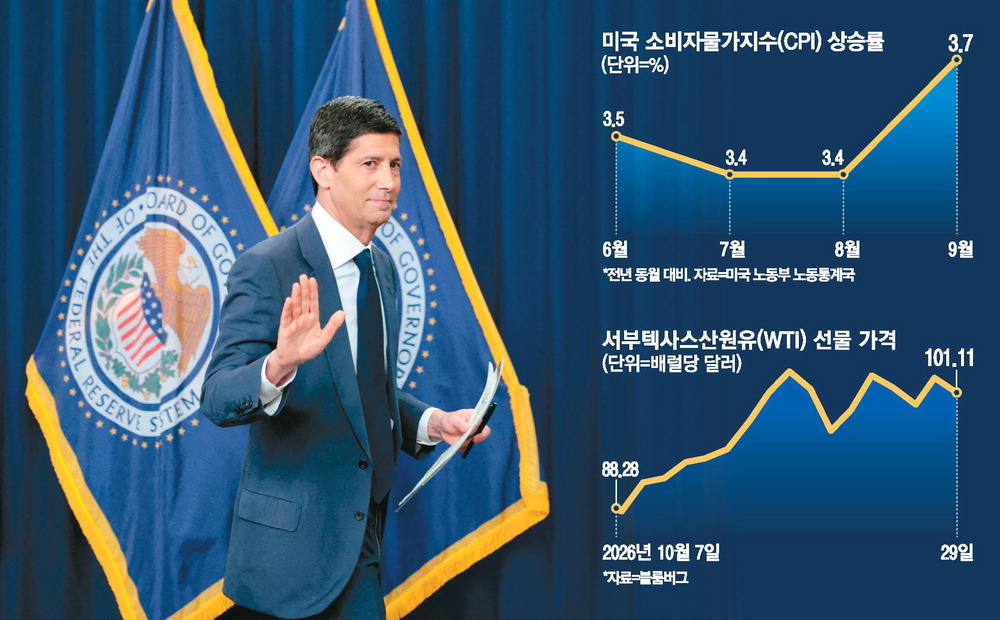
U.S. Federal Reserve Chairman Kevin Wash waves as he leaves after a press conference following the Federal Open Market Committee (FOMC) meeting at the Fed headquarters in Washington, D.C. on the 28th (local time). Reuters Yonhap News
The U.S. Federal Reserve System (Fed) froze the benchmark interest rate at 3.75% to 4% at the first Federal Open Market Committee (FOMC) this month after raising interest rates for the first time in more than three years last month.
“There are no exceptions or clues to realizing price stability, and we will continue to do so,” Fed Chairman Kevin Wash said at a press conference after a regular FOMC meeting on the 28th (local time). Despite the interest rate freeze, the Fed sent a message to the market that it would respond to inflationary pressure.
However, some in the market say that Wash’s remarks did not give a clear signal about the rate hike in December.
First of all, Chairman Wash diagnosed that growth accelerated in the third quarter, with the U.S. GDP growth rising to 2.4% from its initial estimate of 1.8% in the first half of this year. He also explained that the unemployment rate is lower than a year ago and that employment growth is rising at a faster pace than the previous year.
However, he said, “Americans are still suffering from inflation above the committee’s target, and it is our responsibility to lower inflation. This is why FOMC discussions over the past few days have focused on price stability.”
Looking at the economic and financial situation broadly, it is clear that real economic activity is moving in the right direction, but “inflation is too high,” Chairman Wash stressed.
The FOMC’s decision was made with the approval of 10 out of 12 members. Fed Director Lisa Cook and Federal Reserve Bank of Cleveland Governor Beth Hammack expressed a minority opinion at the meeting that the benchmark interest rate should be raised by a quarter of a percentage point. This is the first time Cook has voted against monetary policy decisions since taking office as a Fed director in 2022.
“Inflation remains high,” the Fed said in a statement, explaining that “the accumulation of additional information will help determine the appropriate policy stance to return to the committee’s 2% inflation target in a timely manner.”
The market was already predicting that the FOMC would decide to freeze the benchmark interest rate this month. Inflationary pressure has continued, with the Consumer Price Index (CPI) rising 3.7% in September this year from the same month last year, exceeding the increase in August (3.4%), but the Fed was widely expected to watch the aftermath of last month’s rate hike, with new non-agricultural employment (29,000 people) falling below market expectations in September.
The market is predicting that the FOMC will decide to raise the benchmark interest rate at a meeting in December. However, some say that Chairman Wash did not give a clear signal regarding interest rates on the same day. The Chicago Mercantile Exchange (CME) FedWatch’s December increase rate reached 86% before WASH held a press conference, but fell to 82.6% immediately after the conference and then to 78.4%.
With the Fed’s rate freeze, the interest rate gap between Korea (3 percent) and the U.S. was maintained at 1 percentage point (based on the top of the U.S.).
On the same day, Chairman Wash also announced that he would reduce the FOMC schedule for interest rate decisions once from next year. “We believe that eight meetings a year are a suitable number of times, but we will focus only on a wide range of monetary policy strategies at one meeting next year, and we expect there will be no interest rate votes or policy statements at this meeting,” he said. “The rest of the meetings will be regular FOMC policy-making meetings, and we expect two meetings dedicated to strategic discussions and six policy-making meetings to be held in 2028,” he said.
The market’s attention is focused on the Bank of Korea’s Monetary Policy Committee scheduled for next month. Thanks to semiconductor exports and facility investment, the possibility of achieving 4% growth this year is being discussed, and inflation is also on the rise, which is gaining momentum that the Bank of Korea may start raising interest rates further. After raising the benchmark interest rate in July and August in a row, the Bank of Korea froze the interest rate at 3% per annum at the Monetary Policy Committee held this month. However, it has not stopped the tight monetary policy stance. The Monetary Policy Committee predicts that consumer prices and core inflation will also rise above forecasts (2.3% and 2.5%, respectively).
[Washington correspondent Choi Seungjin / Seoul reporter Kim Yoo Shin]