
The 2026 midterm election results are in, bringing new governors and a Democratic U.S. House and Senate, but what does this mean for technology?
Elections historically can have an impact on state technology leadership, as gubernatorial regime change can sometimes bring CIO changes with it. Typically, when a gubernatorial transition occurs, only 40 percent of state CIOs keep their position — and only 31 percent do so when the governor’s party changes, according to data collected by Government Technology in 2022.
This year, there was no incumbent on the ballot in 18 out of 36 state gubernatorial elections, ushering new governors into state leadership roles in 2027.
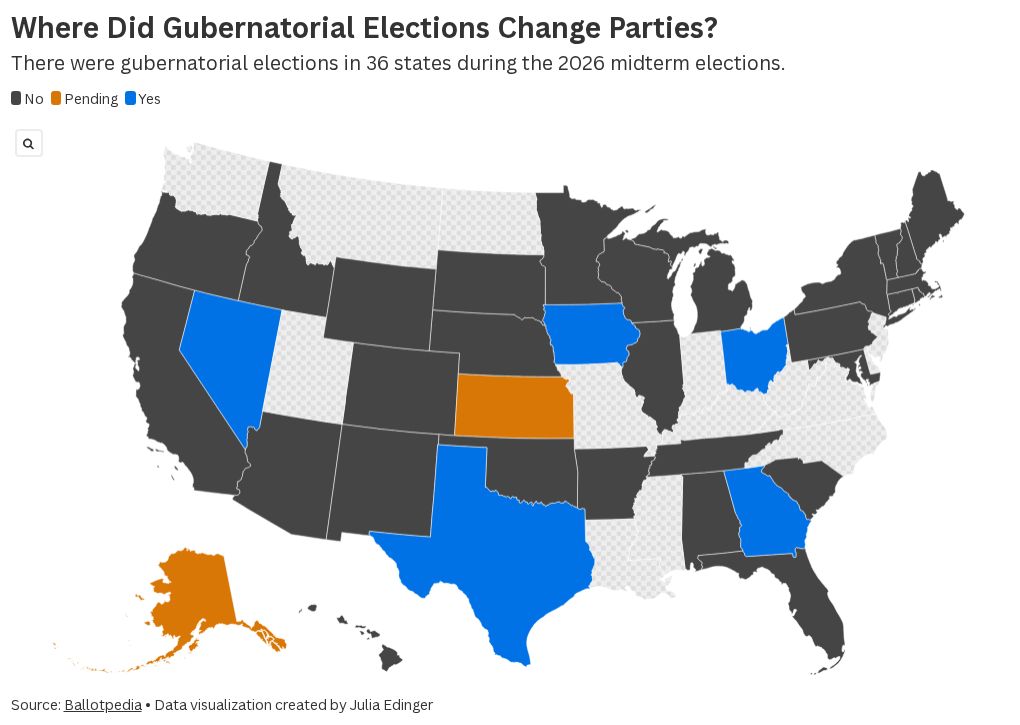
Based on the assumption that states where the governor’s seat changed parties are likely to see new CIOs, Georgia, Iowa, Nevada, Ohio and Texas may see IT leadership changes. Currently, the CIOs in those states are Shawnzia Thomas, Matt Behrens, Timothy Galluzi, Katrina Flory and Tony Sauerhoff, respectively.
But state technology leadership is not the only area likely to be impacted by these election results. At the federal level, the U.S. Senate and House majorities have flipped from Republican to Democrat.
“NASCIO is hopeful that Democrats in Congress will hear the concerns of state governments when it comes to critical cybersecurity and technology needs,” said Alex Whitaker, director of government affairs for the National Association of State CIOs (NASCIO), in an email, noting the limited resources available for state governments.
“We encourage Congress to quickly reauthorize and fund the State and Local Cybersecurity Grant Program, ensure that states can continue to regulate AI technology and enforce their AI laws, provide adequate support for cybersecurity upgrades and technology modernization efforts and treat states as partners in the efforts to secure America’s critical cyber infrastructure,” Whitaker said.
One technology issue that Republicans and Democrats are notably united on is that both state and federal governments should be able to regulate AI. This has been a topic of debate over the past couple of years.
The Trump administration has taken multiple actions in an attempt to limit states’ authority to enact regulatory protections, including a now-stricken decadelong regulatory moratorium in a budget bill, an executive order that threatens federal broadband funding for states if their AI laws are deemed “onerous,” and calls on lawmakers to act to prevent “overregulation.” However, states such as Colorado and Illinois have enacted legislation related to AI.
Another technology issue seeing broad bipartisan agreement is data center opposition, and measures addressing these projects were on the ballot in 10 states during the midterm elections, as shown in the data visualization below created by Governing Senior Staff Writer Carl Smith.*
Polling revealed insights into public sentiments on the topic ahead of this election. For example, 7 in 10 Americans oppose data centers being built in their area, per a Gallup poll. Research from the Information Technology and Innovation Foundation indicated that 46 percent opposed a new data center in their community — more than three times the opposition for new housing. State CIOs have also become involved in the data center debate.
In nearly every instance during the midterm elections, voters passed measures to restrict, regulate, pause or ban data center development.

“Local measures to restrict data centers passed or were leading in more than 30 communities, and Texas and Georgia elected governors whose platforms hinged on their communities’ data center concerns,” said Alejandra Montoya-Boyer, vice president of The Leadership Conference’s Center for Civil Rights and Technology, in an emailed statement. She dubbed the 2026 midterms the “first true AI election in the U.S.”
In some races, experts had predicted prior to the election that candidates’ positions on data centers may sway the results.
For example, Will Lawrence of Lansing, Mich., ran for a U.S. House seat and won; he has said that he was able to gain Republican voters’ support due to his stance opposing these projects. Ohio Sen. John Husted attempted to pass legislation intended to address rising electricity prices caused by data center development, but opponents criticized the bill for not creating binding requirements. And Husted lost his re-election bid to former Sen. Sherrod Brown.
In contrast, Florida Gov.-Elect Byron Donalds was dubbed “Data Center Donalds” by his opponent David Jolly, who opposed the developments; Donalds won the race.
And, of course, it’s not just state and federal government; local IT will also see impacts from this historic election cycle.
“As newly elected leaders set their priorities, local governments need a voice in conversations about technology policy and investment,” National Association of Counties (NACo) CIO John Matelski said in an email, noting that the work of governing continues well after an election. Residents still rely on counties for essential services that depend on technology, he said. “Decisions involving cybersecurity, connectivity, digital services, artificial intelligence and emerging technologies directly affect their ability to serve residents.”
These decisions impact local budgets, especially in small and rural communities. Both funding and access to information will play a role in localities’ technology strategies, and NACo will support county leaders across party lines to help them better serve residents, Matelski said.
While some questions remain, exit polling data reveals that many voters were thinking about technology during this Election Day.
“More than half of all voters across this diverse nation said that AI was a major factor in their vote,” said Common Sense Media CEO and founder James P. Steyer in an emailed statement citing NBC polling. He noted that tech giants have operated “largely unchecked … up until now,” and called on the newly elected Congress and state leaders to “act on behalf of the American public.”

*Governing is part of e.Republic, Government Technology’s parent company.