 사진 확대
The International Monetary Fund (IMF) has significantly raised its growth forecast for this year and next, saying that booming artificial intelligence (AI) and semiconductor exports are leading the Korean economy. However, he ordered that additional monetary and fiscal tightening prescriptions are needed as the economy is expected to heat up due to the semiconductor boom and prices are expected to exceed the target.
According to the Ministry of Finance and Economy on the 17th, the IMF’s annual consultative group announced the “2026 Annual Consultation Results” based on the annual consultations held since the 3rd.
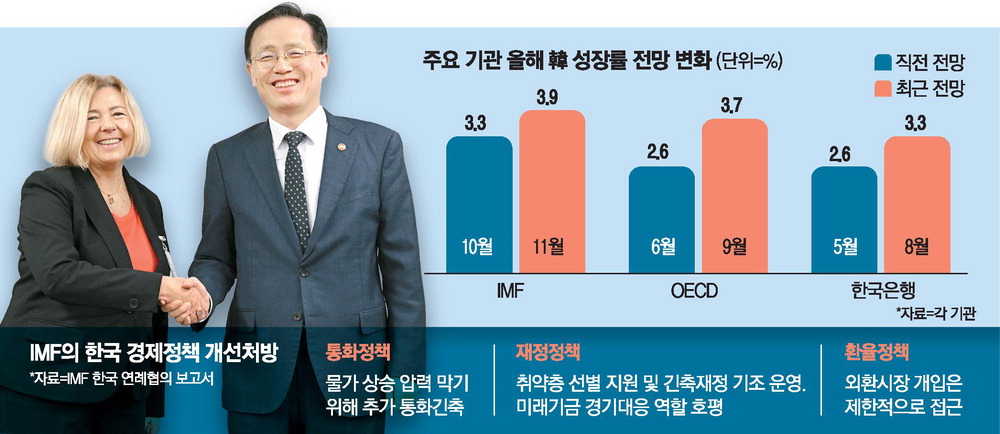
The consultative group expects Korea’s real gross domestic product (GDP) growth to soar from 1.1% last year to 3.9% this year. This is a 0.6 percentage point increase in the eye level in a month compared to the 3.3% presented by the IMF through the World Economic Outlook (WEO) last month. The growth outlook for next year also increased by 0.5 percentage points from 2.8 percent last month to 3.3 percent. For the second consecutive year, the company has forecast a growth of around 3%. In October last year alone, the IMF forecast Korea’s growth rate of 1.8% this year. Since then, it has raised its new forecast by 2.1 percentage points to 3.9 percent this year, following 1.9 percent in January, 2.6 percent in July, and 3.3 percent in October.
This is a change from the IMF’s advice during the annual consultation in September last year that the government should spend more money and lower the interest rate burden to support the economic recovery. In this year’s IMF announcement, the expression “AI boom,” which did not exist last year, appears three times. The IMF evaluated that investment is reviving and consumption is increasing amid a surge in exports of high-tech industries such as semiconductors due to the AI boom. “The growth rate in the third quarter was better than expected, so we raised the outlook by considering the recent export performance,” Corinne Delesha, head of the IMF’s annual consultative group, said at a press conference. It is predicted that large-scale AI investment will increase the basic physical strength for Korea to grow steadily. “Considering large-scale AI-related investments, Korea’s potential growth rate will improve to 2.5% in the medium term,” Delesha said.
However, he recommended that price stability should be tightened further. Korea’s consumer price growth rates for this year and next year, as predicted by the IMF, are 2.7% and 2.3%, respectively. All of them are above the Bank of Korea’s price stabilization target of 2%. The limitation was that the source of growth is focused on the semiconductor industry and the pace of the boom spreading to other companies and households is slow. “We need to maintain the tightening stance of monetary policy so that prices fall to the target level,” Delesha said, stressing that “fiscal should also be operated somewhat tight.” It is explained that the government should tighten its finances together because if the price control task is left to monetary policy, interest rates can rise too high, increasing the burden on vulnerable households. The consultative group said there was still high uncertainty in the economic outlook and downside risks to growth prevailed, stressing that the tightening stance of short-term macro-policy should be carefully coordinated to mitigate risks concentrated in certain sectors.
The government praised the establishment of the 162.3 trillion won Future Response Fund, which is intended to be raised with additional tax revenues following the semiconductor boom, as “welcome.” The government plans to stabilize finances and invest in the future according to economic conditions through the Future Response Fund. “As the semiconductor economy is highly volatile, holding back excess tax revenue can serve as a buffer when tax revenue decreases in the future,” Delesha said.
The consultative group also called for structural reforms to spread the effects of the AI boom throughout the economy. It is necessary to respond to rapid aging, regional imbalances, and productivity gaps between companies and workers. In detail, the IMF proposed ways to increase the participation rate in economic activities and close the wage gap according to the type of work. The exchange rate should be kept flexible, but intervention in the foreign exchange market should be limited to cases that prevent market turmoil, he said.
[Reporter Kim Hee Soo]