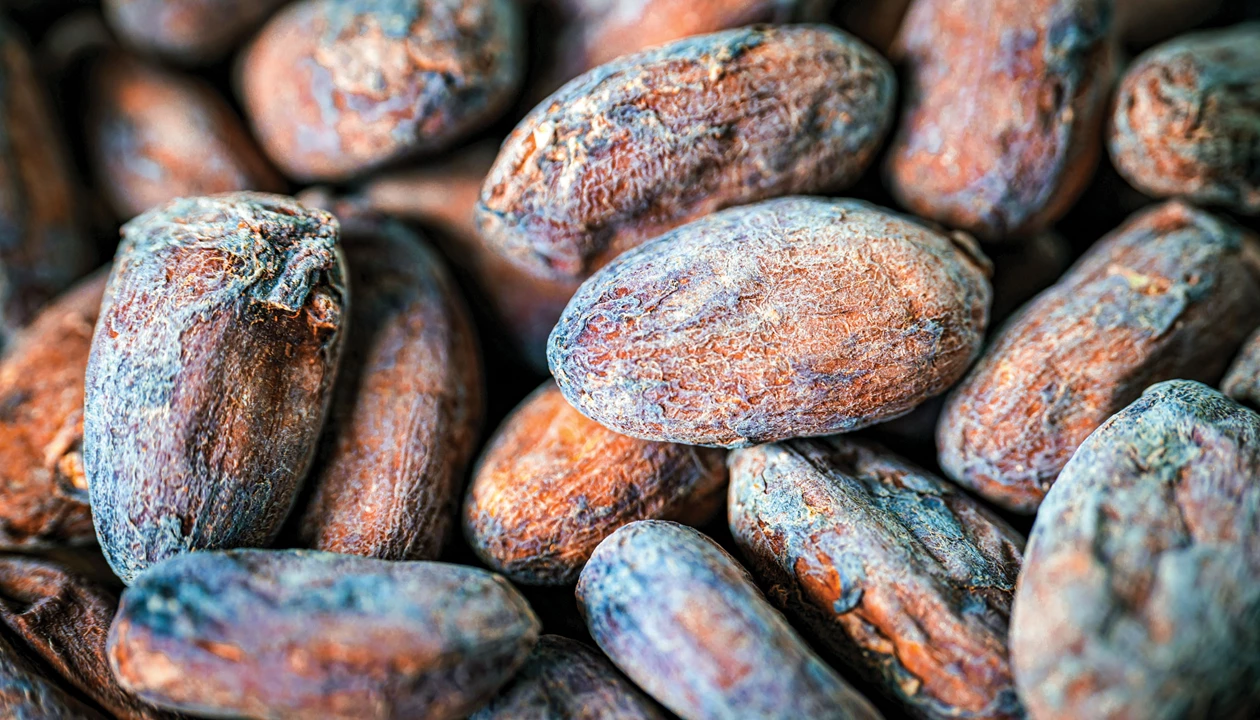
It’s tough to improve on either honey or chocolate. But scientists in São Paulo took on the challenge, for reasons more chemical than culinary.
In a recent study, the team used honey from native Brazilian bees as a solvent to extract bioactive compounds from cocoa bean shells, a waste product of making cocoa and its derivatives.
To enhance the process, the team placed an ultrasound probe that looks like a metal pen inside a pot of honey and cocoa shells. The soundwaves then prompted the cocoa shells’ antioxidant and anti-inflammatory compounds, such as caffeine and theobromine, to migrate to the solvent.
The fibrous shells are milled down to 250–500 μm, just a tad bigger than a dust mite.
“When cocoa bean shells are finely milled, they can be effectively incorporated into the honey matrix, resulting in a homogeneous and smooth product without a gritty texture,” says study leader Felipe Sanchez Bragagnolo, a bioprocess and biotechnology engineer at Universidade Estadual de Campinas. “Therefore, we prioritize controlling particle size during milling, enabling the integration of cocoa shells without generating significant residues or by-products.”
The resulting honey, which has an appealing chocolate flavor, could be sold as a health-boosting food or cosmetic product while helping reduce the more than 635,000 metrictons of annual cocoa shell waste, the authors say in the study (ACS Sustainable Chem. Eng. 2025, DOI: 10.1021/acssuschemeng.5c04842).
“This approach shifts the focus from scientific papers to technical feasibility, economic viability, and real-world usefulness, which is essential for translational research,” Bragagnolo says.
The benefits of bees
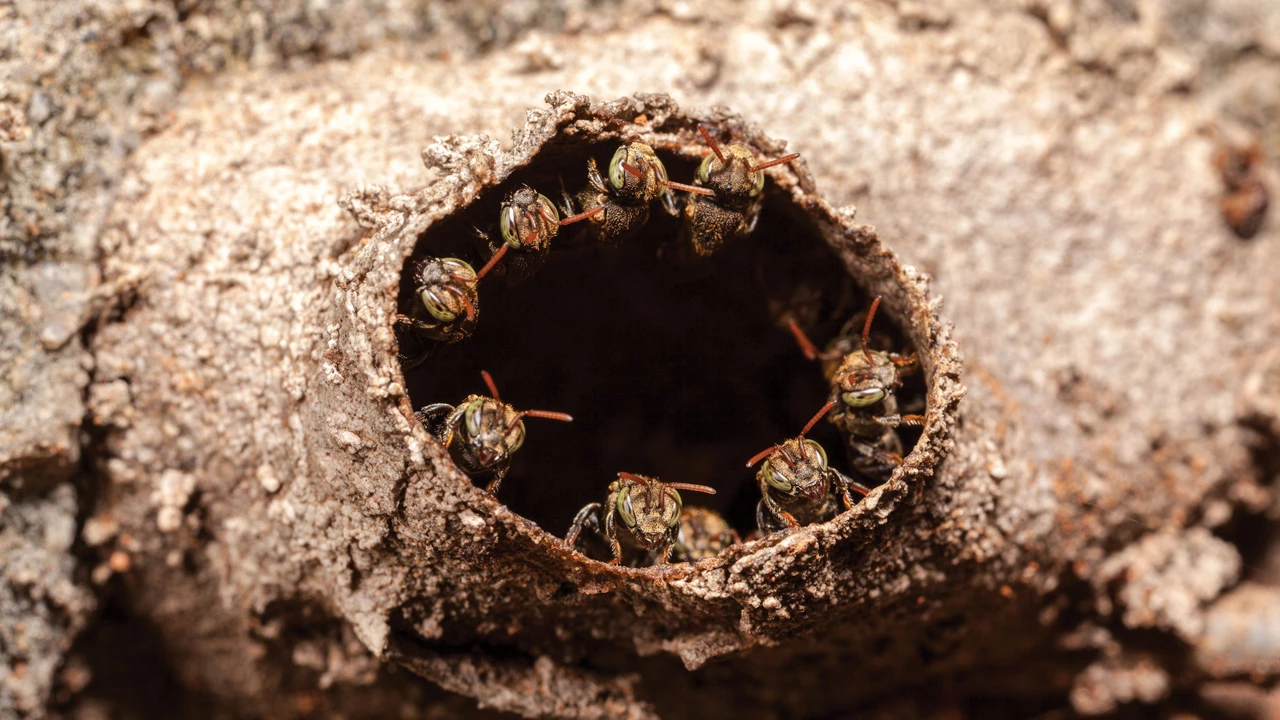
A few stingless bees gather around an opening in their colony.
Scientists used the honey of five stingless honeybees native to Brazil, including Scaptotrigona postica (pictured above in a colony).
Credit:
Tacio Philip Sansonovski/Shutterstock
It all started when Bragagnolo, a hobbyist beekeeper, noticed that honey from native stingless bees is, at about 40% water, less viscous than commercial honey sourced from European honeybees, which is about 20% water.
After further investigation in the lab, Bragagnolo and colleagues found honey from five bee species, including mandaguari (Scaptotrigona postica) and moça branca (Frieseomelitta varia), is chemically similar to natural deep eutectic solvents, which are used in making various natural products.
Even so, Bragagnolo was surprised by how well honey extracted theobromine, the main alkaloid in the cocoa bean.
“Methylxanthines and polyphenols from cocoa, such as theobromine, catechin, and epicatechin, combined with the humectant properties of honey, offer promising benefits for skin-care formulations,” he says.
Honey is already a big player in the cosmetics industry, he adds, and such a “chocolate honey” product has major potential.
“There is room in the cosmetic ingredient space to have more upcycled ingredients,” Gabriella Baki, a professor at the University of Toledo College of Pharmacy and Pharmaceutical Sciences, says by email.
This study “serves as a great example of how companies can make sustainable steps toward ingredient creation, and how the process should be designed and executed,” says Baki, who is director of the school’s Cosmetic Science and Formulation Design Program and was not involved in the research.
Baki also praised the study for comparing the various properties of the honey from the five species. “Not all honey is equal, as the study shows,” she says.
Yet, this variability can pose a problem in reproducibility and standardization, she says, since “changing suppliers can be challenging, and even honey from the same supplier can vary over time.”
Sweeter and more sustainable
Looking to the future, many chemists are exploring ultrasound technology to make their research more sustainable.
For starters, it’s faster and more efficient, and it produces less waste than other methods, which makes it compliant with the principles of green chemistry, according to Maurício Ariel Rostagno, a study coauthor and Bragagnolo’s postdoctoral supervisor.
“We believe that with a device like this, in a cooperative or small business that already works with both cocoa and native bee honey, it’d be possible to increase the portfolio with a value-added product, including for haute cuisine,” Ariel Rostagno says in a statement.
“Since publishing the study, we have received valuable feedback from direct interactions with cocoa and honey producers,” Bragagnolo adds.
What’s more, the ultrasound probe creates microbubbles in the honey that implode and temporarily increase its temperature, which may kill harmful microbes that could contaminate honey. The process also increases the shelf life of honey from European honeybees, which is stored at room temperature.
“From a food safety perspective, I find that to be very interesting to see further research on,” says Meghan Cahill, an analytical chemist at the Connecticut Agricultural Experiment Station who specializes in the elemental analysis of food and whose opinions are not those of her employer.
“Preventing foodborne outbreaks and the shelf life of food is always worth investigation.”
Chemical & Engineering News
ISSN 0009-2347
Copyright ©
2026 American Chemical Society