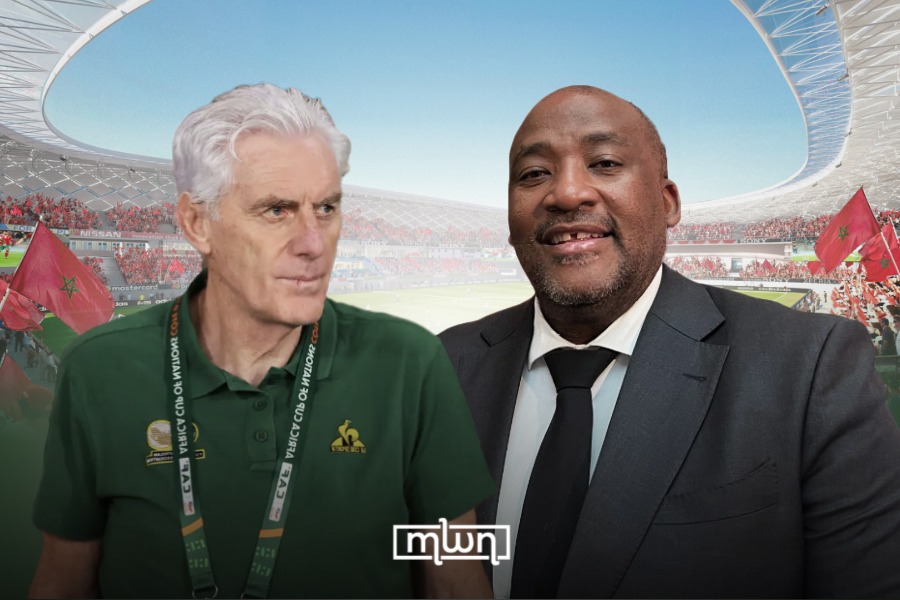
Marrakech – South Africa’s government has publicly contradicted its national team coach’s harsh criticism of Morocco’s AFCON 2025 hosting, with Sports Minister Gayton McKenzie delivering glowing praise for the tournament organization days after Hugo Broos slammed it as “catastrophic.”
McKenzie dispatched a formal letter to Morocco’s Education and Sports Minister, Mohamed Saad Berrada, on January 6, commending the “truly exceptional manner” in which Morocco is delivering the continental championship.
Morocco “is currently hosting AFCON at a genuinely world-class standard,” the minister said, hailing “the quality of the organisation, the professionalism of the tournament structures.”
Thank you Morocco 🇲🇦 🇿🇦⚽️🏆 pic.twitter.com/8B2lCriShh
— Gayton McKenzie (@GaytonMcK) January 6, 2026
This diplomatic endorsement sharply diverges from the harsh and recurrent criticism voiced by Broos throughout the tournament. The Belgian tactician has repeatedly targeted Morocco’s organizational capabilities, describing the situation as “chaos” and lamenting that “nobody is coming to watch the matches.”
Broos’s criticism intensified after South Africa’s group stage defeat to Egypt, when he revealed security concerns affecting his family. “My wife said she was afraid,” Broos stated, detailing how “police prevented certain people from entering the stadium, despite their tickets,” while “crowds of people without tickets” gained access.
The coach drew unfavorable comparisons to previous tournaments, noting: “This is not comparable to the Africa Cup of Nations in Gabon (2017) or Ivory Coast (2024). There, we really felt like we were in a tournament. When we took the bus to training, people waved flags and greeted us. Here, there is nothing.”
McKenzie’s letter directly countered these assessments, detailing Morocco’s infrastructure investments. “The stadiums themselves stand out as symbols of Morocco’s ambition and capacity,” the minister wrote, commending their “design, renovation and modernisation” and noting that “the quality of the pitches has been outstanding.”
He added that hotel arrangements “have been excellent, offering comfort, security, and an environment that allows elite athletes to prepare and perform at the highest level.”
The minister specifically lauded Morocco’s logistical arrangements, stating that “transport logistics from the modern, well-equipped team buses to the efficiency of movement between training sites, stadiums and accommodation – have reflected meticulous planning and significant investment in infrastructure.”
Broos’s complaints extended beyond crowd management to training logistics. Before South Africa’s Round of 16 clash with Cameroon, he criticized the 45-minute journey to training facilities, stating: “We lose 1h30 in the bus instead of training.”
The coach suggested potential interference, noting that both South Africa and Cameroon were assigned to train at Morocco’s base facilities.
View this post on Instagram
South Africa’s tournament campaign concluded Sunday night when they bowed out 2-1 to Cameroon in Rabat. Despite dominating possession with 66% and registering 18 attempts, Bafana Bafana fell short in the knockout stage. Evidence Makgopa’s late strike proved insufficient as Cameroon’s resolute defending secured their quarter-final berth.
McKenzie positioned the tournament as preparation for Morocco’s 2030 World Cup co-hosting duties. “This tournament is more than a continental championship; it is a powerful demonstration of Morocco’s readiness to co-host the 2030 FIFA World Cup,” he wrote, noting the “organisational capacity shown during AFCON.”
The minister extended “sincere congratulations” to the Royal Moroccan Football Federation (FRMF) and acknowledged “the countless professionals and volunteers whose hard work has made this tournament such a success.”
He concluded that “Morocco is sending a clear message to the world that Africa can stage major global sporting events at the highest international level.”
Order threatens imperial memory
This was not the first time Broos has ignited controversy, but the gravity of his remarks is especially jarring given that he is coaching a nation shaped by the scars of apartheid.
The Belgian’s racist remarks during December preparations laid bare an imperial mindset when he singled out defender Mbekezeli Mbokazi for arriving late to training camp.
During a December 12 press conference, Broos declared: “Even if this boy is black, when he comes out of my office, he will be white.”
These comments – compounded by sexist remarks directed at player agent Basia Michaels over Mbokazi’s club transfer – went beyond poor judgment. They revealed a profound discomfort with African agency, professionalism, and modernization.
View this post on Instagram
Broos’s nostalgic yearning for tournaments where “people waved flags and greeted us” is not benign sentimentality; it is a discursive slip that betrays a deeply embedded colonial imaginary. It evokes a vision of Africa as spectacle rather than subject – an affective landscape designed to affirm European centrality and white authority.
In post-colonial terms, this is the classic West-and-the-Rest binary, in which Africa exists to be encountered, managed, and symbolically mastered, not to assert parity or modern competence.
His hostility toward Morocco’s meticulously organized AFCON reflects what scholars describe as the imperial gaze: a mode of perception conditioned to expect African dysfunction and unsettled when confronted with efficiency, order, and excellence.
Morocco’s world-class stadiums, logistics, and institutional professionalism disrupt the epistemology of inferiority upon which colonial authority once relied. The discomfort is not about organization; it is about the collapse of a hierarchy in which Europe commands and Africa complies.
Broos’s rhetoric signals an anxiety rooted in the loss of symbolic superiority. He appears unsettled by an Africa that no longer performs primitivism for Western consumption – an Africa that refuses to remain the mythologized terrain of savagery and disorder immortalized in “Heart of Darkness,” an 1899 novella by Polish-British writer Joseph Conrad.
What he longs for is not football chaos, but colonial legibility: the older Africa where European presence felt elevated, uncontested, and unquestioned.
In this sense, his comments are less about sport than about power, less about AFCON than about decolonization. Morocco’s modernity exposes the fragility of a worldview still tethered to imperial nostalgia – a worldview in which African progress is perceived not as success, but as provocation.