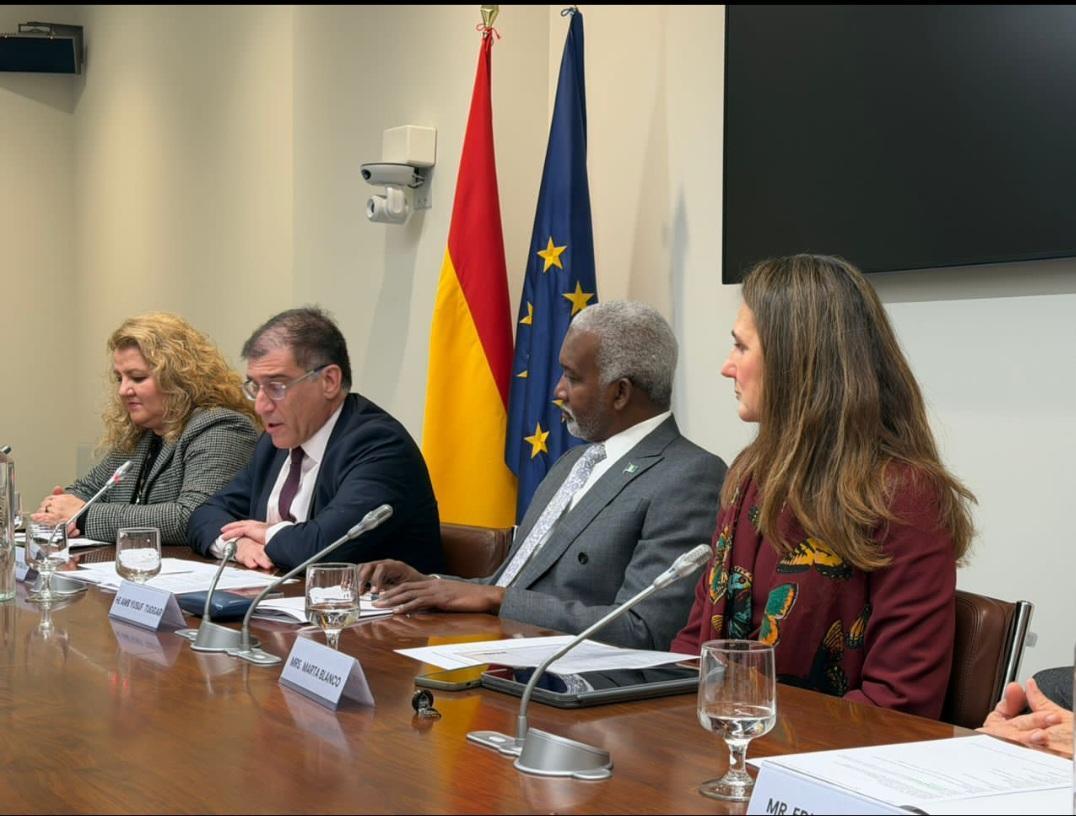
Nigeria has renewed its push to strengthen economic relations with Spain, positioning the country as a key partner and vital link between Africa and Europe.
At an engagement with the leadership of CEOE, Spain’s leading business confederation, Nigeria’s Minister of Foreign Affairs, Yusuf Tuggar, highlighted the nation’s reform-focused economic agenda and its growing alignment with Spain’s globally oriented private sector.
In a statement issued by SA Media to the Minister of Foreign Affairs, Alkasim Abdulkadi, the Minister acknowledged CEOE’s role as the backbone of Spain’s productive economy and outlined Nigeria’s ongoing efforts to stabilise and reposition its economy through structural reforms, diversification, and improved macroeconomic coordination.
“Economic growth,” he noted, “is increasingly driven by non-oil sectors such as agriculture, services, manufacturing, technology, and global services, supported by a population of over 200 million people, more than 70 per cent of whom are young.”
Nigeria emphasised its attractiveness to Spanish investors as Africa’s largest market and a strategic gateway to West and Central Africa. Through the African Continental Free Trade Area (AfCFTA), investments based in Nigeria can access a continental market of over 1.3 billion people.
Tuggar stressed the country’s preference for long-term, productive investments that support technology transfer and value-chain development, rather than short-term or speculative ventures.
Also Read: Nigeria And Spain To Boost Bilateral Economic Viability
Key sectors for potential Spanish investment were outlined. In energy and gas, Nigeria’s extensive reserves offer opportunities in LNG, power generation, petrochemicals, fertilisers, and the energy transition, including major regional projects such as the African Atlantic Gas Pipeline and the Trans-Saharan Gas Pipeline. In agriculture and agro-processing, prospects include mechanisation, food processing, cold-chain logistics, and export-oriented agribusiness.
Infrastructure and industrial development were also identified as priority areas, particularly through public–private partnerships in transport, logistics, and special economic zones. Nigeria further presented itself as an emerging hub for Business Process Outsourcing (BPO), citing its young, English-speaking, and digitally skilled workforce. Technology, fintech, digital infrastructure, creative industries, and professional services were similarly highlighted as high-growth sectors.
On migration, Nigeria reaffirmed its opposition to irregular migration, advocating instead for structured and legal labour mobility aligned with market needs. Spain’s circular migration framework was praised as compatible with traditional West African labour practices, with Nigeria noting that well-managed mobility can enhance competitiveness, reduce irregular migration, and strengthen bilateral trust.
The delegation also pointed to ongoing reforms aimed at improving the ease of doing business, regulatory clarity, and investor protection. Spanish investors were assured of incentives, sector-specific support, expanding infrastructure, and a strong focus on diaspora- and skills-driven investments that link global expertise with local opportunities.
The Minister called on CEOE to play a catalytic role by encouraging Spanish companies “to see Nigeria not just as an export destination, but as a base for production and services; to support joint ventures and SME partnerships; and to help promote a more balanced Europe–Africa economic narrative built on mutual benefit.”
He described Nigeria as “open, reform-oriented, and ready to deepen economic cooperation with Spain.”
Spanish businesses were invited to invest and grow in Nigeria not as a high-risk frontier, but as a platform of opportunity capable of delivering sustainable value, job creation, and long-term partnerships.