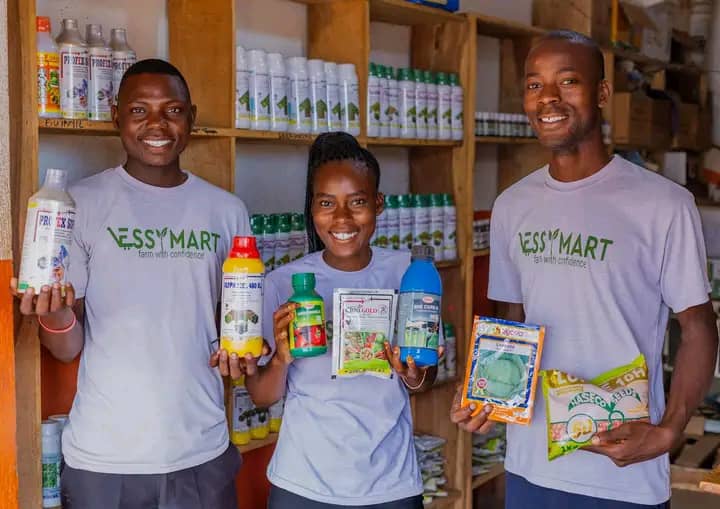
Ugandan agri-tech startup Essymart is working to alleviate hunger and extreme poverty for small-scale farming families by delivering a complete bundle of products and services – financing for improved farm inputs, delivery, agricultural training, and post-harvest market support.
Founded in 2022 by Elvis Kadhama, Viola Nakadama, and Stella Doreen Namulondo, Essymart has developed a suite of products and services it says, taken together, can help farmers significantly increase their crop yields and income, enabling families to begin paths to prosperity.
These include access to high-quality seeds, pesticides and fertilisers; training in modern farming techniques; financing; and post-harvest support. Essymart works directly with farmers, often in remote rural areas, helping them grow more food and earn more income from their land.
“Farmers who join our programme typically see a 40-45 per cent increase in their incomes on the crops, fruit trees, vegetables and other products we support by the use of WebApp, SMS and voice calls,” Kadhama told Disrupt Africa.
Essymart currently serves over 5,000 farmers across counties such as like Mayuge, Iganga, Bugiri, Namayingo, Kaliro and Bugweri. The startup combines technology with on-the-ground presence to offer a farmer-centered ecosystem, rather than just being a product supplier.
The startup, which is primarily self-funded but has also received external funding in the form of grants from the likes of the Sahara Impact Fund, the Tony Elumelu Foundation (TEF), and the Alliance for Green Revolution in Africa (AGRA). This has helped its uptake among smallholder farmers in Eastern Uganda grow rapidly since its 2022 launch with just a few dozen farmers.
“By 2024 we had served about 4,000 farmers, a roughly 20 per cent increase over the prior year, and were nearing our 2030 goal of supporting 20,000 families. Uptake combines direct full-service clients and those reached through partnerships with public and private actors, reflecting both demand for its integrated package of inputs, training, and market linkages and an expanding delivery network,” said Kadhama.
Overall, adoption is strong, with millions of smallholders choosing to work with the fund as it scales toward its mission of improved productivity, resilience, and income. The startup plans to expand to Rwanda and Nigeria in the next few years.