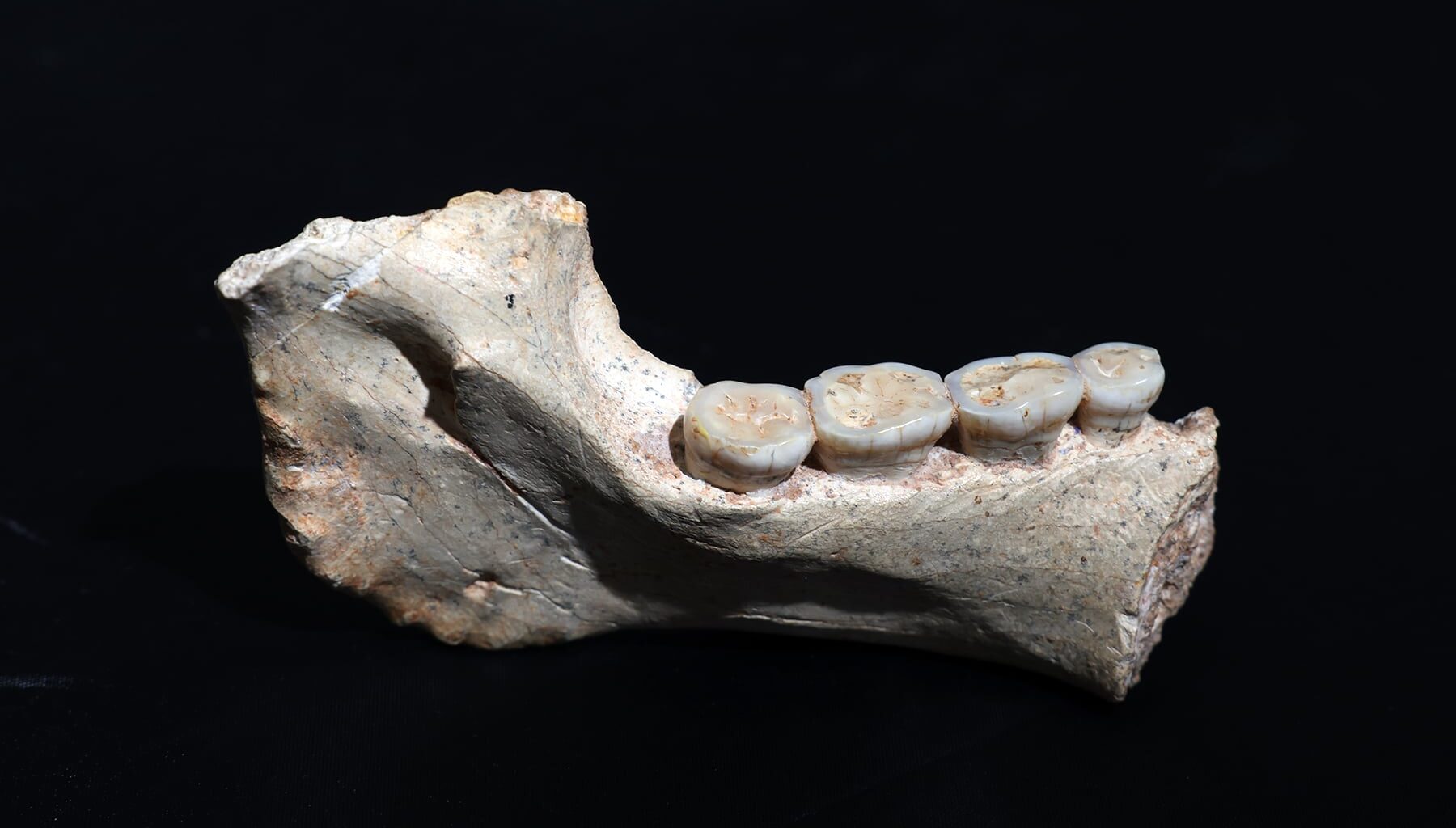
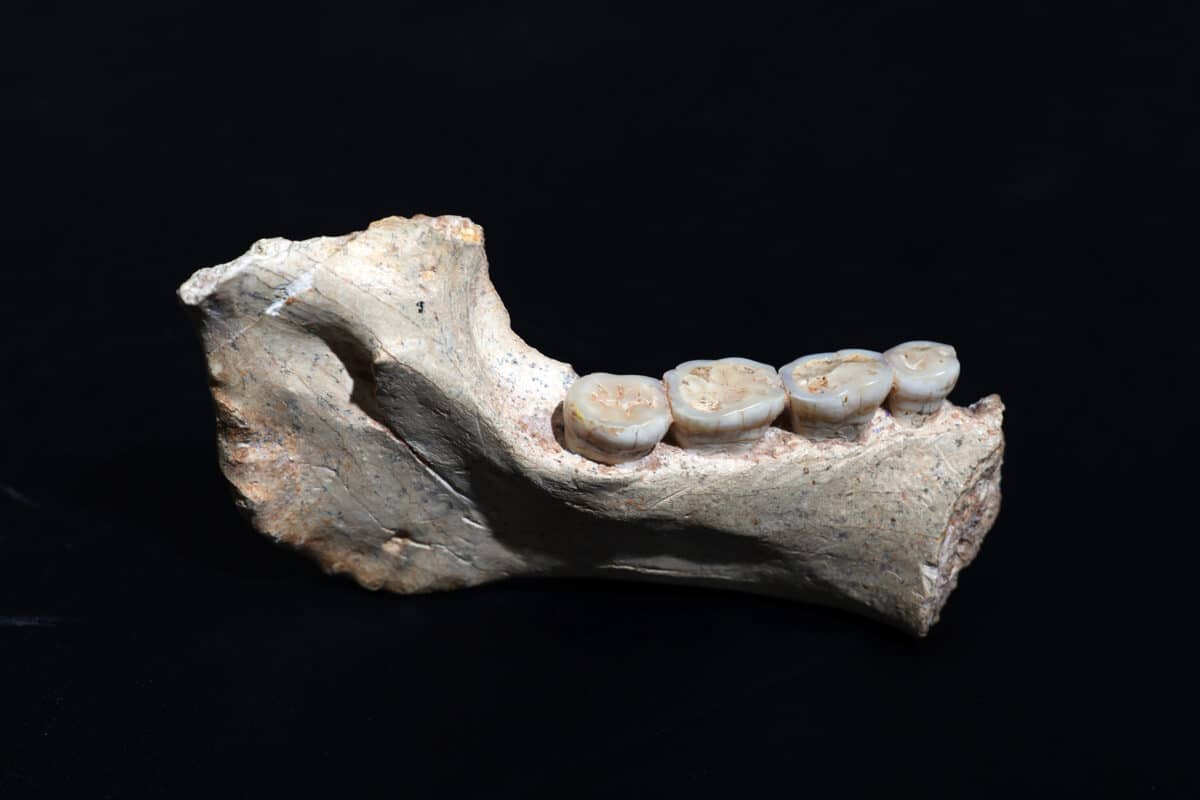
773,000-year-old mandible ThI-GH-1 from Thomas Quarry in Morocco. (Credit: © Hamza Mehimdate, Programme Préhistoire de Casablanca)
Bones From 773,000 Years Ago Capture Human Evolution at a Crossroads
In A Nutshell
Ancient African fossils dated to around 773,000 years ago offer rare clues about the last common ancestor of modern humans, Neanderthals, and Denisovans
The bones show a mix of primitive and advanced features, neither fully modern nor entirely archaic, suggesting populations near the evolutionary split
Magnetic field analysis placed the fossils close to a major geological transition, while extinct mammal species in the cave confirmed the Early-Middle Pleistocene timeframe
All securely dated early Homo sapiens fossils come from Africa or its gateway to Asia, strengthening the case for African, not European, origins of our species
Scientists have discovered human fossils originating from around the time of one of evolution’s most decisive turning points. Unearthed in Morocco, the bones date to roughly the time when our ancestors were diverging from the lineage that would become Neanderthals and Denisovans, offering rare clues about what populations near that ancestral split might have looked like.
Genetic evidence suggests the last shared ancestor of present-day humans, as well as ancient Neanderthals and Denisovans, lived around 765,000 to 550,000 years ago. The Moroccan remains, at around 773,000 years old, fall just slightly older than that genetic estimate but close to the timeframe of divergence.
Researcher Jean-Jacques Hublin and his international team spent over two decades excavating the Grotte à Hominidés at Thomas Quarry I near Casablanca. The cave yielded two partial jawbones, several teeth, eight neck and upper back vertebrae, and part of a thighbone belonging to at least three individuals.
Human-Neanderthal Split Captured in Fossils
The bones display an unusual blend of features. Some traits look primitive, similar to older human ancestors like Homo erectus. Others appear more advanced, hinting at characteristics that would later define both modern humans and Neanderthals. The most complete jawbone is gracile and delicate, with a relatively small body. Its chin area shows subtle modern features, though it lacks the pronounced chin of people today.
The teeth provide additional evidence of this in-between status. Their size pattern, with the wisdom tooth notably smaller than the second molar, resembles modern humans more than earlier human species. Crown and root shapes analyzed through CT scanning show dental anatomy that doesn’t neatly match either group, falling near but not inside the ranges seen in later Neanderthals and modern humans. One adult mandible exhibits some features more common in later European populations that would eventually lead to Neanderthals, while the other adult jaw leans slightly more toward traits seen in the African lineage leading to our species.
Scientists would expect to find exactly this blend of characteristics in populations living around the time of divergence. These individuals weren’t yet fully modern humans, and they may not be the common ancestor itself. They could represent early descendants on the African branch, populations that lived shortly after the lineage split.
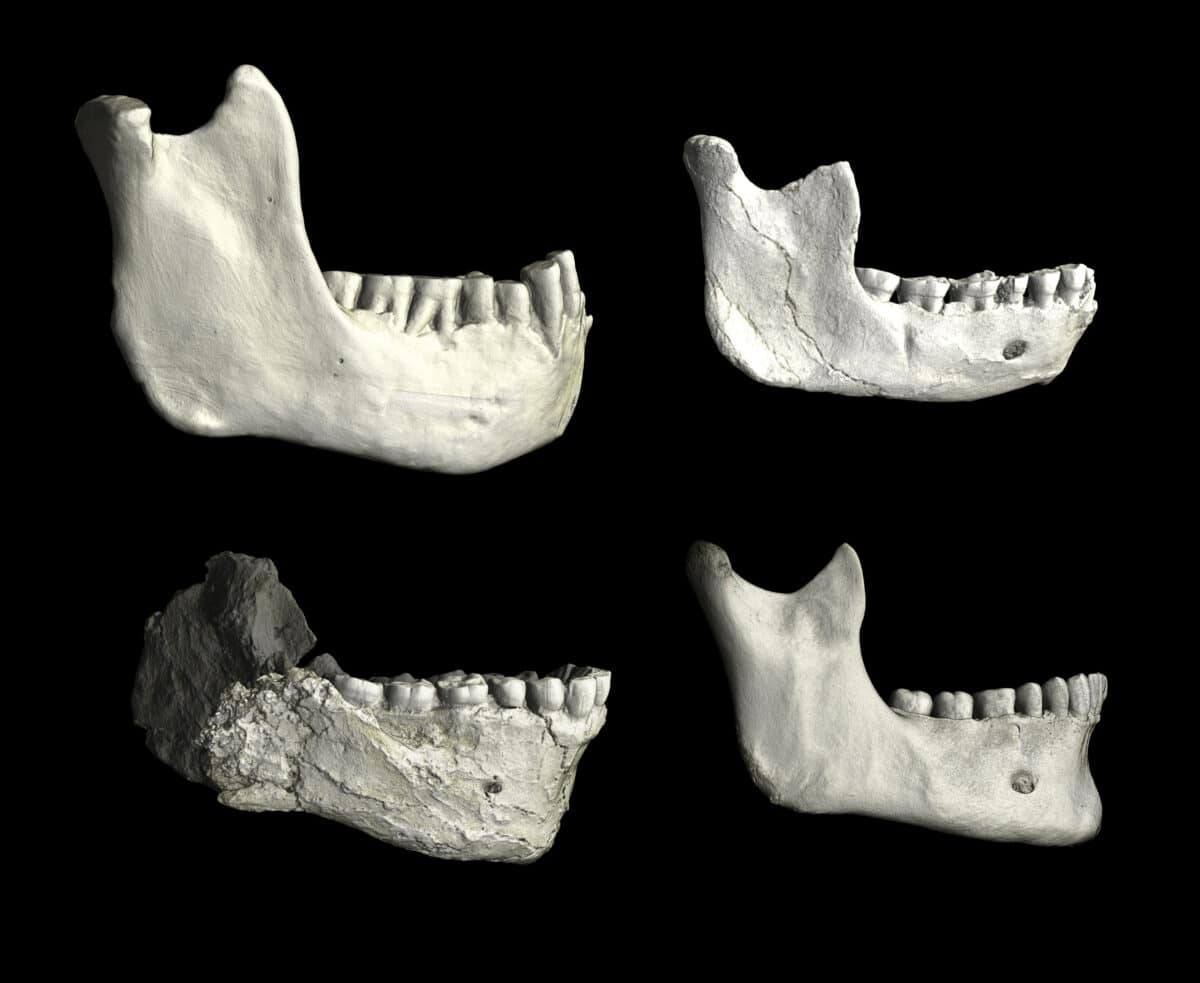
Lower jaws (mandibles) from North Africa, illustrating variation among fossil hominins and modern humans. The fossils shown are Tighennif 3 from Algeria (upper left), ThI-GH-10717 from Thomas Quarry in Morocco (upper right), and Jebel Irhoud 11 from Morocco (lower left), compared with a mandible from a recent modern human (lower right). All specimens are shown at the same scale, allowing direct comparison of their size and shape. (Credit: © Philipp Gunz, MPI for Evolutionary Anthropology)
Dating Methods Pinpoint 773,000-Year Timeline
The research team used Earth’s magnetic field reversals to establish the age. These reversals (periodic flips where the north magnetic pole becomes south) leave distinctive signatures in rocks and sediments. The team found evidence of the Matuyama-Brunhes transition, a well-documented magnetic reversal with a nominal age of 773 ± 4,000 years, in the same layers where the fossils were found. They analyzed 181 magnetostratigraphic samples to build a detailed magnetic timeline.
The cave’s geological history supports this dating. It was carved into older beach deposits during a period of high sea levels around 795,000 years ago, then gradually filled with marine sediments before transitioning to continental deposits. The fossils were recovered from this transition zone, placing them close to the time of the magnetic reversal.
Other dating attempts produced conflicting results. Optical luminescence methods suggested ages around 400,000 years, and uranium-series dating of teeth indicated roughly 500,000 years. The researchers favor the magnetostratigraphic evidence because it aligns with the geological context and the types of extinct animal species found alongside the human remains. The fossil assemblage includes 37 mammal species, including extinct forms like Theropithecus oswaldi and Ceratotherium mauritanicum known from sites dating to the Early-Middle Pleistocene boundary.
The study, published in Nature, compared the fossil bones to hundreds of other hominin specimens from across Africa, Europe, and Asia using 3D geometric analysis, examining 301 measurement points on the jawbones and detailed tooth crown and root shapes.
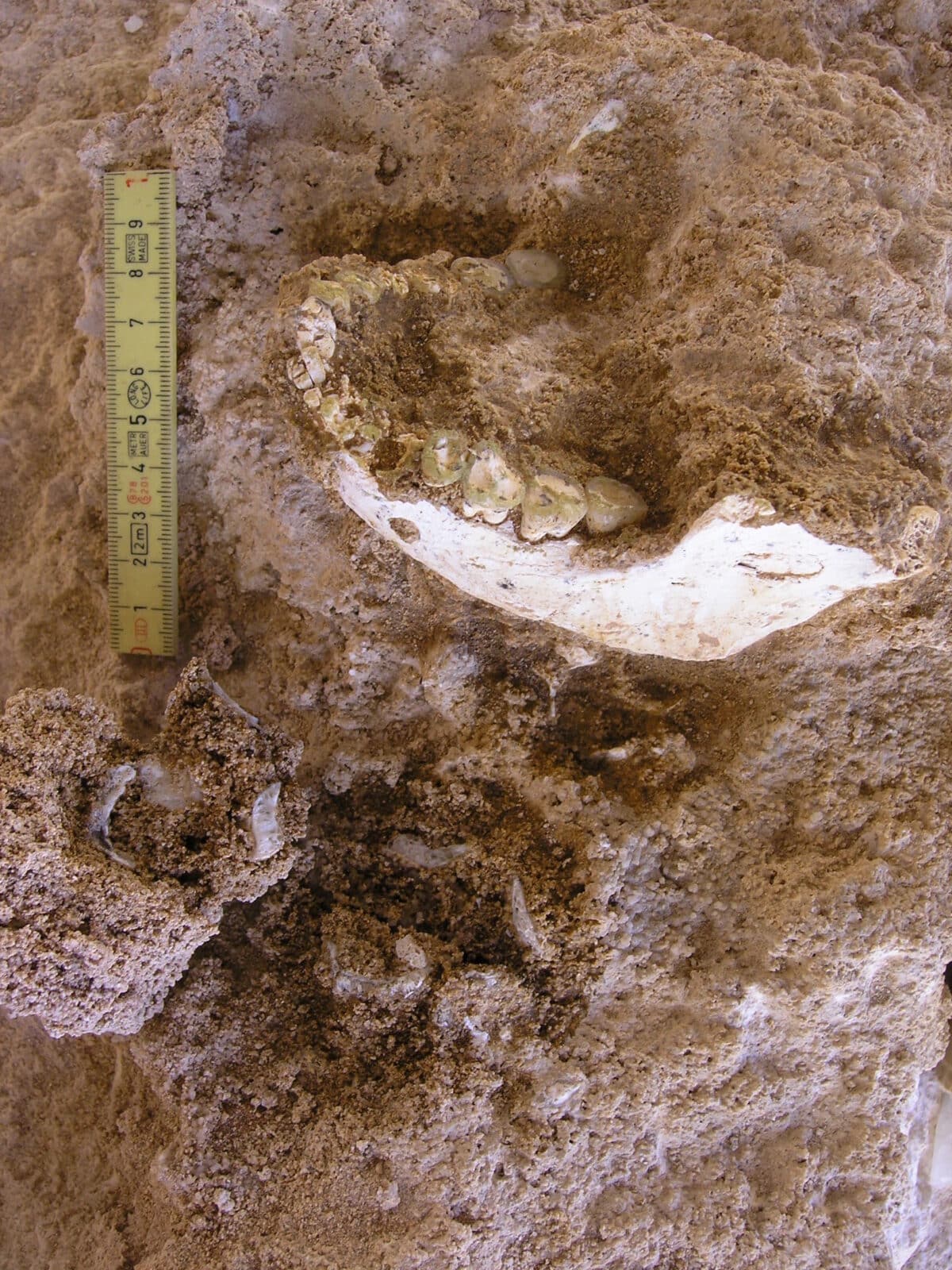
Thomas Quarry I, Grotte à Hominidés: Mandible ThI-GH-10717 during the excavation. (Credit: © J.P. Raynal, Programme Préhistoire de Casablanca)
Morocco Fossils Support African Origins Theory
All securely dated Homo sapiens fossils older than 90,000 years come from Africa or the doorway to Asia. Some researchers have proposed fossils like Homo antecessor from Spain as potential candidates for the ancestral population shared by modern humans and Neanderthals, but the Moroccan discoveries strengthen the case that African populations, not European ones, gave rise to our species.
By 773,000 years ago, human populations in North Africa and Europe were already developing distinct characteristics. The Moroccan individuals differ subtly from roughly contemporary remains found in Spain, suggesting the European and African populations were beginning to diverge. The European populations likely led to Neanderthals, while the African populations appear to have given rise to modern humans.
Paper Notes
Limitations
The fossil sample is fragmentary, consisting primarily of jawbones, teeth, and vertebrae. No skulls, limb bones (except one fragmentary femur), or hands and feet were recovered, limiting conclusions about brain size, body proportions, and locomotion. The original context of one important mandible (ThI-GH-1) is uncertain because it was found by an amateur collector in disturbed deposits below the cave, though sediment analysis suggests it likely came from the same layers as the other fossils. Some dating methods produced conflicting results: optical luminescence and uranium-series methods yielded younger ages than the magnetic reversal evidence, though the researchers favor the magnetostratigraphic dates based on geological context.
Funding and Disclosures
Research was funded by the European Research Council under the European Union’s Horizon 2020 program (grant 819960), the French Ministry of Europe and Foreign Affairs, the University of Bordeaux, the French National Centre for Scientific Research, the Italian Ministry of University and Research (PRIN2020 project ‘Dynasty’), Spain’s Ministry of Science and Innovation (project PID2021122355NB-C31), and France’s LabEx Archimède program. The Max Planck Institute for Evolutionary Anthropology in Germany provided additional support. Authors declare no competing interests.
Publication Details
Title: Early hominins from Morocco basal to the Homo sapiens lineage
Authors: Jean-Jacques Hublin, David Lefèvre, Serena Perini, Giovanni Muttoni, Matthew M. Skinner, Shara E. Bailey, Sarah Freidline, Philipp Gunz, Mathieu Rué, Mohssine El Graoui, Denis Geraads, Camille Daujeard, Thomas W. Davies, Kornelius Kupczik, Mykolas D. Imbrasas, Alejandra Ortiz, Christophe Falguères, Qingfeng Shao, Jean-Jacques Bahain, Alain Queffelec, Asier Gómez-Olivencia, Stefano Benazzi, Adeline Le Cabec, Rita Sorrentino, Inga Bergmann, Fatima-Zohra Sbihi-Alaoui, Rosalia Gallotti, Jean-Paul Raynal, and Abderrahim Mohib
Journal: Nature DOI: 10.1038/s41586-025-09914-y Published: January 7, 2026 (online)