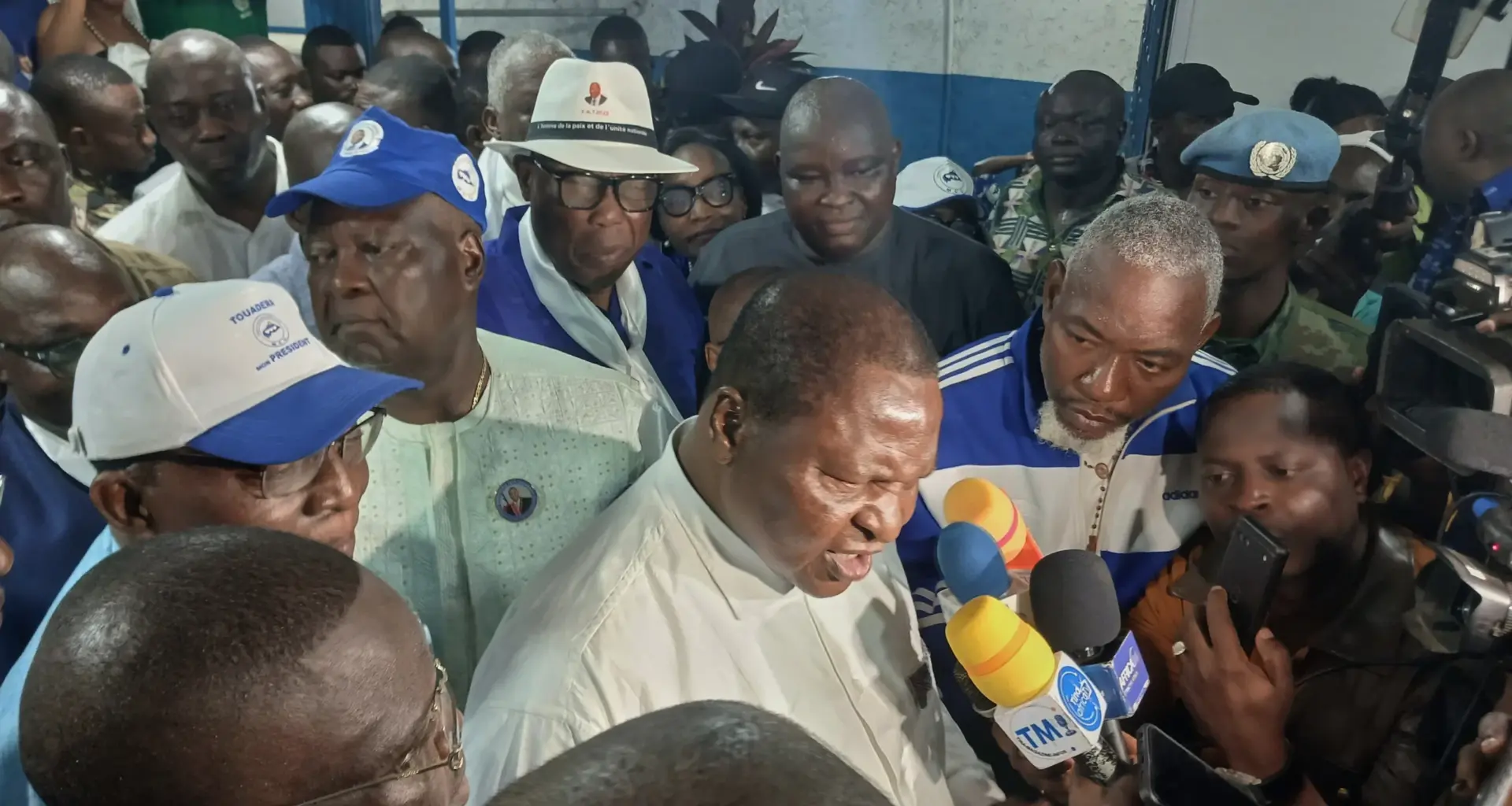
YAOUNDÉ, Cameroon – Central African Republic President Faustin-Archange Touadéra has secured a controversial third term, winning an outright majority in a December election boycotted by the main opposition.
The 68-year-old leader captured 76 percent of the vote, a victory widely anticipated after a 2023 constitutional change removed presidential term limits.
Touadéra campaigned on his security record in the nation still grappling with instability from a 2013 rebel crisis, which led his government to enlist support from Russian mercenaries and Rwandan soldiers.
His main challengers, former Prime ministers Anicet-Georges Dologuélé and Henri-Marie Dondra, received 15 percent and 3 percent of the vote respectively and have called for the results to be annulled, citing widespread fraud and irregularities.
A leading Catholic leader in the country has praised the peaceful conduct of the election, and urged unity as the President embarks on a new mandate.
Looking beyond the contested politics, Cardinal Dieudonné Nzapalainga, the Archbishop of Bangui and a key architect of the country’s peace, offered a profound perspective.
In an interview with Crux, he insisted that “the winner is the people” and called on the new leadership to heal divisions by uniting marginalized regions.
The cardinal urged both his compatriots and the international community to move beyond a narrow focus on security, advocating instead for a “symphony” of efforts which integrate education, justice, and humanitarian aid—to forge a sustainable legacy of peace for future generations.
Following are excerpts of that interview….
Crux: How would you assess the conduct of the election in terms of turnout and security?
Nzapalainga: Elections are an important moment for a country because they bring citizens together to make free and transparent choices, to choose the people who will determine the country’s future. As a pastor, I also want to raise awareness and inform people so that they can cast their votes. This means contributing to the future change of this country.
I am very happy to see that, in general, the country has remained calm. At the same time, we have not seen any violence or aggression. Of course, I hear here and there that there have been irregularities and other issues, but it will be up to the ANE (National Electoral Authority) to rule on irregularities and fraud. Disputes are settled peacefully, through dialogue, and it is up to the ANE and the Constitutional Court to rule on them. So, you see, the state has set up bodies to deal with disputes, so that there can be peace and tranquility in the country.
The elections are supposed to be a sign of hope for a new chapter in the history of the Central African Republic. Yet many citizens live in the shadow of armed groups and chronic insecurity. From your pastoral perspective, how do you address this tension between the hope for a democratic process and the daily reality of fear for your flock?
I could say that I am now speaking with great reserve, not to mention looking back in the rear-view mirror. In the past, from 2013 to 2015, we went through difficult times. There was insecurity, and the authority of the state was reduced to Bangui. However, since 2020, we have seen the effective presence of internal security forces that are operational. Today, we cannot say that the rebels control most of the territory as they did in the past.
Of course, there are still acts of banditry, and extremists too. But compared to what I have experienced, I see a clear improvement in security, because you can leave Bangui and travel to the Cameroon border.
I can leave Bangui and travel to Bambari without being stopped by bandits on the road. Before, we used to travel with a great deal of fear and apprehension. That is why I am saying, be careful, because what you read on social media and what is actually happening on the ground are two very different things.
I am well aware that in the towns of Zémio and Bombouti, in the Haut-Mbomou prefecture, there are pockets of insecurity. Even in Bangui, there are robberies and armed thefts. At the same time, we are calling on the government to make efforts to bring peace and calm to the neighbourhoods. At the same time, regions such as Zémio, Obo, Dembia, Derbissaka and Bambouti must also be able to regain peace. Today, when we talk about insecurity in Bambouti, Obo and Zémio, we are not at ease, because we are part of one country.
As pastors, we cannot rejoice when our sheep are lost. Or even abroad, as is the case with the people of Zémio who are refugees in the DRC. Or those from Bambouti who have left for Sudan.
Everyone would like to be at home. This is also an opportunity for me to appeal to young people who have weapons. I want to say that we will never build this country with weapons.
We will build this country when we agree to sit down and engage in dialogue, ask the real questions and seek solutions together. No one else will bring a diplomatic briefcase to pull solutions out of their pocket for us. On the contrary, it is up to us to come up with proposals that draw on the genius of our culture and our people.
Yes, we have suffered enough. It is time to talk; it is time to negotiate. It is time to seek what is called a consensus so that we can sacrifice certain things.
Not just for ourselves, out of selfishness, but for future generations. Providing space or time for young people to go to school, for people to go shopping, I am talking about shopkeepers, or even for parents to go to the fields; for the sick to receive medication. That is what freedom of people and goods means. We must think about all this. So there you have it, a look at a situation that has changed a great deal.
There are grey areas that must not be ignored. We must recognize them and demand that these grey areas be clarified through concrete measures.
Can the winner of the latest election-who happens to be President Faustin-Archange Touadéra claim a genuine mandate when parts of the population may have been silenced by insecurity?
I had qualified my position by saying that most of the country has been taken back from the rebels. Officially, it is in the hands of the state.
There are still areas where there are rebels. Whoever wins will have to unite, unite and unite. The winner is not the one who has won.
The winner is the people. And when we say the people, we mean the East, the West, the North and the South. So we need to overcome our differences and reach out to those on the other side, in the other group, in the other region. We need to give them the chance to contribute too. Because behind the demands, there is often an expression of frustration among men and women who want to contribute but feel marginalized. And they think they can find the solution through arms.
I would like us to find the solution through dialogue. As a Christian, I base my beliefs on the Holy Scriptures, which declare that in the beginning was the Word.
I rely on Jesus Christ, the word that touches, the word that pacifies, the word that transforms, the word that creates. And I believe that by relying on Jesus Christ, who is the Word, I can engage in dialogue and open up communication with my brothers and sisters. This also means listening to my brothers and sisters.
And together, we can build. So, I think that each of us has our place. It is in our interest to look each other in the eye.
It is in our interest to be able to say that we share a heritage, I mean a treasure: The Central African Republic.
What do we have in common? Are we going to let it fall apart? Are we going to destroy it? No! Instead, we must preserve, build and, sooner or later, pass on a legacy to the next generation- a reliable legacy. Let’s say a legacy that will enable these children to build in good conditions.
How do you assess the role of the international community? Are its current security-focused interventions sufficient?
There is no single solution to the problems facing the Central African Republic.
We must accept plurality and diversity. By that I mean that it is not only the humanitarian approach that must be taken into account. Above all, there are other religious approaches that must be considered. There is also the military approach and the judicial approach. All of these approaches must be complementary and combined in order to find solutions. Unfortunately, some people think that theirs is the only way to find solutions.
No! I believe that security is not everything, nor is it the only answer. There are times when we need security. There are times when we need religious leaders. There are times when we also need teachers. There are times when we need doctors.
Everyone has their place. It is about the whole body of a country. And if everyone could play their part, as we do in music, we would have what we call a symphony. We would produce a sound that is pleasant to listen to. This is what we want for our country: let us work with a view to complementarity. Let us work to produce a symphonic sound, so that everyone feels like one of many actors, capable of making their contribution.
From this perspective, no one can view others as adversaries or enemies. Instead, we are all actors in the recovery and construction of this country. And once we begin to respect and value each other, we will build this country, our group, and our community.