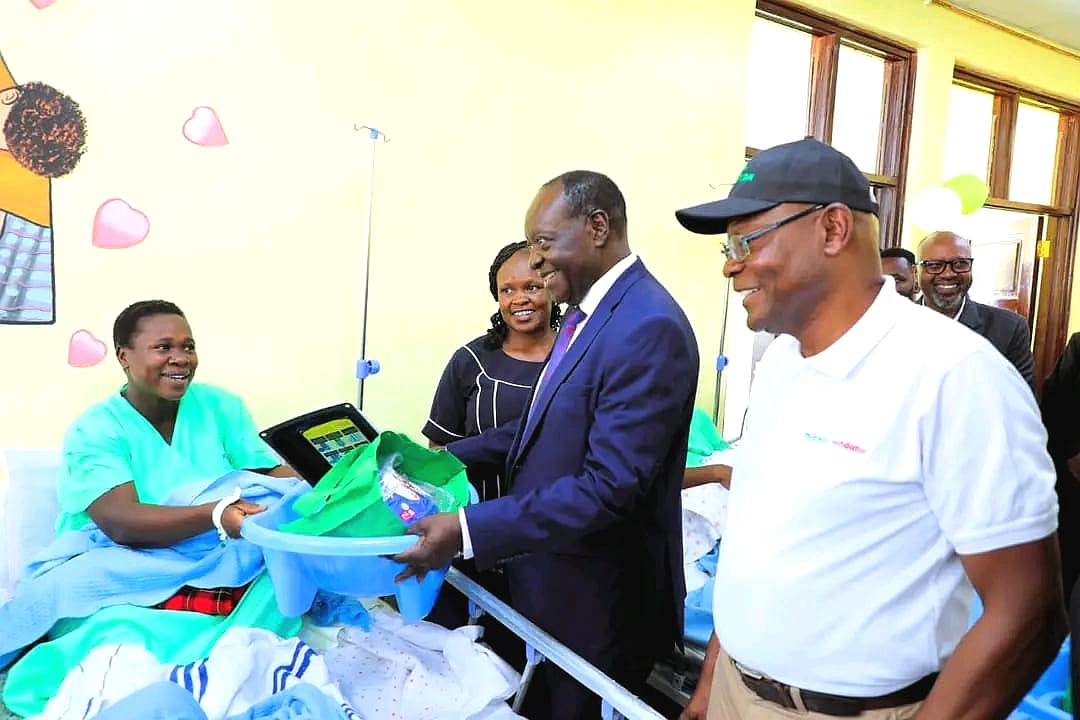
 Vihiga Governor Wilber Ottichilo issues assorted new-born items to a new Mother. Looking on is Safaricom Foundation chairperson Joseph Ogutu during the opening of Mother and Child Health Integrated Unit at Vihiga County Referral Hospital/HILTON OTENYO
Women in Vihiga have a reason to breathe a little easier after the county government in partnership
with Safaricom’s M-Pesa Foundation commissioned a new maternal and
child health complex at the referral hospital in Mbale.
The Sh60 million 40-bed facility is
more than just a building—it represents hope, safety and lifesaving care for
mothers and newborns.
Equipped with prenatal and postnatal
services, a neonatal intensive care unit, emergency obstetric care and a fully
equipped caesarean section theatre, the complex aims to tackle the persistent
challenge of maternal and infant mortality.
Currently, Vihiga records 75
maternal deaths for every 100,000 live births, a statistic Governor Wilber Ottichilo is determined to reduce.
“No mother deserves to die while
bringing forth life. This complex is a major milestone in our commitment to
providing quality healthcare for mothers and newborns,” he said during the
launch, noting that previously, delayed deliveries were common due to congested
facilities and long distances to clinics.
The complex includes a three-bed
delivery room, a 12-bed antenatal ward, a 20-bed postnatal ward, an eight-bed
newborn unit, pharmacy, reception area, nursing stations and a modern medical
gas supply system.
These additions aim to ensure
mothers receive timely, specialised care, particularly in complicated cases
that can now be referred from smaller health facilities.
M-Pesa Foundation chairman Joseph
Ogutu hailed the partnership as a model of how public and private collaboration
can transform healthcare.
“Every woman giving birth deserves a
safe environment. Maternal health is critical to improving access to quality
healthcare across the country,” he said, adding that telemedicine services will
soon extend specialised care to mothers in remote areas.
Community health promoters also play a vital role in the initiative.
They are the first line of defence,
linking mothers to healthcare services and ensuring early intervention during
pregnancy.
Vihiga health executive
Nicholas Kitungulu urged CHPs to continue encouraging expectant mothers to seek
hospital-based care, emphasising that early monitoring can prevent
complications during childbirth.
For expectant mothers like Jane
Kavayi, six months pregnant, the facility offers reassurance and peace of mind.
“It is reassuring to know that there
is a facility nearby where I can safely deliver my baby. I used to worry about
the long distances,” she said.
The Vihiga maternal and child health
complex is not just infrastructure—it is a lifeline.
By bridging critical gaps in care,
reducing maternal and infant risks and bringing services closer to
communities, it embodies a promise that mothers and newborns can now look
forward to safer, healthier beginnings.