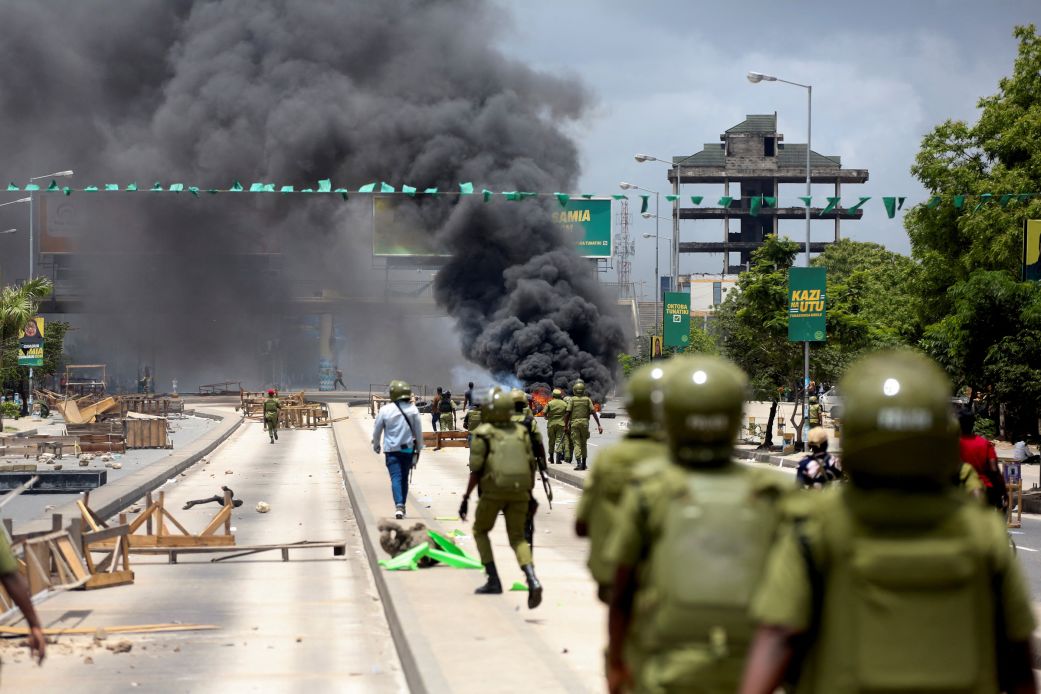
New research on Tanzania’s political future has revealed that the country will never be the same following the controversial October 29 election, which resulted in deaths and destruction of property.
Published in the Journal of Democracy by Johns Hopkins University Press on January 1, 2026, the study by scholar Dan Paget, titled “Tanzania Will Never Be the Same”, argues that the political turbulence sparked by demands for reform may persist, as the government brutally suppressed the real issues raised by protesters.
“The question now is whether, in the wake of the crackdown, the movement that had begun to reemerge after the election can coalesce and become a sustained force in Tanzanian politics. The risk of harsh repression could be severe enough to break any movement. But there are reasons to believe that this one will live on in some form,” the findings note.
Triggered by alleged electoral manipulation, protests erupted on October 29 in several neighbourhoods of Dar es Salaam, Tanzania’s commercial capital, as voting began. They quickly spread to Mwanza, Mbeya, Arusha, Geita, Dodoma, and other towns.
In the post-election turmoil, the internet was shut down for almost a week, and in some areas, daily life ground to a halt, household essentials ran out, streets became unsafe, and freight transport was disrupted.
The research explains that the suppression of protests has exacted a heavy toll on citizens and the economy.
“Meanwhile, the fundamental issues that drove the protests remain. It is no coincidence that this re-emergent movement in Tanzania has sister movements across East Africa, most notably in Kenya. Like its neighbours, Tanzania faces a cocktail of challenges—social, demographic, and economic—that make it ripe for protest…” the study observes.
The research stressed that developments in other East African countries will shape how Tanzanians respond to their leaders. A dire economic situation and a growing youth population are expected to fuel further protests whenever dissatisfaction arises.
“More than half of all citizens are under eighteen years old, and many of these young people are desperately poor. The overwhelming majority (72 per cent) of Tanzanians work in informal jobs, and despite strong economic growth (averaging 5.5 per cent over ten years), poverty has endured and perhaps increased since the COVID-19 pandemic in 2020, while living standards have plateaued,” the findings note.
Paget elaborated that Tanzania’s ruling party, Chama Cha Mapinduzi (CCM), has a long history of using authoritarian tactics to tilt the electoral playing field, from suspending regime-critical newspapers to banning opposition rallies.
“Yet in 2025, under Hassan, the CCM government crossed autocratic thresholds it had not transgressed in decades. Perhaps most troubling, it kept both of Hassan’s principal opponents off the presidential ballot.”
He added that the damage to the regime’s legitimacy caused by the protests is overshadowed by the reputational self-harm inflicted through its violent response.
“From now on, as Tanzanians pass CCM branch offices and party flags in their neighbourhoods, their eyes will be on the bullet holes and empty chairs that serve as monuments to the deadly crackdown—living contradictions of CCM’s claims of popularity and benevolence,” the research notes.