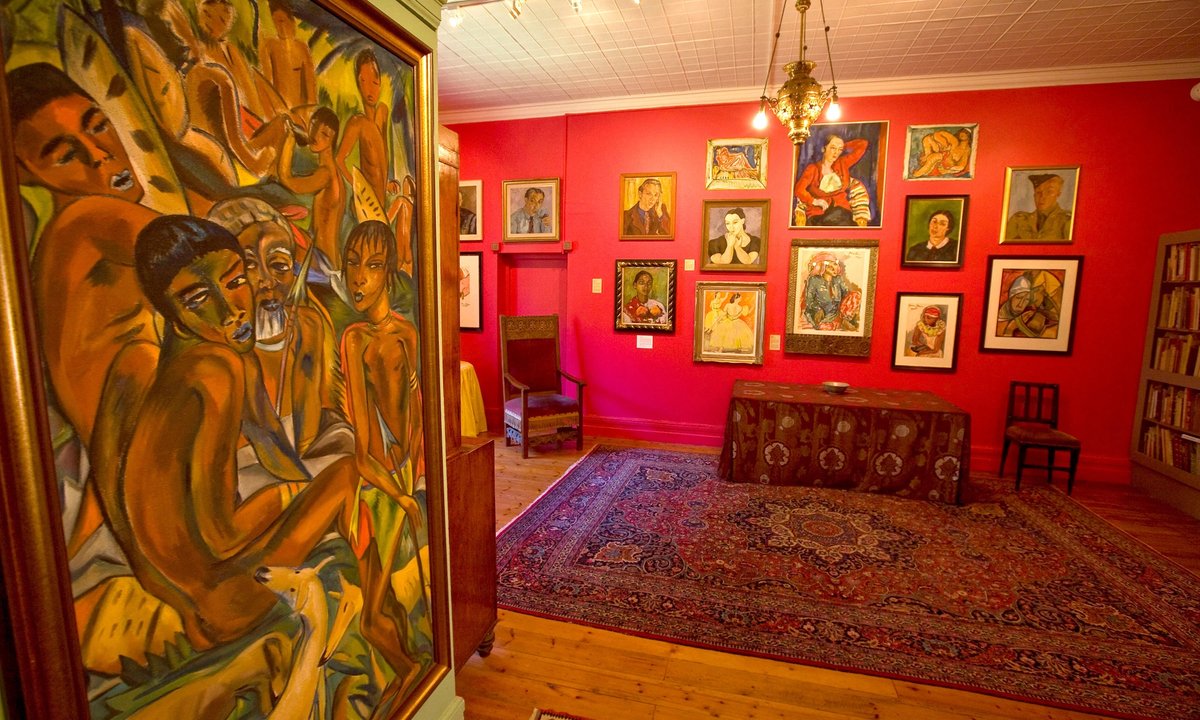
A row has erupted over the closure last year of the Irma Stern Museum (ISM), founded in 1971 to celebrate one of South Africa’s best-known artists, amid continuing uncertainty over when and whether it will reopen.
Irma Stern (1894-1966), whose work was displayed at the Venice Biennale several times in the 1950s and was the subject of an exhibition at Berlin’s Brücke Museum last year, is recognised both domestically and internationally. Her parents were German-Jewish but she was born in Transvaal and throughout her life travelled extensively, notably to Germany where she was initially associated with the German Expressionist painters of the time.
Having settled in South Africa in the 1920s, she moved into a house called The Firs in Rondebosch, Cape Town, and remained there until her death. She left her collections in trust for the encouragement and promotion of art: artefacts she had collected, plus her own works of art. Some rooms were kept substantially as they were when she lived there – most notably her studio with her paintbrushes, easel, rags and art. The collection was owned by a trust, and the museum was administered by University of Cape Town (UCT) on behalf of the trustees.
But in October, the university and the Irma Stern Trust issued a joint statement announcing the end of their 56-year partnership, which they said paved the way for “renewal”. According to the statement, the collections will be moved to another storage facility and The Firs “repurposed”.
The museum’s closure the following day triggered outrage: the decision had “left people angry and deeply suspicious”, according to Phillippa Duncan, a heritage researcher. “Staff were removed from the museum without clarity about their future, the public was kept in the dark, and the official announcement came only after pressure,” she says. “There’s been a complete lack of transparency.”
UCT said at the time that the reasons for the closure were “operational”, without giving details, and that the cancellation of the agreement and sale of the property was “a matter of sadness.” Asked to comment further, a spokesperson says the university was “regrettably not in a position to comment further on the matter at this stage. UCT and/or the Irma Stern Trust will issue further updates as and when necessary—either jointly or separately—in due course.”
After the closure announcement, the chairman of the South African auction house Strauss & Co, Frank Kilbourn, issued a statement saying: “We at Strauss & Co, as well as many Capetonians and art lovers across the world, were shocked and taken aback by recent, unexpected announcements about the closure of the ISM.”
Funds raised for preservation
In 2022 a sale of art organised by Strauss raised around 22m Rand (almost $1.3m) intended for the preservation of the museum.
The trust belongs to a financial services company now called Nedgroup Private Wealth. Facing a public outcry and a petition demanding transparency and accountability, Nedgroup organised a public consultation in November and afterwards said it would form a management committee and advisory board, to be announced before the end of 2025 (though, as we went to press, no announcement had been made).
“The relocation of the artworks is under way but not yet complete. It may take several months to decommission the museum. The new storage facility is in the Nedbank Clocktower Building in the V&A Waterfront, Cape Town,” the statement said.
Nedgroup said the proceeds of the 2022 sale had been invested and would be used for managing and maintaining The Firs. “The Irma Stern Collection and The Firs will continue in a rejuvenated guise; new exhibition and branding partnerships, and new plans for how The Firs will live on, are all currently developed and will be announced when the necessary arrangements and agreements are in place,” it said.
Kilbourn, the former vice-chairperson of the Irma Stern Museum’s committee, says the museum’s trustees and UCT should have reached out to a wider public earlier to save the museum.
“I believe the situation calls for a renewed effort by Nedbank and the trustees of the Irma Stern Trust to enter into a dialogue with affected role players and leaders in the art industry to examine the merits of alternative ways to deal with the challenges they face,” Kilbourn says.