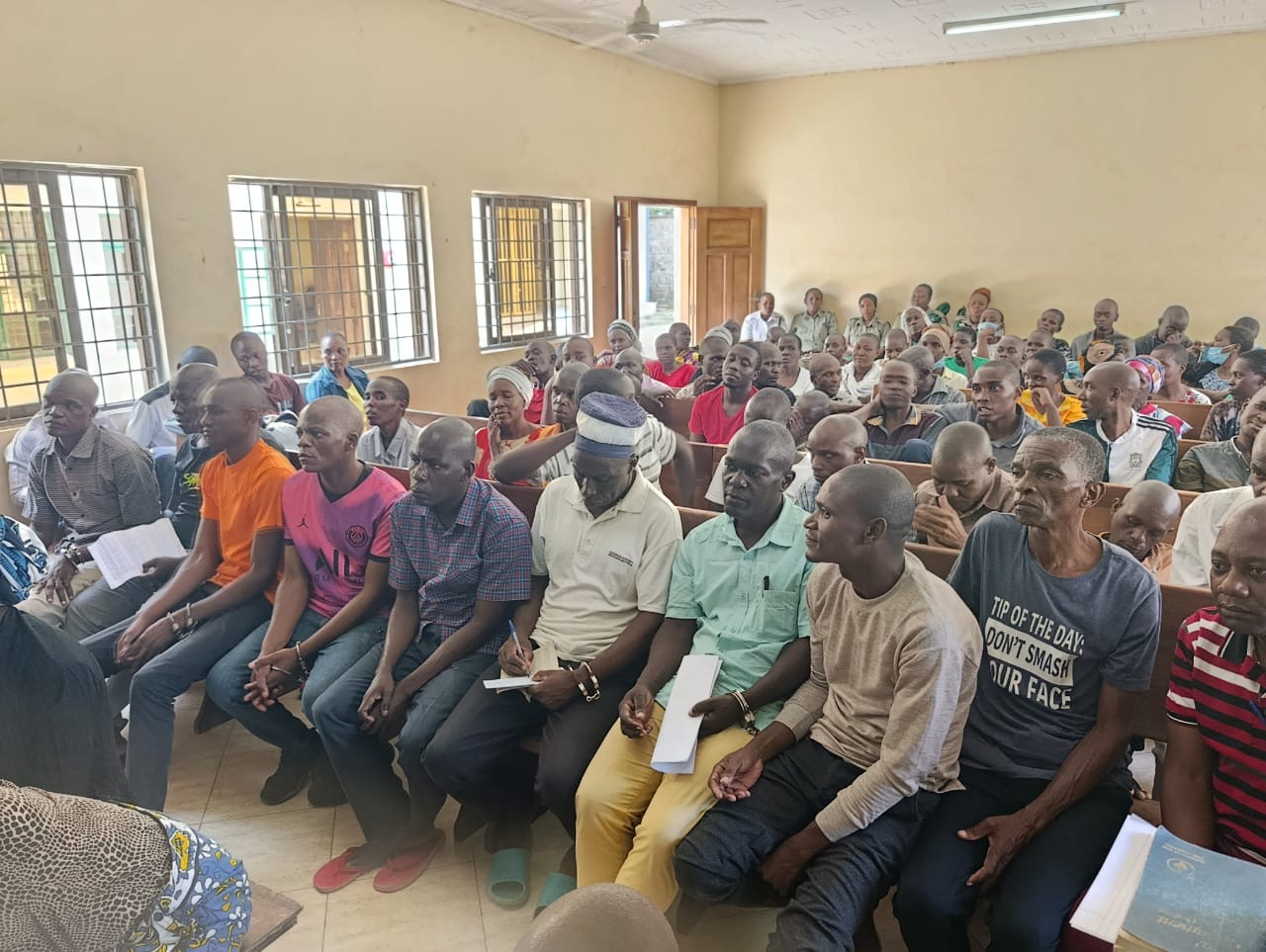
 Paul Mackenzie (far right in red and white striped shirt) and his co-accused during a court session at Shanzu Law Courts in Mombasa.
The Directorate of Public Prosecutions (DPP) has closed its case against Good News International Church leader Paul Nthenge Mackenzie and 96 co-accused in the ongoing Shakahola massacre trial.
The case involves investigations into deaths that occurred in Shakahola Forest, Kilifi County.
Principal Magistrate Leah Juma adjourned the prosecution’s case after hearing testimony from four investigators who described how Mackenzie allegedly used the Good News International Church to influence followers over several years.
Chief Inspector Raphael Wanjohi told the court that Mackenzie used various media platforms, including television, YouTube, seminars, crusades, and WhatsApp groups, to communicate his teachings.
The court was informed that some of these platforms attracted large followings both online and in person.
The prosecution presented evidence that between 2020 and 2023, followers were reportedly instructed to isolate themselves from formal education, healthcare, and government institutions.
Investigators said some parents withdrew their children from school and relocated them to Shakahola Forest, sometimes telling relatives they were moving to Malindi for land purchases.
The court heard that Mackenzie had acquired 480 acres of land in Shakahola, which was divided into settlements with biblical names, including Galilee, Bethlehem, Judea, and Emmaus.
The settlements reportedly had a structured hierarchy, with Mackenzie at the top, assisted by deputies, security personnel, and other roles.
Investigators said that 426 bodies were exhumed from the forest, with more believed to remain.
Medical and forensic reports suggested that some deaths resulted from starvation, with accounts indicating that children and women were particularly affected.
Inspector Onyango Owade testified that 28 minors rescued from the forest described strict rules that included fasting, challenging claims by the accused that the deaths were voluntary.
Doctors treating survivors corroborated accounts of severe dehydration and malnutrition, while forensic pathologists linked the deaths to starvation and related illnesses.
Chief Inspector Peter Mwangi testified that DNA analysis established that many of the deceased were relatives of the accused, including parents and children, with some entire nuclear families affected.
Records recovered from homes reportedly included payments by parents and lists of deceased and surviving children.
Investigators submitted Bibles, DVDs, and other religious materials for review by counter-terrorism experts and religious scholars.
The experts reportedly concluded that some biblical passages were interpreted in ways that discouraged engagement with education, healthcare, and broader society.
Constable Alfred Mwatika told the court that the teachings influenced followers’ behaviour, including leaving employment, closing businesses, and relocating to Shakahola.
Investigators described the church as having at least 25 branches nationwide, and noted that it was designated as a criminal organisation in January 2024.
Prosecutors said Mackenzie and his co-accused allegedly used the church’s structure to commit offences that included radicalisation, murder, manslaughter, and cruelty to children.
The trial began on July 8, 2024, with the prosecution calling 96 witnesses, including survivors, experts, and investigators, and presenting around 500 exhibits.
With the prosecution’s case now closed, the court will set a date for further submissions, after which it will decide whether Mackenzie and the co-accused have a case to answer.