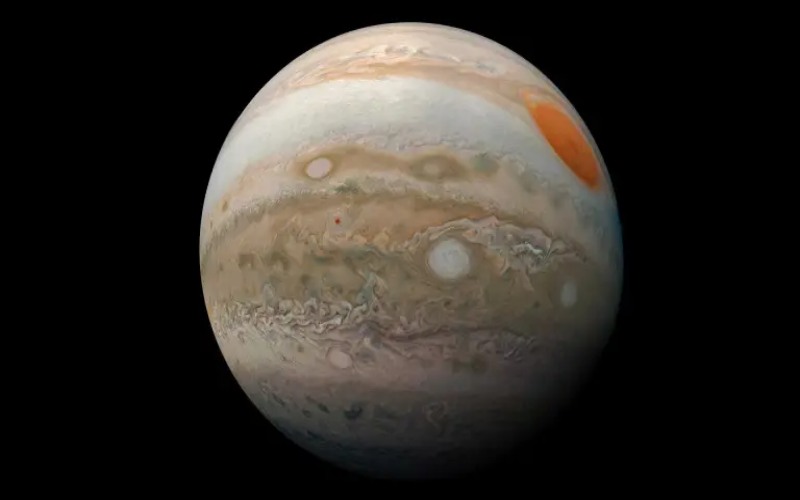
The Kenya Space Agency (KSA) is reminding sky watchers to observe tonight’s celestial phenomenon, when Jupiter will appear larger and brighter than usual as Earth aligns directly between the Sun and the planet, a cosmic positioning known as opposition.
As a result, Jupiter will appear luminous and visible all night long, marking its most spectacular appearance this year.
“To catch the view, look toward the eastern sky after sunset. Jupiter will rise early and stay on display until dawn, glowing steadily in the constellation Gemini, its celestial home during this period,” the Agency says.
Viewers will be able to witness the phenomenon with the naked eye, but those using binoculars will get to see its four largest moons, as those using a telescope enjoy a greatly enhanced viewing experience.
“For amateur stargazers, the Stellarium app is a helpful tool for locating the constellation Gemini and, consequently, Jupiter,” the agency added.
According to Space.com, the visibility of planets in the sky varies dramatically based on their orbital positions relative to the sun and the Earth.
“The best time to view superior planets, worlds that orbit the sun at a greater distance than our Blue Marble, is at their points of opposition, when they line up in our night sky directly opposite the sun, with Earth in the middle,” the platform says.
The moment of opposition coincides with when a planet draws near to its closest point to Earth in its orbit.
“As a result, tonight, Jupiter will appear brighter and subtly larger in the eyepiece of a telescope boasting an angular size of 45.6 arcseconds at opposition, as opposed to the 31.3 arcseconds it would occupy when furthest from Earth (when it would be hidden behind the sun). For context, the full moon takes up between 29.4 and 33.5 arcminutes, with each arcminute being the equivalent of 60 arcseconds,” it adds.
Jupiter, also referred to as a gas giant, lacks a solid surface and is composed of light elements like hydrogen and helium. It features deep, dense layers of gas and liquid hydrogen under immense pressure, formed from the gas-rich outer solar system
It makes for a dazzling astronomical target when viewed with the naked eye, which only gets more impressive when viewed through a telescope, which helps reveal its colourful atmospheric cloud bands.