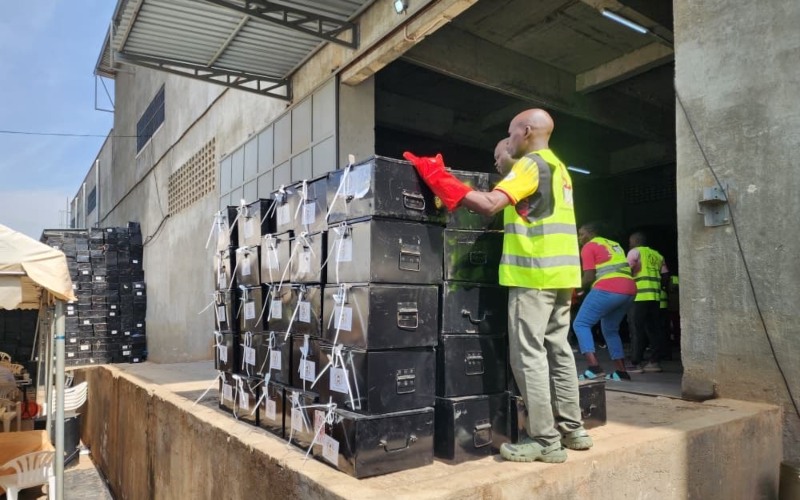
Next week’s elections in Uganda will take place in an environment marked by widespread repression and intimidation against the opposition, human rights defenders, journalists and those with dissenting views, a report from the UN Human Rights Office (OHCHR) has warned.
Ugandans are set to vote between January 15 and February 6, 2026, during which long-serving President Yoweri Kaguta Museveni seeks a seventh term in office amid what the UN terms as a ‘fragile’ multi-party democracy characterised by a ‘fragmented’ opposition and allegations of entrenched corruption in the electoral process.
According to the report, authorities have relied on a series of laws enacted or amended since the last election in 2021 up to September last year, entrenching repression and impunity, particularly against the opposition, and restricting the rights to freedom of expression, association and peaceful assembly ahead of the January 15 polls.
The report also recalls the 2021 general elections, which were marred by widespread arbitrary arrests and detention, and abduction of members and supporters of opposition parties, particularly those associated with the National Unity Platform (NUP).
Back then, the report says security operatives used disproportionate or unnecessary force during the management of an opposition-led peaceful protest ahead of the elections in November 2020, resulting in the extrajudicial killing of at least 54 people and the disappearance of hundreds of NUP supporters.
“Concerning the legacy of the 2021 general elections, there has been no substantive accountability for violations committed in the context of the elections, such as prosecution of the officials suspected to be responsible, including those of alleged enforced disappearances of NUP supporters and compensation for victims of extrajudicial killings, despite the President’s pledge to compensate victims,” the report notes.
As the country heads to the polls, the UN notes that the institutional mechanisms for promoting and protecting human rights in the country, such as the UHRC and the Equal Opportunities Commission (EOC), have been under increasing strain and pressure due to chronic funding shortages and concerns over a lack of impartiality and independence in their work.
The report further expresses concern over the State’s use of the law to silence dissent, amongst them the wider trend of using and misusing the Anti-Terrorism Act to target the political opposition.
It notes that the Uganda Communications Act and its accompanying frameworks continue to raise concern as they have deepened the restrictive environments for independent media, online expression, and artistic freedom, raising serious human rights concerns over Uganda’s compliance with Constitutional and international human rights standards on freedom of expression.
At the same time, it adds that since its introduction in 2013, the Public Order Management Act (POMA), 2013 has been used to repress political opposition activities and other dissenting voices critical of the government.
“The Act grants the Inspector General of Police (IGP) and other members of the Uganda Police Force (UPF) untrammelled discretionary powers to regulate, restrict, or disperse public meetings on grounds of public order, safety, and security,” says the report.
Others include; the Computer Misuse (Amendment) Act, 2022 introduced undue restrictions, particularly on online expression and information sharing in contravention of international human rights law, the Non-Governmental Organizations (Amendment) Act, 2024, that enabled excessive governmental control over the work of civil society organizations and centralized regulatory authority, for instance, in terms of licensing, permit issuance, and permit renewal, the Uganda People’s Defence Force (Amendment) Act, 2025 that reintroduced the provisions allowing military trials for a broad list of persons including civilians and offences under ‘exceptional circumstances’.
“Leading opposition figure Kizza Besigye remains in detention on questionable treason charges since he was abducted in neighbouring Kenya in November 2024. He and his associate Obeid Lutale have been repeatedly denied bail on unclear grounds. The recent arrest of renowned human rights defender Sarah Bireete, as well as the Government’s recent directive imposing a blanket ban on live broadcasting of “riots” and “unlawful processions”, are the latest in a series of concerning developments,” the report says.
Reacting to the report, UN High Commissioner for Human Rights Volker Türk has called on the Ugandan authorities to uphold the rights of all Ugandans to take part in the public affairs of their country.
“The Ugandan authorities must ensure all Ugandans can participate fully and safely in the election, as is their right under international law. They must, among others, ensure that no unnecessary or disproportionate force, including lethal force, is used to disperse peaceful protests,” said Türk, adding that firearms must only be used as a measure of last resort to prevent imminent death or serious injury in line with the international human rights law.
Türk further called for those responsible for election-related human rights violations, including unresolved violations from the 2021 elections, to be held to account through fair proceedings following effective, thorough, and impartial investigations.