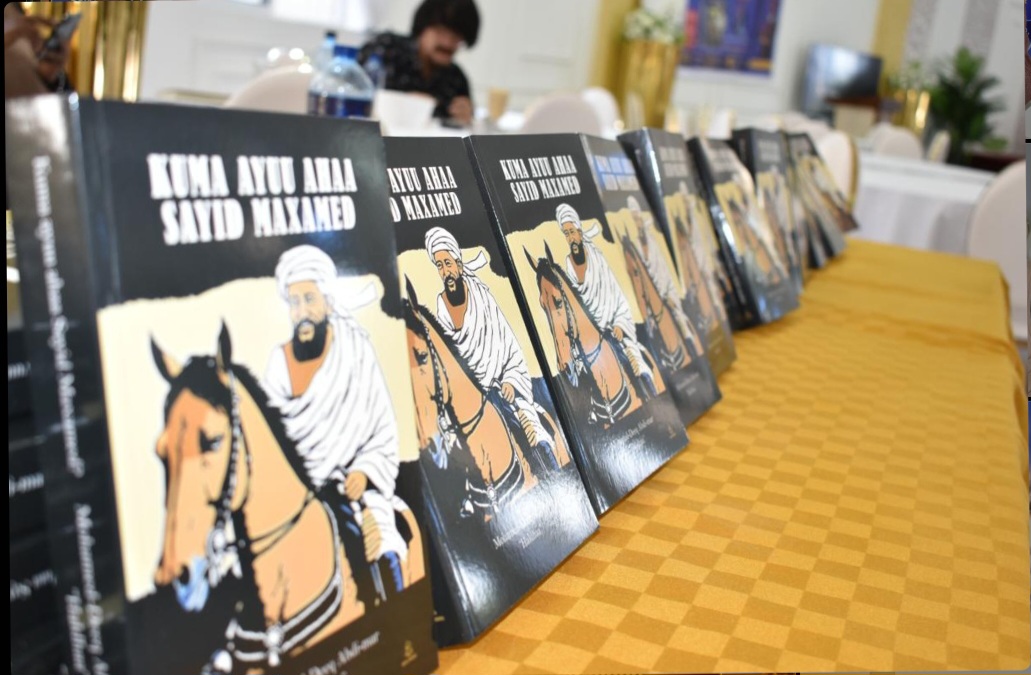
A book that examines the life and role of Somali freedom fighter Sayid Mohammed Abdulle Hassan was launched in Nairobi on Saturday, bringing together scholars, leaders, and members of the Somali community to discuss his place in history.
The book titled “Kuma ayuu ahaa Sayid Maxamed,” which translates to “Who was Sayid Mohamed,” was written by Mohamed Deeq Abdi Maar, who is known by the name Haldhaa.
The author said the book seeks to explain who Sayid Mohamed was and the role he played in Somali resistance during the colonial period.
The launch event was held in Nairobi and attended by community members, researchers, ulamaas and political leaders.
Sayid was born in 1856 in the Sa’Madeeq valley near Buuhoodle. He received Islamic education from 72 teachers in different places before travelling to Mecca to perform the Hajj.
During his stay in Mecca, he joined the Salihiyya order. After returning to the Somali territories, he opposed the presence of Christian missionaries and rejected colonial taxation.
In 1899, he formed the Dervish movement, which aimed to resist British, Italian, and Ethiopian expansion in Somali areas. His campaign turned into a long conflict that lasted more than 20 years.
British authorities referred to him as “The Mad Mullah,” a name used during the colonial period, while at the same time acknowledging his influence as a speaker and military planner.
Sayid used Somali oral poetry as a means of communication. Through poetry, he addressed clans and called for unity against foreign rule. His leadership led to the formation of a Dervish administration, with its centre based in Taleex. From there, his forces controlled large parts of the Somali interior for many years.
During this period, the Dervish movement resisted four British military campaigns. The movement also gained attention beyond the region. During the First World War, the Ottoman and German empires treated Sayid as an ally in their wider conflict with Britain.
In 1920, British forces launched a campaign that ended the Dervish resistance. The operation included the use of aircraft by the Royal Air Force, marking the first time air power was used in sub-Saharan Africa. The attacks destroyed Dervish bases, including those in Taleex.
Sayid escaped the final assault with a small group of followers and moved into the Ogaden region. Later that year, he died of influenza on December 21, 1920. He was 64 years old.
Today, Sayid is remembered as a central figure in Somali history. Many regard him as the father of Somali nationalism and a symbol of resistance against foreign rule. His role in opposing three colonial powers at the same time remains part of public memory and debate.
Speaking to Eastleigh Voice during the book launch, author Mohamed said he aimed to present a record based on facts. He said the book was written to help readers understand the history of Sayid Mohamed without distortion.
He explained that he decided to write the book after noticing accounts that, in his view, misrepresented Sayid’s history. He said this prompted him to begin the project.
“I felt it was the right time to write his biography, who he was and what he did,” he said.
Mohamed said the writing process took almost five years, noting that he received support from other researchers and contributors during this period. He also said the book has now reached its third printing.
“Readers of this book will understand that what Sayid spoke about more than 100 years ago is happening now,” he said.
Kamukunji MP Yusuf Hassan, who addressed the audience at the launch, spoke about Sayid Mohamed’s role in Somali society. He said Sayid Mohamed defended his community and faith and had knowledge of Islamic law.
“He defended his people and religion and understood Islamic law,” said the MP.
The MP added that Sayid Mohamed’s contribution to Somali history continues to shape discussions about identity and resistance. He said his place in history cannot be replaced.
According to the organisers, the book launch in Nairobi is part of a wider plan to reach more readers. The book is expected to be relaunched in other parts of the city, including Eastleigh and South C, in the coming weeks.