
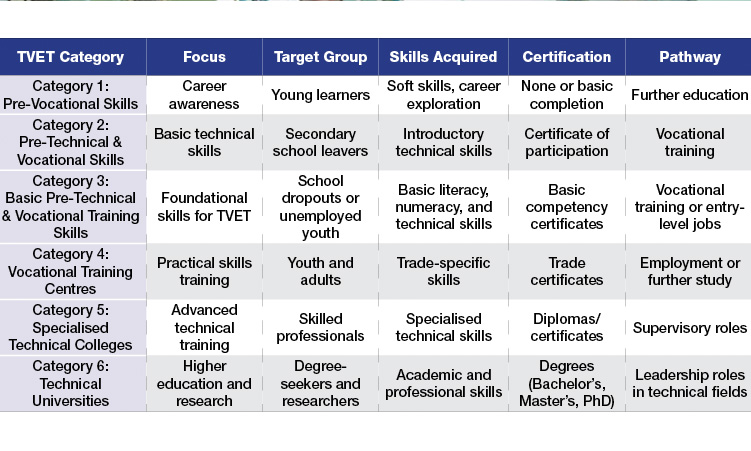
The Cabinet has approved a national pathway allowing Grade 9 pupils to progress through the technical and vocational education and training (TVET) system to obtain university-level qualifications – including doctoral degrees.
This was confirmed by the Ministry of Education, Innovation, Youth, Sport, Arts and Culture his week.
This comes after the Namibia Training Authority (NTA) conducted nationwide consultations across all 14 regions to align training with industry needs and international standards.
Under the new model, learning begins at entry-level vocational training.
A Grade 9 pupil can enter the TVET system at the introductory or foundational level, where they are introduced to basic technical skills, workplace safety and hands-on exposure to different trades.
Pupils who may have dropped out of school or lack formal qualifications are also accommodated through foundation programmes that strengthen literacy, numeracy and basic technical competence.
REDUCING FAILURE
NTA chief executive Erick Nenghwanya says the decision will reduce the failure rate and ensure industry relevance.
“This upholds standards by enforcing competency based steps, aligning with international models of structured pathways.
It prevents misalignment, reduces failures, and ensures industry relevance without compromising national benchmarks.
“The system inclusively serves youth/adults via clear pathways, expanding opportunities without barriers,” he says.
The new framework positions TVET not as a second option, but as a parallel pathway to doctoral qualifications.
Nenghwanya says this does, however, not create shortcuts.
“Pupils must progress through each competency level, complete practical training and meet entry requirements before progressing.
“A pupil cannot jump directly from Grade 10 into a degree programme without completing the required vocational and technical stages,” he says.
He says the reform also seeks to address long-standing challenges in the TVET sector, including institutions offering programmes beyond their mandate, misalignment with industry needs, and high failure rates caused by poorly structured progression routes.
Currently, pupils can only attain university degrees through the Namibia Senior Secondary Certificate Ordinary or Namibia Senior Secondary Certificate Advanced Subsidiary qualifications.
‘NO COMPETITION’
Education minister Sanet Steenkamp says this reform complements rather than competes with the university system.
“The colleges will have a distinct mandate focused on applied, practice-oriented and occupationally directed qualifications, with strong industry alignment and work-integrated learning.
“Universities will continue to focus primarily on academic, research-intensive and theoretical programmes.
This difference will be reinforced through programme approval processes under the Namibia Qualifications Authority (NQA) and relevant higher education regulatory structures,” she says.
She says while the Cabinet has approved the transformation, the specific institutions identified for elevation have not yet been formally gazetted.
Steenkamp says all Level 7 qualifications, which typically involve degrees offered by colleges, will be subject to the same national quality assurance requirements as those offered by universities.
This includes accreditation by the NQA, compliance with national qualification descriptors, external moderation, programme reviews and institutional audits.
“No institution will be permitted to offer Level 7 programmes without meeting full accreditation requirements,” she says.
‘NOT READY’
The minister says not all existing TVET centres are ready to deliver higher-level programmes.
“This is why the reform is being implemented on a phased basis over several years.
The transformation will be supported through targeted infrastructure upgrades, lecturer development and upskilling, strategic reskilling, and revised funding models aligned to expanded institutional mandates.
“The Cabinet’s approval recognises that additional investment will be required, and this is being addressed through medium-term planning and partnerships where appropriate. Quality remains the central priority,” she says.
STUDENT UNION HAPPY
Steenkamp says the move will directly address graduate unemployment and the longstanding mismatch between skills training and labour market needs.
Namibia National Students Organisation leader Dorthea Nangolo yesterday welcomed the move.
“TVET contributes to our country and it is not valued.
The lack of value results in people thinking they are not academically talented or illiterate, and they are not being taken seriously.
“People with brilliant manual skills and minds can now also progress.”
In an age of information overload, Sunrise is The Namibian’s morning briefing, delivered at 6h00 from Monday to Friday. It offers a curated rundown of the most important stories from the past 24 hours – occasionally with a light, witty touch.
It’s an essential way to stay informed. Subscribe and join our newsletter community.

The Namibian uses AI tools to assist with improved quality, accuracy and efficiency,
while
maintaining editorial oversight and journalistic integrity.
Stay informed with The Namibian – your source for credible journalism. Get in-depth reporting and opinions for
only N$85 a month. Invest in journalism, invest in democracy –
Subscribe Now!