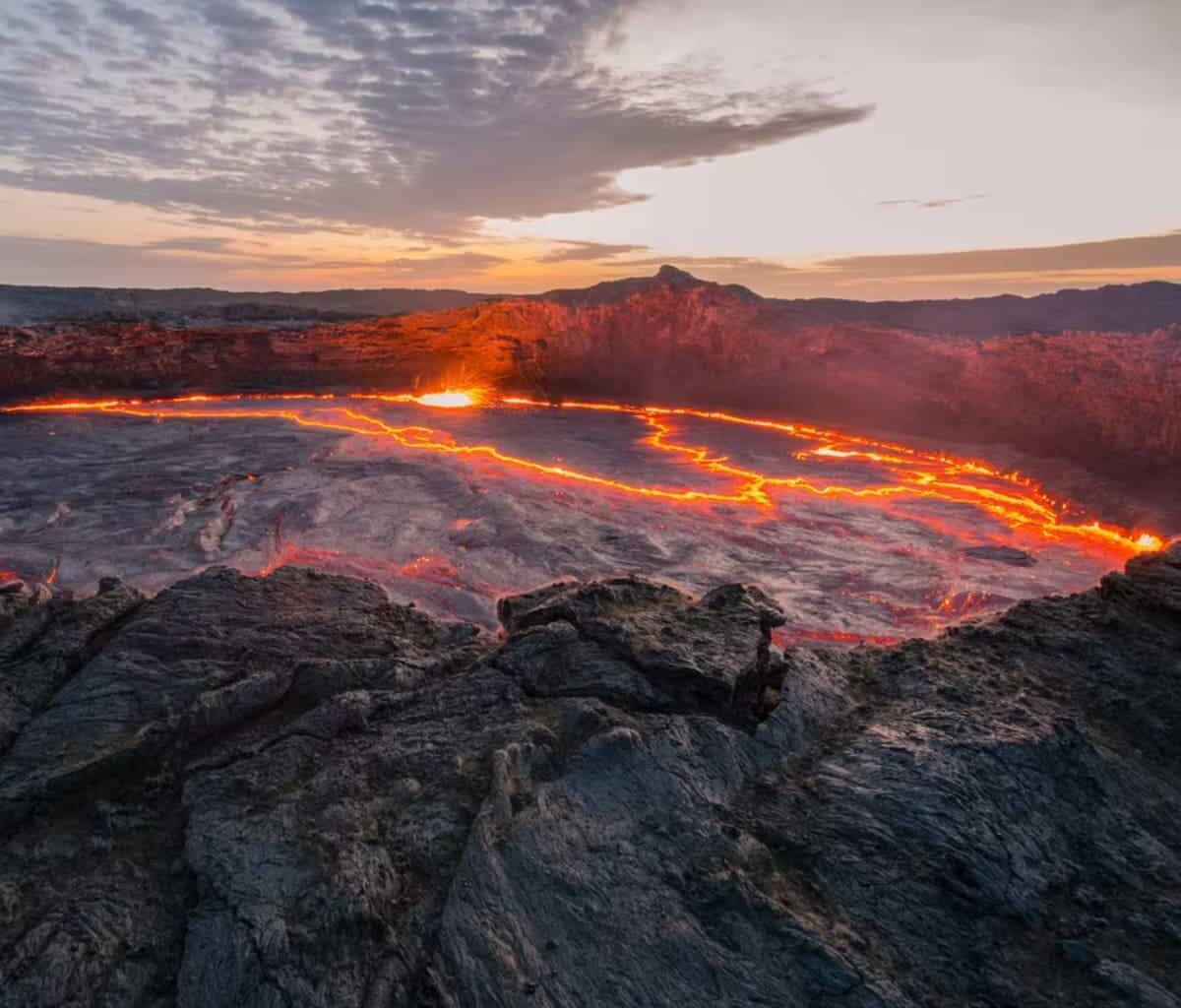
Following a wave of unusual earthquakes, a powerful jet of steam and mud has burst from Mount Dofen in Ethiopia — a development scientists believe is tied to underground magma movements. The activity has sparked growing concern that a volcanic eruption could be imminent.
It’s easy to forget, but a brand-new ocean is slowly being born in East Africa. Along the East African Rift, one of Earth’s most dramatic tectonic processes is underway. The continental crust is literally tearing apart, pulled in opposite directions by geological forces that are gradually separating the Horn of Africa from the rest of the continent — millimeter by millimeter.
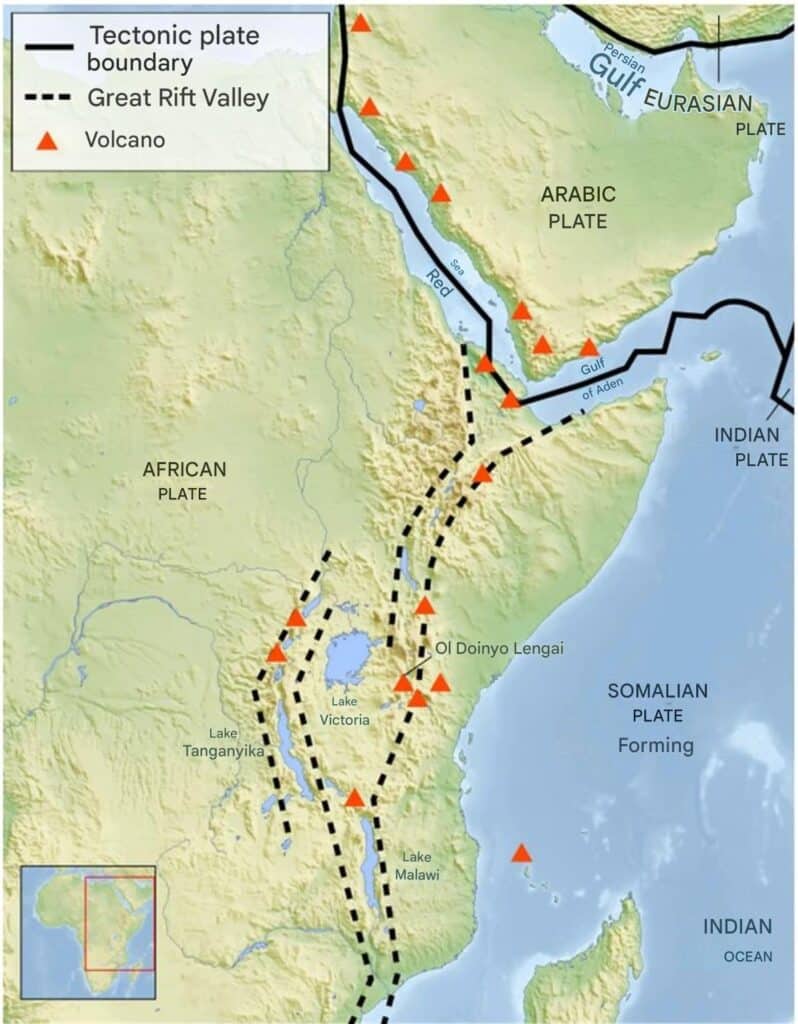
Map showing the location of the East African Rift (between the dotted lines). © Sémhur, Wikimedia Commons
A process already in motion
That ocean won’t appear anytime soon, but the process is well underway. The region’s restless geology — frequent quakes and volcanic rumblings — is proof. As the crust stretches and thins, molten rock pushes upward, forcing its way toward the surface.
The East African Rift is home to a long chain of volcanoes fueled from deep below by what geologists call the African superplume — a vast upwelling of hot mantle material that causes the crust to bulge. This uplift explains why the rift’s northern section, though already in a mature oceanic phase, remains above water. The situation mirrors that of Iceland, which straddles the Mid-Atlantic Ridge and sits atop a hot spot that keeps its oceanic crust exposed rather than buried beneath the sea.
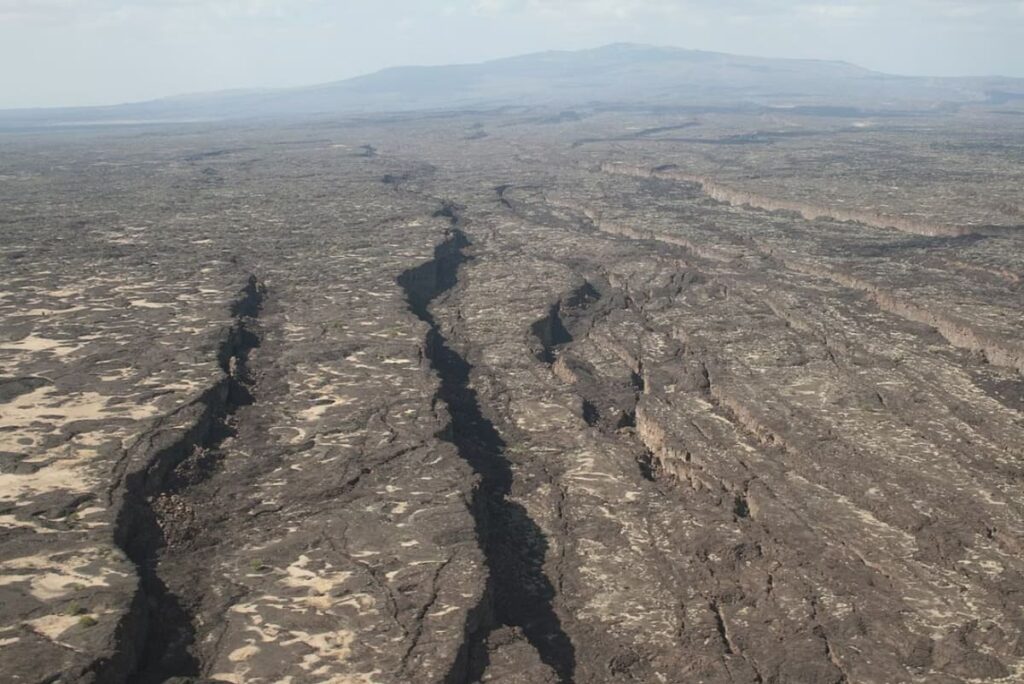
Landscape of the East African Rift, marked by a series of normal faults that form a large rift basin. © DavidMPyle, Wikimedia Commons, CC BY-SA 4.0
Rising seismic unrest in Ethiopia’s Afar region
Over the past two weeks, Ethiopia’s Afar region has experienced an unusual swarm of earthquakes — fifty-five moderate tremors below magnitude 4 and two stronger ones reaching 5.1. Though no damage has been reported, the activity has intensified, prompting authorities to evacuate several hundred residents.
The concern now isn’t just shaking ground — it’s what’s brewing beneath it. Scientists believe the earthquakes are being triggered by magma shifting within the crust, a suspicion confirmed when explosive hydrothermal activity suddenly erupted.
Steam vents and boiling mud pools signal danger
A violent jet of steam, spewing mud and shattered rock, has appeared on Mount Dofen — an ancient volcano long thought dormant. Nearby, bubbling mud pools have formed, the result of groundwater coming into contact with rising magma. Following these events, two stronger earthquakes, with magnitudes of 5.5 and 5.8, shook the area.
Volcanic eruption in Ethiopia on January 3, 2025, in the Dulecha district, Mount Dofan, Afar Regional State. © UMD Media, YouTube
Until now, Dofen had shown no sign of life. No historical eruptions are known, leaving scientists uncertain about its true behavior. But with magma clearly on the move and hydrothermal systems awakening, officials have ordered evacuations in high-risk zones around the volcano.
What’s happening in Dofen is more than a local event — it’s a vivid reminder that East Africa sits on one of the planet’s great tectonic frontiers, where continents split and the Earth reshapes itself in real time.

Morgane Gillard
Journalist
As a child, I dreamed of being a paleontologist, an astronaut, or a writer… and ultimately, my heart led me to geology. After years of studying to gain deep knowledge, I now share it with you, the readers of Futura!
Looking back, I realize that my passion for Earth and science in general started very early! My first spelunking expedition was at the age of 4, my first scuba dive at 7, fossil hunting all across France, nighttime outings to watch the stars… With a father who was a chemistry teacher and an avid cave diver, and a mother who was the first female commercial diver in France, my childhood was filled with adventure and discovery! One memory in particular stands out: observing the Hale-Bopp comet in 1997, in the middle of the night, standing in a field while my parents whispered the countdowns for the exposure times to photograph that strange celestial object lighting up the sky. That image is forever etched in my memory, a moment filled with a certain magic—and even today, I still get chills when I gaze up at the stars. Head in the stars, feet on the ground. It was probably during our travels in an old Volkswagen van, between Andalusia and the barren lands of the North Cape, that I discovered the incredible beauty of nature and the stunning diversity of landscapes our planet has to offer.
Discovering Earth and Its Inner Workings
After high school, pursuing scientific studies felt like a natural choice, so it came as no surprise when I enrolled at university for a full degree in Earth Sciences. But I struggled to stick to just one field. During my studies, I explored all areas of geoscience: from geodesy to electromagnetism, from mineralogy to field geology… I loved learning about Earth and its complexity, its beauty, its strength, and its fragility. So when I was offered the chance to start a PhD in geodynamics in 2011—studying the development of the Australian and Antarctic margins—I didn’t hesitate. More things to learn and discover!
One of the most fascinating aspects of geosciences is how you juggle both vast timescales and spatial scales. You never stay still—you’re constantly zooming in and out. In a single day, you might shift from looking at the oceanic crust to analyzing a tiny mineral. You might be discussing tectonic plate movements and then chemical interactions between minerals. What could be more exciting?
From Continent to Ocean: The Incredible Journey of a PhD
Over those three years, I gradually specialized in seismic interpretation. Like a detective, I learned to read those striped black-and-white images and reconstruct a story—the story of plate tectonics and the opening of an ocean. Specifically, I worked on the development of detachment faults in the continent-ocean transition zone and the sedimentary record they produce. I had the opportunity to present my work at many international conferences and built a strong scientific identity. Three years of hard work, amazing discoveries, and incredible encounters shaped me into who I am today. After defending my thesis in 2014, I completed several years of postdoctoral research with CNRS and in collaboration with oil companies interested in these increasingly strategic zones for petroleum exploration.
Science, Always and Forever
But… academia is demanding, requiring full-time commitment—something not always compatible with starting a family. So I made the tough decision to shift career paths and turned to scientific writing. It turned out to be a great choice, as it allows me to keep talking about science, especially geology. Working with Futura is a real opportunity because it lets me share the world of Earth Sciences—an often-overlooked field—with a broad audience. After all, what could be more important than understanding the planet we live on?