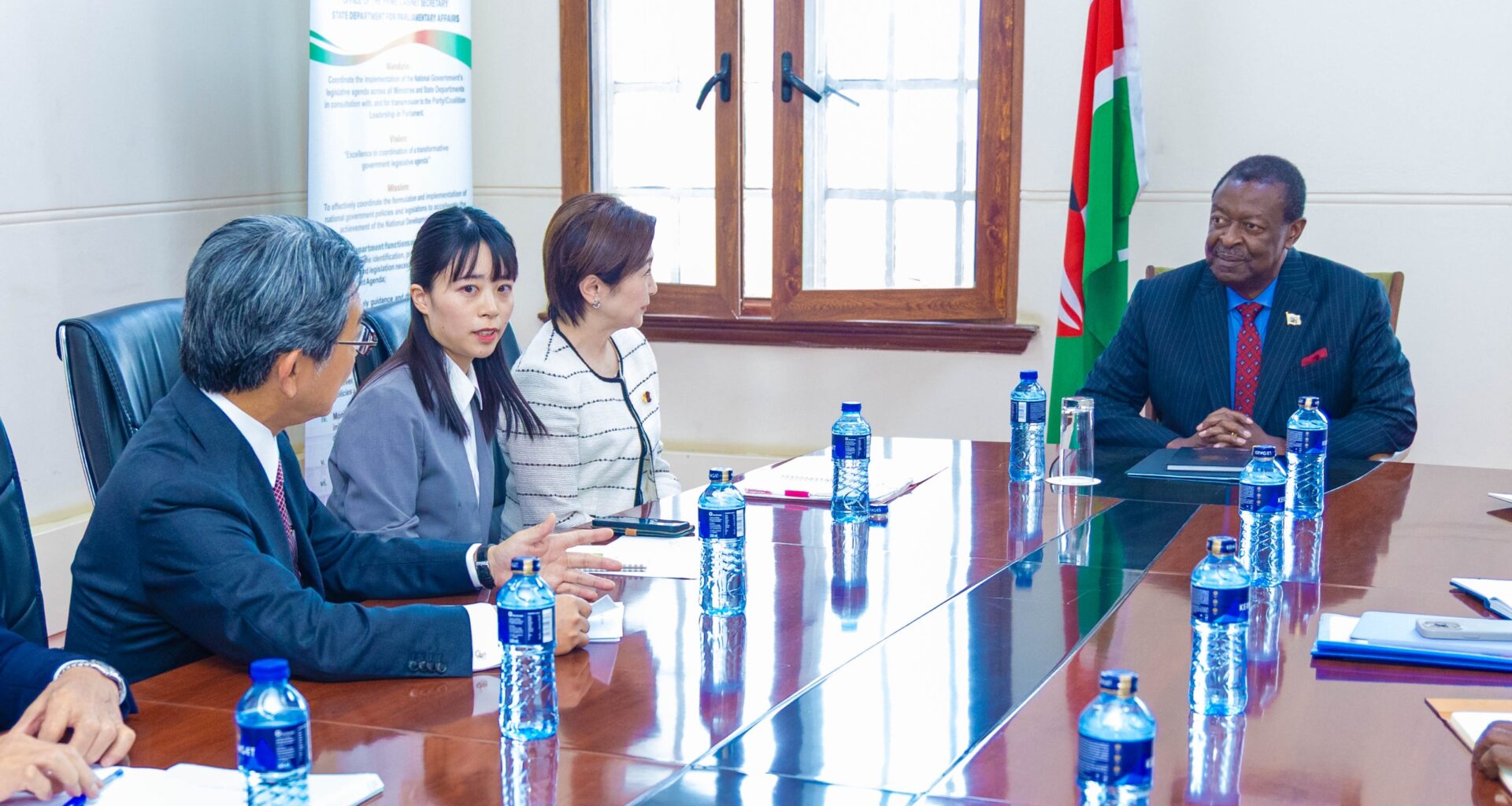
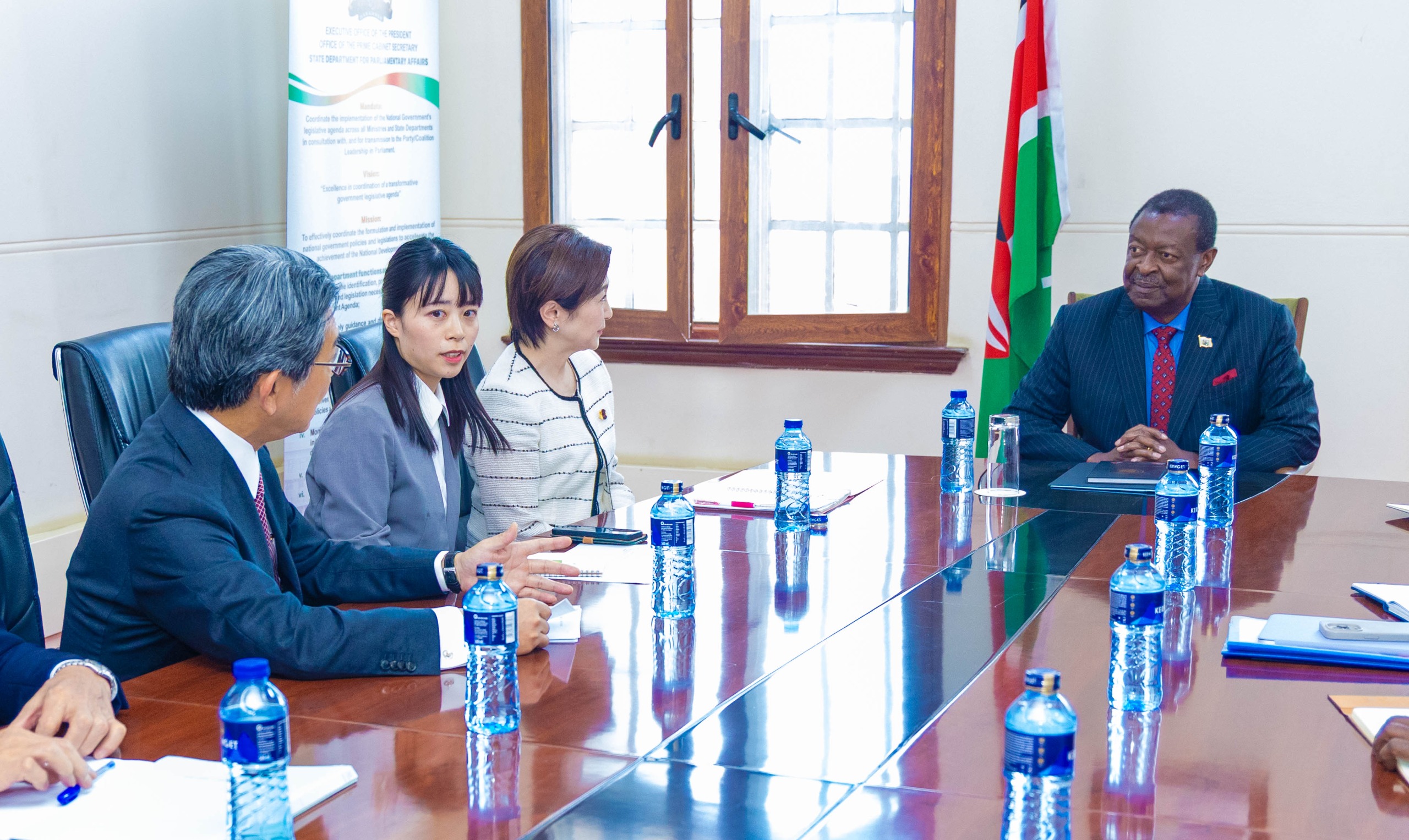
 Foreign Affairs CS Musalia Mudavadi meets a high-level delegation from Japan’s Official Development Assistance research mission at his office on January 8, 2026Kenya is seeking to expand its long-standing development
partnership with Japan beyond traditional aid as the two states explore new
areas of cooperation in trade, investment and private sector-led growth.
Prime and Foreign Affairs CS Musalia Mudavadi on Wednesday
said Kenya continues to attract strong global partnerships that deliver “real
results”.
Mudavadi made the remarks following talks with a high-level
delegation from Japan’s Official Development Assistance (ODA) research mission
of the House of Councillors.
The Japanese mission, led by Ikuina Akiko, a member of the
Committee on Health, Welfare and Labour, is in Kenya to assess the impact of
Japan-supported projects in infrastructure, health, education, energy and
agriculture sectors.
The team’s focus is on outcomes, sustainability and future
collaboration.
The delegation also included lawmakers Aoshma Kenta of the
Committee on Land and Transport and Otsu Tsutomu of the Committee on Cabinet
and Japanese Ambassador Matsuura Hiroshi.
Mudavadi said discussions centred on scaling what works and
unlocking new areas of cooperation.
“We identified practical pathways to expand collaboration
into trade and investment, manufacturing, private sector partnerships and
sports, aimed at driving jobs, growth and long-term economic value,” he said.
“Kenya takes seriously Japan’s support in sectors that
deliver measurable impact and strong multiplier effects, lifting communities
out of poverty, strengthening healthcare and education systems and accelerating
economic growth.”
The call for an expanded scope of cooperation is aimed at
driving job creation, economic growth and long-term value.
This signals a shift from development assistance anchored
mainly in public projects to partnerships that actively involve the private
sector.
Already, Japan has undertaken various projects in the
country, including in infrastructure, energy, agriculture, education and
research sectors.
In infrastructure, examples include the Dongo Kundu Bypass,
which was constructed through ODA loans.
Japan also supported the Port of Mombasa expansion and
associated infrastructure under long-term development cooperation, as well as
the Ngong’ Road expansion through a grant that financed both Phase I and Phase
II of the road.
In energy, Japan has assisted with Olkaria Geothermal
Development by contributing turbines and technical expertise to expand
geothermal energy capacity.
Japan’s ODA has supported the Sondu-Miriu hydropower project
and energy distribution improvements in Nakuru and Mombasa.
In agriculture, it has been involved in irrigation
development and technical assistance to boost rice productivity in Mwea through
new cultivation techniques and scheme expansion.
Mudavadi said Kenya places high value on Japan’s support in
sectors that deliver measurable impact and strong multiplier effects,
particularly those that lift communities out of poverty and strengthen public
service delivery.
“Kenya takes seriously Japan’s support in sectors that
deliver measurable impact and strong multiplier effects, lifting communities
out of poverty, strengthening healthcare and education systems, and
accelerating economic growth,” he said.
The inclusion of sectors such as manufacturing and sports in
the discussions signals a broadening of Kenya-Japan relations beyond
traditional development priorities, potentially opening new avenues for skills
transfer, youth engagement and investment.
Additionally, the focus on outcomes, multiplier effects and
private sector participation closely mirrors the priorities outlined in the
Draft 2026 Budget Policy Statement, which lays bare the fiscal pressures
forcing the government to rethink how it finances development.
According to the policy statement, revenue performance in
the early months of the 2025-26 financial year fell significantly below target,
with total revenue and Appropriation-in-Aid underperforming projections and
triggering the need for a supplementary budget.
Treasury warns that this underperformance has sharply
constrained fiscal space, leaving the government with limited room to
accommodate emerging priorities without cutting spending elsewhere or
increasing borrowing.
It is against this backdrop that Mudavadi’s emphasis on
concessional partnerships speaks to the financing constraints realities.
With domestic revenues falling short and tax measures
politically sensitive, the policy statement directs ministries to prioritise
programmes with “high impact” and “strong multiplier effects” — precisely the
sectors highlighted in Japan-supported projects.
The policy statement also flags significant fiscal risks
linked to Kenya’s debt profile, particularly vulnerability to external shocks,
such as exchange rate volatility, rising global interest rates and tightening
international financial conditions.
While Treasury maintains that public debt remains
sustainable, it cautions that adverse macroeconomic developments could quickly
increase debt-servicing costs and crowd out development expenditure.
In this context, Japan’s ODA, which is largely concessional,
long-term and predictable, offers a financing model that aligns with Treasury’s
goal of reducing exposure to expensive commercial borrowing.