The Central African Republic’s latest presidential election has delivered a familiar outcome.
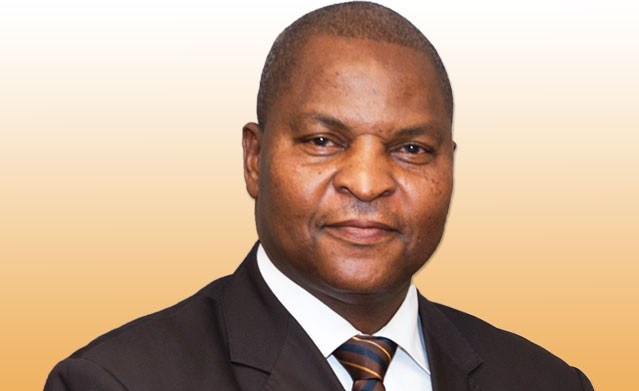
President Faustin-Archange Touadéra has secured a third term with a commanding margin. On paper, the result suggests continuity and stability in a country long scarred by conflict. In reality, it exposes the deep contradictions at the heart of CAR’s politics — where order is increasingly maintained by force and foreign backing, while democratic legitimacy continues to erode.
The election was widely disputed. Opposition candidates rejected the results, citing irregularities, intimidation, and an uneven political playing field. Much of the opposition had already been weakened by the 2023 constitutional changes that removed term limits, a move seen by critics as designed to entrench Touadéra’s rule rather than strengthen institutions. Low trust in the electoral process means that, for many Central Africans, the vote did little to resolve questions of who truly governs in their name.
Touadéra himself is a complex figure. A former academic and prime minister, he came to power in 2016 promising reconciliation after years of chaos. His record is mixed. On the positive side, his presidency has coincided with a reduction in large-scale rebel offensives and the re-establishment of state authority in parts of the country that were once entirely outside government control. For citizens exhausted by violence, this relative calm matters.
Keep up with the latest headlines on WhatsApp | LinkedIn
But that stability has come at a price. Touadéra’s government is heavily propped up by foreign militaries — most notably Russian-linked forces and Rwandan troops — alongside the UN peacekeeping mission. These forces have been decisive in keeping the government in power, but they have also raised serious concerns about sovereignty, accountability, and human rights. CAR increasingly looks less like a state rebuilding its own capacity and more like one outsourced to external security guarantors.
For ordinary people, the political debate often feels distant from daily hardship. CAR remains one of the poorest countries in the world, despite vast natural wealth in diamonds, gold, timber, and other resources. Economic growth has been limited and uneven, with little evidence that resource revenues are translating into broad improvements in living standards. Jobs are scarce, infrastructure weak, and basic services unreliable. Stability without development risks becoming hollow.
Geopolitically, Touadéra’s re-election reinforces CAR’s alignment with Russia and signals a continued distancing from Western partners. In a wider African context, the country has become a symbol of shifting global influence, where governments under pressure turn to non-Western allies who offer security support with fewer political conditions. Whether this ultimately benefits CAR or locks it into new forms of dependency remains an open question.

Sign up for free AllAfrica Newsletters
Get the latest in African news delivered straight to your inbox
Success!
Almost finished…
We need to confirm your email address.
To complete the process, please follow the instructions in the email we just sent you.
Error!
There was a problem processing your submission. Please try again later.
Is Touadéra good for the country? The answer depends on what one values most. If the priority is short-term security and regime survival, his model has delivered results. If the goal is long-term nation-building — rooted in credible elections, strong institutions, and shared economic opportunity — the picture is far less convincing.
CAR now faces a choice, even if it is not being openly debated. Stability imposed from above can hold for a time, but without legitimacy and inclusion, it is fragile. Touadéra’s third term may buy the country calm, but whether it builds a future for its people is still very much in doubt.
——————————
Daniel Makokera is a renowed media personality who has worked as journalist, television anchor, producer and conference presenter for over 20 years. Throughout his career as presenter and anchor, he has travelled widely across the continent and held exclusive interviews with some of Africa’s most illustrious leaders. These include former UN Secretary General Kofi Annan, former South African presidents Nelson Mandela and Thabo Mbeki, former Libyan leader Muammar Gaddafi, Zimbabwean Prime Minister Morgan Tsvangirai and presidents Robert Mugabe of Zimbabwe and Joseph Kabila of the Democratic Republic of the Congo. He currently is the CEO of Pamuzinda Productions based in South Africa.