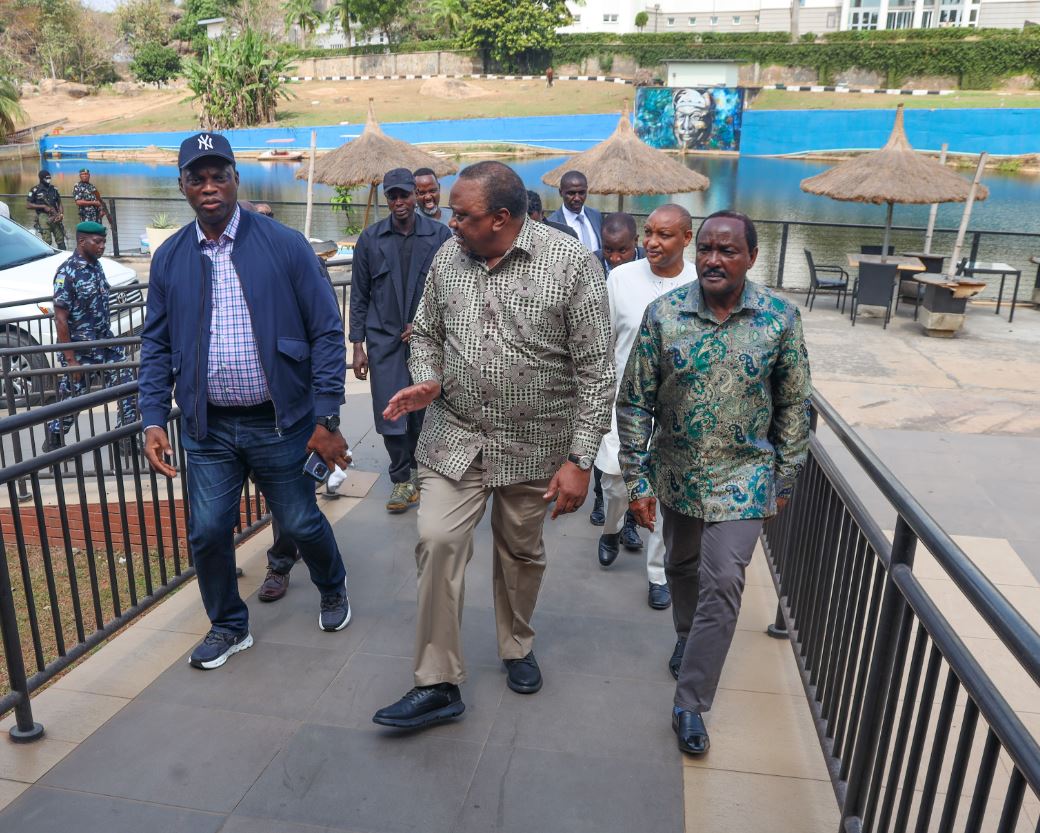
 Former President Uhuru Kenyatta and Wiper leader Kalonzo Musyoka undertook an extensive tour of the Olusegun Obasanjo Presidential Library (OOPL) in Abeokuta, Ogun State, Nigeria, on January 3, 2026Retired President Uhuru Kenyatta’s influence is once again
casting a long shadow over opposition politics.
Fresh alignments and manoeuvres ahead of the 2027 General
Election are exposing both his enduring clout and the fragility of unity in the
United Opposition.
Uhuru is increasingly being linked to an emerging push for a
Kalonzo Musyoka-Fred Matiang’i ticket, a line-up that, if it works out, would
significantly reshape the opposition landscape.
His recent high-profile engagements with Wiper party leader
Kalonzo Musyoka in Nigeria have only fuelled speculation about his role in
quietly steering the direction of opposition succession politics.
Uhuru and Kalonzo spent at least three days together in
Lagos, Nigeria, where they attended several engagements, including meetings
with former Nigerian President Olusegun Obasanjo.
The two leaders also jointly addressed winners and alumni of
the Future Africa Leaders Awards at Omnia Towers in Lagos, presenting a united
front on leadership and governance issues in Africa.
Their trip extended beyond Lagos to Ogun State, where they
undertook an extensive tour of the Olusegun Obasanjo Presidential Library.
The visit exposed the leaders to exhibitions chronicling
Nigeria’s democratic evolution, regional peace initiatives and Obasanjo’s role
in shaping governance across Africa.
Collections highlighting Africa’s place in global diplomacy
and sustainable development further reinforced the continental framing of their
engagement.
Back home, however, political observers are reading deeper
domestic implications into the visit.
Makueni Senator Dan Maanzo, a close ally of Kalonzo, told
the Star there are talks between Uhuru and Kalonzo, saying the recent meetings
“cannot be for nothing”.
“Uhuru wishes the best for this country,” he said.
“Matiang’i is seeking to be President but hasn’t been
elected before. So they are talking and they have been consulting.”
He said the two leaders are to jointly visit Raila’s home on
Wednesday.
He added that there are attempts to hijack Jubilee in the
larger scheme to destabilise the United Opposition.
The visible closeness between Uhuru and Kalonzo revives
memories of the 2022 Azimio coalition formation, during which Uhuru was widely
reported to have played a decisive role in persuading Kalonzo to back Raila
Odinga’s presidential bid despite not being offered the running mate position.
At the same time, Uhuru is also widely perceived as the
driving force behind Matiang’i, his former powerful Interior CS.
Uhuru, who remains the Jubilee party leader, last year
endorsed Matiang’i for the top job, expressing confidence in his leadership
credentials given his record in different dockets.
However, these manoeuvres are unfolding at a moment when the
United Opposition is struggling with internal cohesion.
The Kalonzo-Rigathi Gachagua axis has increasingly appeared
to sideline the Jubilee wing, raising questions about the role Uhuru’s party
will ultimately play in the opposition arrangement.
Some political analysts have predicted that both Kalonzo and
Matiang’i will be on the ballot, offering President Ruto an easier chance for a
second term.
This dynamic places Gachagua in an awkward position because
while he has developed close political ties with Kalonzo, including publicly
pledging to rally millions of votes for him in the Mt Kenya region, the former
DP has been openly sceptical of Jubilee’s involvement in the opposition.
The DCP leader has urged Matiang’i not to join the United
Opposition under the Jubilee banner, given that such a move would dilute the
influence of his Democracy for the Citizens Party in Mt Kenya.
Instead, Gachagua has suggested that Matiang’i should form a
new political party with roots in the Kisii region.
Gachagua has also questioned Jubilee’s political identity,
openly expressing confusion over whether the party considers itself part of the
government or the opposition. This ambiguity, he argues, undermines trust and
complicates coalition-building efforts.
Despite this, his cooperation with Kalonzo has deepened,
with the two reportedly agreeing on arrangements that would allow DCP to field
candidates for governor, senator and woman representative in Nairobi, as well
as several parliamentary seats in the capital.
Uhuru’s re-emergence in opposition politics has not gone
unnoticed by the broad-based government.
Some leaders aligned to President William Ruto have accused
Uhuru of undermining the Kenya Kwanza administration by actively shaping
opposition strategy from behind the scenes.
The criticism has also come from ODM, with legislators
allied to the President accusing Uhuru of fuelling divisions within the Orange
party.