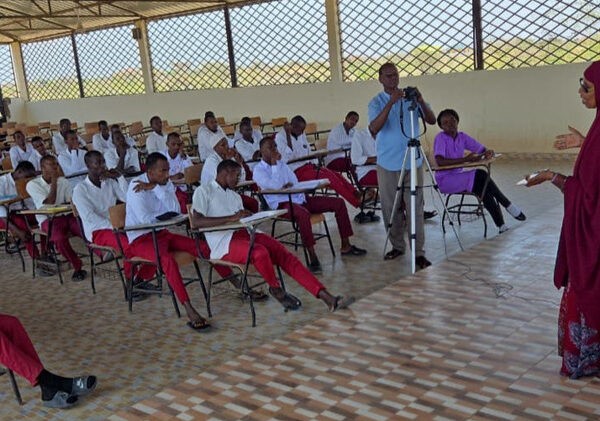
Kenya will on Monday mark a historic milestone in education as the first cohort of Grade 10 learners under the Competency-Based Education (CBE) system transitions to senior school.
Approximately 1.13 million students across the country will begin studies in the newly introduced STEM, Social Sciences, and Arts and Sports pathways, ushering in a skills-focused learning era.
Statistics from the Ministry of Education show that more than half of the transitioning learners have chosen the STEM pathway, 437,000 opted for Social Sciences and 124,000 selected Arts and Sports.
Basic Education Principal Secretary Julius Bitok said the admission process will be fully digital, conducted through the same system used during the placement exercise, to enhance transparency and efficiency. He added that by the end of the week, the ministry expects to have a clear picture of how many students have reported to schools.
While the transition is celebrated as a milestone, it faces significant challenges, including a shortage of teachers, infrastructure gaps and the urgent need to deliver textbooks to the 1.13 million students.
Last week, the Kenya Institute of Curriculum Development (KICD) and the Kenya Publishers Association (KPA) held a joint meeting to plan the printing and nationwide distribution of Grade 10 textbooks.
KPA Chairperson Kiarie Kamau assured KICD that production of the 35 approved textbooks and literary works for Grade 10 learners would start immediately following the government’s release of Sh5.64 billion.
He noted that at least 50 per cent of the required books would be delivered to schools by Friday, January 16, 2026, with full printing and nationwide distribution scheduled for completion by January 31, 2026.
The Teachers Service Commission (TSC) has also highlighted critical deficits in technical subjects, including marine and fisheries, agriculture and creative arts. According to the commission, the country needs 35,000 teachers for STEM, 14,600 for Social Sciences and 8,778 for Arts and Sports.
TSC Acting Chief Executive Officer Eveleen Mitei assured parents on Friday that the commission would recruit adequate staff to support the senior school transition.
“We want to assure parents that teachers are prepared to receive Grade 10 CBE candidates joining senior school from Monday. Our teachers are equipped with the competencies, skills, and confidence required to meet the diverse learning needs of our students,” she said.
She said teachers have been equipped with the competencies and confidence to handle diverse learner needs, but acknowledged gaps in facilities and staffing in some institutions.
“I appeal to heads of institutions to creatively broaden the curriculum offerings, even where facilities may be inadequate, to allow learners to explore their full potential,” she said, adding that TSC remains committed to addressing shortages, especially in specialised learning areas.
Infrastructure gaps, particularly classrooms and laboratories, have also posed a major hurdle as learner numbers grew. Although the government has committed to building 1,600 laboratories, many schools currently lack the facilities required to teach practical subjects such as electricity and aviation.
Education stakeholders have warned that failing to address these gaps could create a two-tier system, favouring learners in top-tier schools and widening the urban-rural education divide.
Demands for illegal levies, including clearance of remedial fees, motivation fees for teachers, and replacement of lost textbooks, are among other obstacles threatening the full transition of students to Grade 10, civil society groups have warned.
“Approximately 1.13 million CBC/CBE pioneer students will be reporting to senior school on Monday, but the majority face a risk of missing their slots due to a systemic failure of the online placement system that has exposed parents to corruption,” Cornelius Oduor, Deputy Executive Director of KHRC, said during a press briefing in Nairobi.
The group also reported that some learners’ Kenya Junior School Education Assessment transcripts have been withheld over illegal levies, directly undermining their right to education.
Parents have also been reportedly asked to pay fees not sanctioned under the Free Day Secondary Education policy, with schools citing budget shortfalls and delayed government disbursements.
“For those lucky enough to make it, they will face classes lacking essential equipment and demotivated staff, as the William Ruto administration has consistently underfunded the education sector,” Oduor said.
Placement errors have further compounded the crisis. Some students have reportedly been assigned pathways that do not align with their interests or abilities, while others have been posted to distant day schools, disregarding the proximity rule.
The backlash has been significant, with 355,457 learners applying for placement reviews by December 2025. Of these, 143,821 appeals were rejected, largely due to overcrowding in preferred schools.
The lobby has issued several demands to the Ministry of Education, including an urgent resolution of placement challenges, a comprehensive audit of school infrastructure, and a review of the automated placement system to enhance transparency and flexibility.
The group also called for an immediate directive banning the withholding of academic transcripts over illegal levies and the establishment of a whistleblower mechanism to report corruption in admissions and school finances.
PS Bitok said the ministry is conducting a second review of Grade 10 placements to address parental concerns.
Education Cabinet Secretary Julius Ogamba assured parents, teachers and learners that measures are in place to ensure a smooth transition into senior school despite the challenges that have dogged the reforms.
Ogamba noted that the shift represents a defining moment in Kenya’s education history, marking the formal transition from the 8-4-4 system to a skills-oriented, learner-centred model. He said the move to CBE is a deliberate departure from exam-centred learning towards nurturing competencies, values and practical skills relevant to the 21st century.
“With infrastructure expansion, teacher recruitment, improved financing, and policy reforms underway, the foundation has been laid for a smoother and more credible transition under CBE, one that will ultimately redefine learning outcomes for generations to come,” he said.
He acknowledged that the journey to CBE has not been without setbacks, citing early resistance, inadequate infrastructure, teacher shortages and concerns over preparedness.
“The transition to competency-based assessment marks a decisive step forward, one that shifts our focus from rote memorisation to the demonstration of skills, values, and knowledge that empower learners to thrive in the modern world,” Ogamba said, adding that the reforms are designed to nurture every learner’s potential and prepare them for life and work.