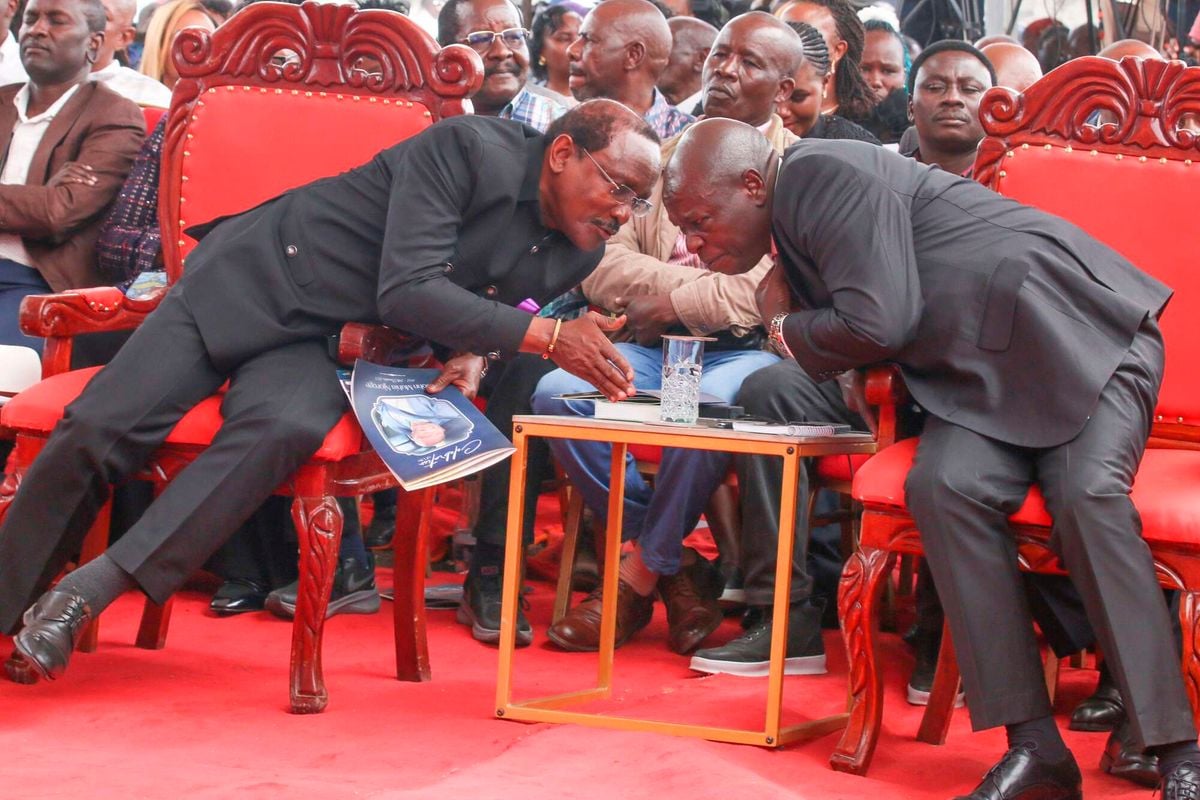
 Wiper leader Kalonzo Musyoka and DCP boss Rigathi Gachagua in Kyuluni Village, Kathiani constituency, Machakos county, during the burial of Mzee Jonathan Kiilu Ng’ata on January 10Wiper leader Kalonzo Musyoka and DCP’s Rigathi Gachagua are
increasingly finding themselves at odds over strategy, messaging and the path
to the 2027 polls as the opposition struggles to present a united front.
The latest public disagreement played out on Wednesday, when
Kalonzo was forced to clarify claims that the opposition is against the Somali
community. Gachagua triggered the storm by linking business activities in
Eastleigh to the Minnesota fraud.
Speaking at the funeral of Kipipiri MP Wanjiku Muhia’s
father Muhia Njoroge, Kalonzo sought to calm the backlash against the
opposition and particularly Gachagua from the leadership of Northeastern.
The Wiper boss said the opposition stands in solidarity with
all communities, adding that Gachagua’s remarks should not be interpreted as a
blanket condemnation of the Somalis.
“We want to assure Somalis and every other Kenyan who is not
a criminal that we are together; we are working for the real unity of Kenya,”
Kalonzo said.
Speaking at the same function, Gachagua denied targeting any
specific individual or community, saying his comments had been deliberately
misrepresented.
“I recently spoke about a mall in Eastleigh that was used to
import rice at the expense of our farmers,” he said.
“I have seen people saying that I have attacked the mall. I
never mentioned the mall or the owner or the community he comes from.”
Among those who criticised Gachagua and by extension his
political ally Kalonzo was Wajir Governor and Council of Governors chairman
Ahmed Abdullahi.
“Gachagua has taken Somaliphobia to an unacceptable level.
The owner of BBS Mall has been a serious businessman in this country way before
President William Ruto came to power,” he said.
“To Kalonzo, an otherwise good man, with friends like
Gachagua, you don’t need enemies. Whenever Rigathi opens his mouth,
independent-minded Kenyans’ support for Ruto surges.”
While both leaders sought to de-escalate the backlash, the
incident was yet another point of departure between them,
particularly around messaging and strategy.
Notably, the two are widely viewed as the most formidable
figures in the opposition, each commanding a significant regional following in
Ukambani and the Mt Kenya region.
Only last weekend, the two clashed over the timing of naming
the opposition’s presidential flag bearer for the 2027 polls.
Kalonzo had earlier announced that the opposition had
resolved to unveil its candidate by March this year, framing the early decision
as key to giving the opposition enough time to organise and mount a credible
challenge against President William Ruto.
However, Gachagua publicly poured cold water on the plan,
warning that an early announcement would be premature and potentially expose
the candidate to sustained state pressure.
Speaking in Kigumo, Murang’a county, Gachagua urged
patience, arguing that the opposition would be better served by waiting until
later in the election cycle.
“We shall have one candidate to face Kasongo [President
William Ruto]. I want to ask for patience. Don’t be in a hurry. The election is
still far away,” he said.
“If we announce our presidential candidate right now, he
will be intimidated and harassed by Ruto. We can’t do that. We are not fools.”
He spoke during the burial of Embakasi North MP James
Gakuya’s mother Alice Wangari.
Kalonzo and Gachagua have also previously clashed over
Nairobi’s political arrangements ahead of 2027.
In December, Kalonzo was forced to deny claims that his
Wiper party had agreed to cede all major elective seats in Nairobi to
Gachagua’s DCP.
“Stop this propaganda that Wiper has left all the seats in
Nairobi for DCP. They have to try everything to create tensions between us,”
Kalonzo said at the time, dismissing the reports as unfounded.
Those claims had been triggered by Gachagua’s remarks during
a church service in Kariobangi North, where he asserted that Wiper would
withdraw most of its candidates in Nairobi in favour of DCP.
“We have an arrangement with the Wiper party leader. Out of
17 constituencies, DCP will take 16. Out of 85 wards, between DCP and Wiper, we
will have 75,” Gachagua said then.
While Kalonzo publicly disowned the claims, Gachagua’s
comments were interpreted by some in the opposition as the behind-the-scenes
lobbying and negotiations that are still ongoing in the coalition.
However, the disagreements risk reinforcing perceptions
that, despite public declarations of unity, strategic differences persist
within the opposition on how best to counter the Kenya Kwanza administration.