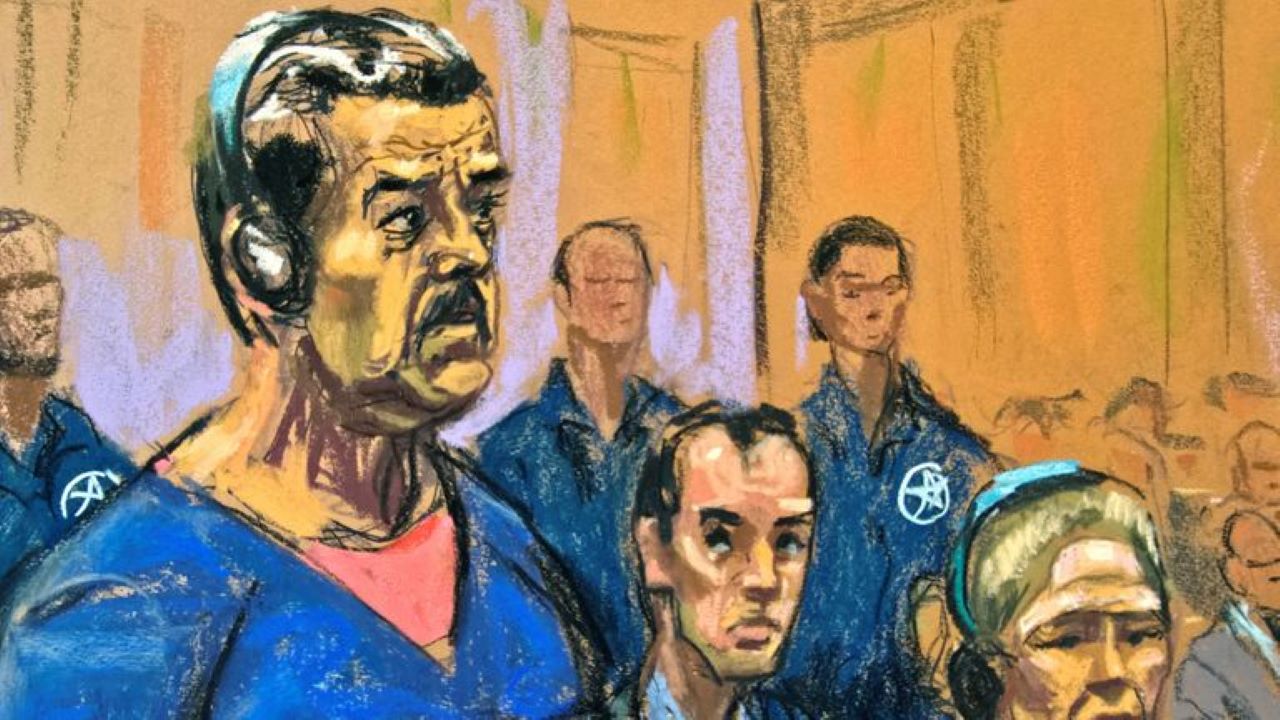
In the aftermath of the invasion of Venezuela by United States’ forces, on the orders of President Trump, and the extradition of President Nicolas Maduro and his wife, Celia Fores, to the U.S. for narco-terrorism trial, commentators have scaled up forecasts on the trajectory Nigeria must chart to avoid the Venezuela treatment.
That country is stripped of its claim to sovereignty. After an initial swagger, the interim leadership of Delcy Rodriguez has now agreed to cooperate alongside the United States and comply with whatever President Trump recommends. Somehow, Venezuela has ceded self-rule to Trump.
Venezuela and Nigeria look alike in some ways, including not having committed and selfless leadership. Some are praying that Nigeria should not end up like Venezuela. But the truth is; long before the Christmas Day U.S. airstrikes on terrorists’ facilities in Sokoto State, there had been several warnings that Nigeria was already on the way to Venezuela.
It was feared that if the political leadership did not manage the economy well, cut governance costs and stop political rascality, there were indications that the country was primed for failure. The worry is that the airstrikes might just be the prelude to other things.
Some patriots and scholars might reason that it sounds condescending to drag Nigeria to the level of Venezuela.
Nigeria, some would argue, is providentially designed to be a big player in global geopolitics and rank among the world’s best countries. The abundance of human and natural resources fuels this assertion. Nigeria, in some reckoning, cannot be treated just like any Banana Republic. That’s the defiant conversation in some quarters.
However, the reality of the moment compels a comparison. What has become of Nigeria, and also Venezuela is the outcome of a prolonged absence of accountable leadership.
Development experts had for decades categorised the two as belonging to the class of countries that are blessed with vast extractive resources and agriculture potentials, but whose citizens are among the poorest globally.
Venezuela is reported to own the world’s largest proven oil reserves, but the country’s Gross Domestic Product (GDP) fell at the rate of 80 per cent within a decade. The inflation rate was reported in 2025 to be 150 per cent. The poverty rate is estimated to be over 90 per cent, with extreme poverty affecting around 77 per cent of the population.
Nigeria has around 37 billion barrels of proven oil reserves and 209.26 trillion cubic feet (TCF). Nigeria began oil exploration more than 50 years ago and has made a fortune from exporting oil. But the country has been struggling since the mid-80s when the economy stymied. Solution was sought from the World Bank and IMF, but each year, more people fall into poverty. Recent forecast by PricewaterhouseCoopers (PwC), projects the poverty rate to rise to 62 per cent, dragging with it about 141 million Nigerians below the poverty line.
Nigeria’s inflation has dropped on paper due to the rebased computation. In practical terms, retail prices are climbing higher. Food inflation has dropped for some items, but the gas to cook the food is more costly than the food. For many households, Nigeria has not had it this tough. Medicines and health components, machinery, automobiles and accessories are way higher than what ordinary citizens can handle. Transportation costs, on air and land are not customer-friendly.
The major escape route from hardship for citizens of Nigeria and Venezuela is to emigrate. Since 2014, around eight million Venezuelans have fled the country, due to economic and political instability. The political system is repressive and intolerant of the opposition.
About 1.3 million have applied for asylum in the U.S. with more than a million of them already living in that country. Trump is not comfortable with many of them, whom he accused of engaging in criminal activities. They are the major factor in Trump’s anti-migration policies.
Nigeria too, has been battling economic woes for decades due to political and economic corruption. The last 10 years have been excruciating for citizens. To escape the hardship, citizens explore avenues to leave the country. Those who cannot do it through official means do it the hard way by road through Sahara Desert to North Africa and in deadly sails through the Mediterranean. The casualty numbers are troubling, but those who are desperate are not deterred.
So, being afflicted by what is referred to as the Dutch Disease, Nigeria and Venezuela are unable to transform their economies with proceeds from oil and gas. It is stolen by the political class while the corrupt systems cannot attract foreign investments. Venezuela is struggling to produce around one million barrels of crude per day, not enough to finance its dubious socialist economy. Nigeria is unable to produce two million barrels per day due to theft and lack of capacity.
Both countries have to surrender to outside help. Nigeria is heavily indebted (nearly N150 trillion), and has not stopped borrowing. Venezuela’s total liabilities are put around $150-170 billion. China is producing around 60,000 barrels of Venezuelan oil per day to offset defaulted loans. Citizens of Venezuela have lost faith. But there are enough armed civilian militia to extract loyalty from a despondent population. Russia and Iran are two other allies propping the doddering economy.
Nigeria has been battling terrorists for close to 10 years and unable and unwilling to deal with it. Trump has offered to help and no one knows how that will pan out. There are worries, that so long as this government is blinded by politics and refuses to frontally contain the insurgents, Trump might find the excuse to continue to exert pressure.
Unfortunately, this is not the Nigeria of the 70s and 80s, where the leadership asserted her sovereignty regionally, continentally and globally. With highly compromised politicians, some with despicable dossiers locked in FBI files, the country becomes more vulnerable.
Trump has called off another round of strikes in Caracas. The government has started cooperating and implementing Trump’s policies: access to oil and release of political prisoners, among others. Trump acknowledged it as a sign of “seeking peace, a very important and smart gesture.”
In the case of Nigeria, the government said the Sokoto airstrikes is not a one-off. Trump equally warned last week, that the U.S. could launch additional strikes if attacks on vulnerable population by terrorists persist. Indeed, the terrorists are yet to relent, despite heightened military offensive.
Civil society groups in the country have expressed grave concern over what they frame as abdication of responsibility by Nigeria’s political and military leadership, which resulted in the airstrikes. They said in a press statement: “It is obvious that Nigeria is in a dual crisis of leadership and security, and at the heart of this crisis is the apparent abdication by the President of the Federal Republic of Nigeria, Bola Ahmed Tinubu, of his constitutional role as Commander-in-Chief of the Armed Forces. By inviting a foreign government to manage what is fundamentally an internal security challenge, the President ceded sovereign authority in a manner that undermines Nigeria’s constitutional order.
“Even more disturbing is that during and after the operation, the President, the service chiefs, and the leadership of the National Assembly were either on vacation or completely silent, leaving the Minister of Foreign Affairs, Ambassador Yusuf Tuggar, to publicly rationalise decisions that strike at the core of national sovereignty and democratic accountability.”
Wike runs rampage in Rivers
AS soon as President Tinubu travelled to Europe to observe his New Year holiday, the Minister of the Federal Capital Territory, Nyesom Wike, abandoned Abuja and relocated to Port Harcourt, to peddle trouble. He said he went home to thank the people for their 2023 votes for Tinubu. His mission, he said, is to ask them to vote for Tinubu again come 2027.
In the first place, the Independent National Electoral Commission (INEC), has not released the timetable for the 2027 elections. Wike’s open campaigns for Tinubu amounts to a contravention of the Electorate Act, 2022. The Professor at INEC, Joash Amupitan, should not sleep on duty. Let him call Wike to order.
Wike also used the opportunity to remind Abuja how he manipulated the 2023 election in Rivers State for APC. He is warning the party not to tempt him to spill more beans. He also warned APC top leaders to stay away from the N600 billion Governor Siminalayi Fubara has refused to spend. He has instigated another impeachment attempt to remove Fubara. That money is too tempting to let go.
When the President returns, he should call Wike to order. Afterall, Fubara has joined the All Progressives Congress (APC). What else does Wike want?
EFCC denies politicising activities
The Economic and Financial Crimes Commission (EFCC), has dismissed the claims that its operations are weaponised against opposition politicians. But the EFCC cannot be the judge in its case. The Commission can shrug off allegations but cannot decide how its activities are perceived by Nigerians. Let the people be the judge.
It is true that politicians make bogus claims. When they are in office, they do whatever pleases them. But when it is time for reckoning, they allege all sorts. However, let the EFCC treat all cases equally. Yahaya Bello, former governor of Kogi State, for instance, cannot now become APC’s poster boy, after all he did to evade and frustrate the EFCC arrest.
Let the EFCC prosecute his case with the same zeal it is handling that of Abubakar Malami and others. Yahaya Bello cannot run for Senate in 2027, until the case(s) with the EFCC are dispensed with, expeditiously and judiciously. Let there be transparency, even when it involves plea bargaining. No backdoor negotiation for the APC members.
INEC finally wakes up to delist Julius Abure
It is curious, that since 2023, when Julius Abure held the Labour Party (LP) by the jugular, INEC looked the other way, claiming respect for judicial processes. Even when the Supreme Court decided that leadership disputes should be left for parties to handle, INEC allowed Abure to hold on. But as soon as Peter Obi joined the African Democratic Congress (ADC), INEC has now invalidated Abure’s chairmanship. What changed? Nigerians are asking!