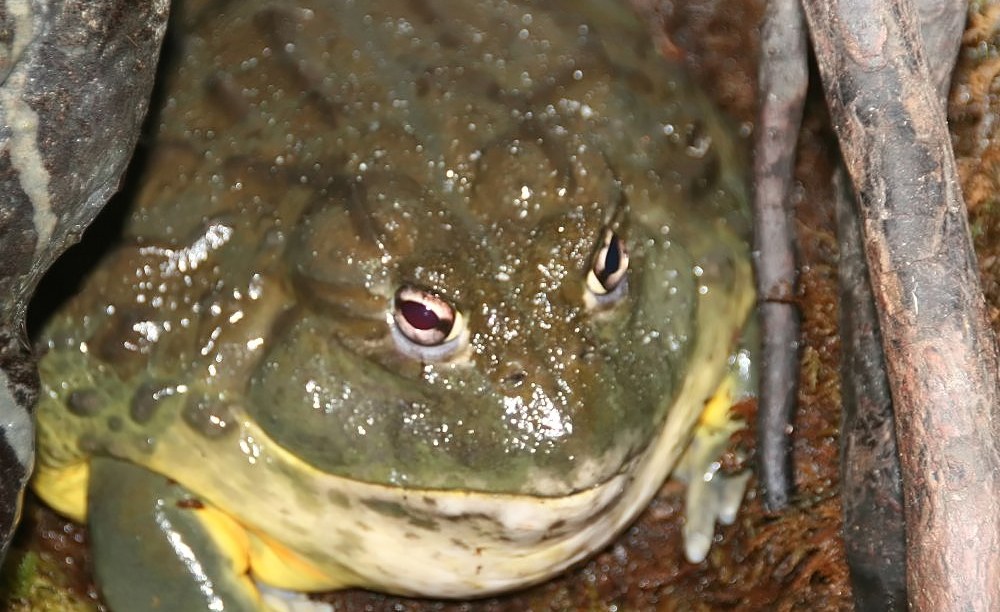
Namibia is endowed with an extraordinary range of wildlife, magnificently adapted to survive and flourish under the country’s harsh arid and semi-arid climatic conditions, including a remarkable diversity of amphibian species.
These embrace notable frog species such as the Giant African Bullfrog, the Common Platanna, and the Mapacha Grass Frog, among others.
The Giant African Bullfrog (pyxicephalus adspersus), in particular, is predominantly distributed across the central and northern regions of Namibia and has been subjected to intense exploitation for human consumption.
This unsustainable level of harvesting has resulted in localised population declines, as documented by the IUCN SSC Amphibian Specialist Group in 2013.
Follow us on WhatsApp | LinkedIn for the latest headlines
The species is widely regarded as a culinary delicacy by several indigenous communities and local inhabitants, who harvest it both for subsistence purposes and for commercial sale at informal markets.
Beyond anthropogenic pressures, the Giant African Bullfrog is further imperilled by natural predation from species such as saddle-billed storks and monitor lizards, compounding the conservation challenges facing this iconic amphibian.
LEGALITIES
The Nature Conservation Ordinance, 1975, subsequently strengthened by the Nature Conservation Amendment Act, 2017, is Namibia’s principal legislative instrument governing the conservation of nature and the regulation of wildlife utilisation.
The ordinance establishes a comprehensive taxonomic framework through which fauna occurring in the wild are stratified into distinct legal classes, namely “specially protected game”, “protected game”, “huntable game”, “huntable game birds”, “exotic game”, and “wild animals”.
While the law expressly enumerates species falling within most of these classifications, it notably refrains from providing exhaustive species lists for the categories “exotic game” and “wild animals”, opting instead to define the scope of animals encompassed therein.
The Giant African Bullfrog is conspicuously absent from all enumerated “game” categories, a legislative silence that renders its protected status susceptible to oversight or misinterpretation.
It is therefore imperative to interrogate the statutory definition of “wild animals” to properly ascertain the level of legal protection for the species.
Ordinance No 4 of 1975 defines a wild animal as “any vertebrate (including birds, fish and reptiles), whether kept or bred in captivity or elsewhere, belonging to a non-domestic species and the habitat of which is in the Republic of South Africa or Namibia”.
When this definition is applied, the inclusion of the Giant African Bullfrog within the ambit of legally protected wildlife is unequivocal.
SPECIFIC PROVISIONS
The abovementioned ordinance expressly proscribes the catching or killing of the Giant African Bullfrog without prior authorisation, in the form of a valid permit issued by, or with the consent of, the lawful owner of the land, as stipulated under section 34(2).
In unequivocal terms, anyone who engages in hunting, harvesting, or destruction of the Giant African Bullfrog, or indeed any other frog species, without the requisite permit directly contravenes the law.
Such unlawful conduct attracts the full punitive weight of the state, and upon conviction, the offender is exposed to severe statutory sanctions, including a monetary penalty of not less than N$750 and not exceeding N$1 500, or a term of imprisonment ranging from a minimum of 12 months to a maximum of three years, or the imposition of both such fine and custodial sentence.
WHAT IT MEANS
A substantial proportion of Giant African Bullfrog harvesting takes place on communal land, which is vested in and owned by the state.
In this context, Ordinance No 4 of 1975 unequivocally recognises the Namibian government as the lawful proprietor of such land.
Consequently, the state retains proprietary rights over the wildlife occurring thereon, including the Giant African Bullfrog.
It follows, as a matter of law, that any individual seeking to hunt or harvest Giant African Bullfrogs on communal land is legally obligated to secure a permit from the government.
This statutory requirement, however, is presently being overlooked, resulting in widespread, unregulated, and unlawful exploitation of the species.
THE IMPLICATIONS
Should the harvesting of the African Giant Bullfrog continue in an unregulated and unchecked manner, it will result in grave ecological consequences, including rampant over-exploitation and the very real prospect of severe population declines or localised extinction in Namibia.
Beyond the direct threat to the species itself, indiscriminate harvesting threatens to unravel ecological stability – the depletion of bullfrog populations would precipitate a surge in insect numbers, particularly disease-carrying mosquitoes upon which the species preys.
This cascading disruption would further reverberate through the food web, depriving natural predators such as snakes and avian species of a critical food source, thereby exposing them to nutritional stress and potential population declines.

Sign up for free AllAfrica Newsletters
Get the latest in African news delivered straight to your inbox
Success!
Almost finished…
We need to confirm your email address.
To complete the process, please follow the instructions in the email we just sent you.
Error!
There was a problem processing your submission. Please try again later.
In this way, the unregulated removal of the Giant African Bullfrog risks triggering a broader ecological imbalance with far-reaching and enduring consequences.
NEED FOR CONTROL
The regulation and control of African Giant Bullfrog harvesting is imperative to safeguard the long-term sustainability of the species, a goal that can be effectively realised through the implementation of rigorously monitored quota systems by the authorities.
The continued absence of regulatory oversight will, over time, inflict profound and irreversible damage on the ecological fabric of affected ecosystems.
Environmental conservation is not the burden of the state alone but a shared and collective obligation: the fate of the African Giant Bullfrog in Namibia ultimately rests in our hands as Namibians.
The decisions taken today will determine whether this species endures as a living component of Namibia’s natural heritage or is lost to neglect and inaction.
Ruben Angala is a masters student in Natural Resource Management at the Namibia University of Science and Technology; email: rubenndatitangi@gmail.com